
The invention of Normandy is the result of the combination of the development of means of transport due to the Industrial Revolution, the establishment of a national health policy, the rise of leisure activities and purely financial considerations.
Dieppe is perhaps, under the Restoration and the July Monarchy, the first seaside resort under the impetus of the Duchess of Berry, but it is under the Second Empire that the fashion for resort towns flourishes, whether thermal or seaside.
The presence of Napoleon III and Empress Eugénie in the spa towns contributes greatly to the rise of thermalism and then to the development of seaside towns.
This presence is not insignificant, it participates in the implementation of a national health policy. A mineral water commission headed by a medical inspector, set up by the Emperor in 1854, is responsible for monitoring the first French thermal and seaside resorts. The recognition of the municipalities concerned as hydromineral or climatic resorts makes it possible to capture the wealth of the “subscribers” – because we are not yet talking about tourists – by collecting various taxes, whether it be the tourist tax or the tax on games.
All the thermal and seaside resorts experience a similar development pattern and flourish around the lucrative construction of a casino, large hotels and bathing establishments. Their common denominator is the luxury that comes to satisfy the desires of a bourgeoisie born with the French Revolution and an Empire nobility born under Napoleon I who both flourish during the Second Empire.
Therapeutic is coupled with hedonism in the context of what Norbert Elias calls “controlled relaxation”. And therapeutic and hedonism are the basis of juicy real estate operations for certain personalities, whether they are close to political power or not.
Deauville, Cabourg or Trouville, which benefit from their proximity to Paris and a new way of looking at the shore, are all seaside inventions created by foreigners in the country for the same foreigners in the country, on the ashes of anonymous fishing villages whose houses are demolished and the inhabitants expelled. The pretext is medical since the French Second Empire implements a hygienic public health policy – it is a question of getting away from the miasmas of the big city – but the reality is mainly economic. Each resort town becomes the place of a power play between the medical inspector and the doctors who wish to preserve their freedom of prescription. The notoriety of the prescribing doctor has the power to make a particular resort town famous by prescribing to his patients the one that will be most appropriate for the concerned illness. The truth is that the doctor is both a relay for the propaganda of the Second Empire and sometimes even a direct shareholder in the real estate development company of the seaside resort town whose merits he praises.
He is not alone. He is accompanied by bankers, industrialists and individuals who invest in the creation and development of resort towns, knowing that the success of the latter depends on a chain of successive actors: the discoverers, then the founder-promoters.
The discoverers are often artists or writers who reveal the resort to the Parisian bourgeoisie. The Impressionists will play a crucial role in the rise of Normandy – without even knowing it.
Once discovered, the bucolic place is undertaken by its future founder-promoter, who will raze the fishermen’s houses, chase away the inhabitants by buying their land at low price and build a seaside resort that will be ordered according to a very precise plan.
The journalists, newspaper directors and guidebook writers sometimes paid by the promoter of the seaside resort follow, playing a key role in the promotion of the place.
The founder-promoter sometimes works hand in hand with the transport companies. In 1848, the opening of the Paris-Le Havre and Paris-Dieppe railway lines creates the first enthusiasm for sea bathing among the Parisian bourgeoisie, seaside resorts being soon grafted onto the railway “like the leaves of a tree onto its branches”, with what are called “pleasure trains”.
As passengers on pleasure trains only took first or second class seats – never third class – the flow of “subscribers” soon becomes very profitable.
The different coasts of France are named after the Côte d’Azur, and Normandy is adorned in less than fifty years with a Côte d’Albâtre, a Côte de Grâce, a Côte Fleurie and a Côte de Nacre – not to mention all the others.
The creation of seaside resorts, which are new towns created – as it has been said by foreigners in the country for foreigners in the country – is done around a structuring axis between the train station and the casino or the bathing establishment. Around this axis is organized the life of the aristocratic or bourgeois clan that will have co-opted the seaside resort.
Although Haussmannian Paris is the absolute reference, historical styles are revisited, whether it is the Gothic style, the Renaissance style or the Anglo-Norman style and the seaside town is organized around more or less affluent districts, being understood that the seafront remains the area of the richest. Having long remained the playground of the aristocracy and the upper middle class until the Belle Époque, the Normandy seaside town is soon the scene of the democratization of access to vacationing and the rise of tourism in the 1930s and especially in the 1960s.
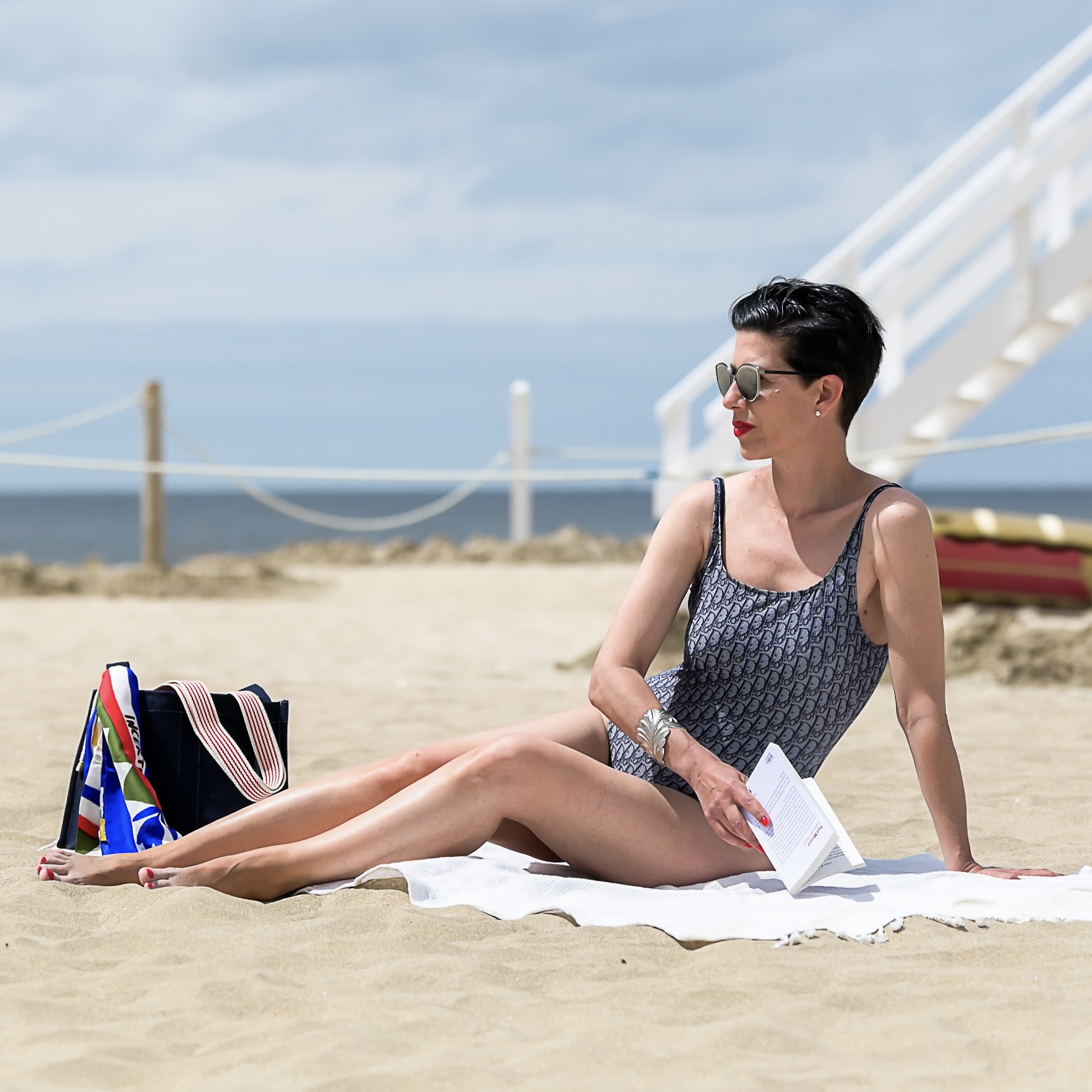
Interesting to think about all this, half asleep on the beach at Deauville.


August 8, 2025
