
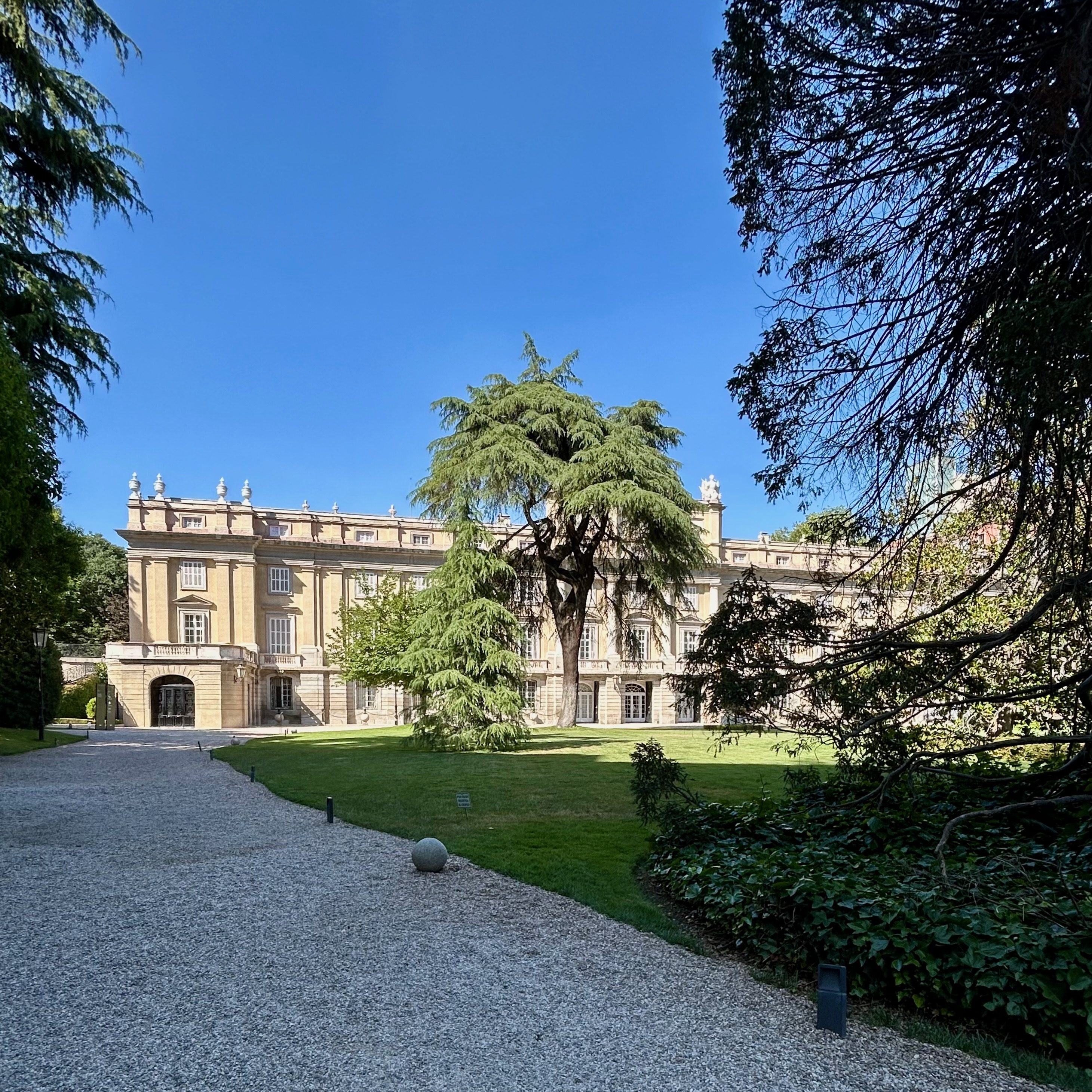
Built around 1770 according to the plans of architect Ventura Rodríguez, the Liria Palace stands out in the heart of Madrid for its strikingly English architecture.
It is commissioned by James Fitz-James Stuart, the third Duke of Berwick but also the third Duke of Liria (hence the name of the palace).
Eugénie de Montijo, the last French Empress, dies there in 1920 – she is originally from Madrid, and her sister Paca married the Duke of Alba in 1848 and thus resides in the Liria Palace.
Eugénie dies sixty years after her sister, but her presence in the palace explains the numerous portraits of her and the remarkable collection of Sèvres porcelain housed there.
The palace comes into the inheritance of the House of Alba at the beginning of the 19th century.
It is completely destroyed during the Spanish Civil War (1936–1939), except for its façades. The interior is rebuilt according to the plans of British architect Edwin Lutyens by Jacobo Fitz-James Stuart, the 17th Duke of Alba, and his daughter Cayetana Fitz-James Stuart, the 18th Duchess of Alba, who heads the House of Alba from 1955 to 2014.
Although the Liria Palace is the official residence of the 18th Duchess of Alba, she prefers to live in her later years in the palace of Las Dueñas in Seville, where she passes away.
Today, her heir Carlos Fitz-James Stuart, the 19th Duke of Alba, and his brother Fernando reside in the Liria Palace.
In fact, the Liria Palace is one of the few inhabited palaces open to visitors.
It can rightly be described as a museum-palace, as it houses a remarkable private collection of European art, including paintings by Perugino, Titian, El Greco, Goya, Murillo, Rembrandt, Rubens, Ingres, Courbet, Fantin-Latour, and Boudin.
There are numerous sculptures and prints as well – Dürer, Mantegna, Van Dyck, among others.
The gardens are designed by some of the most prestigious landscapers and architects of the time, such as Ventura Rodríguez, Sabatini, and the French architect and landscape designer Jean-Claude Forestier.
Originally geometric and French in style, the gardens are later redesigned in a more romantic English style.
In front of the palace grow chestnut trees, mimosas, yews, and a pomegranate tree.


The Liria Palace also houses a library of over 20,000 volumes, including letters from Christopher Columbus and the first Bible in Castilian, dating back to 1431.


At the back of the palace, the more geometric garden is inspired by the Versailles style, with flowerbeds bordered by hedges. It undergoes several modifications in the 18th and 19th centuries. A basin adorned with a sculptural group overlooks the entire area.


November 6, 2026
