
Just like Deauville, the town of Arcachon was born from a financial coup. On the edge of the vast bay with its mild climate, the area – not yet called Arcachon – is originally home to only a few fishermen’s huts before a railway line connecting Bordeaux to La Teste-de-Buch is established in 1841. In 1845, a pier ias built on the bay, a road is traced through the salt meadows, and the first villas begin to appear.
Once a mixed district of fishermen’s huts and modest houses in La Teste-de-Buch, Arcachon is officially made a commune by a decree from French Emperor Napoleon III in 1857. This is the era of thalassotherapy, climatotherapy, and thermal treatments – and Arcachon happens to offer all the health benefits one could desire, especially after the discovery of the Sainte-Anne des Abatilles spring, reputed for its healing properties.
The first visitors at the end of the 19th century are mainly from Bordeaux and come only in the Summer. The area’s popularity is still somewhat limited.


That is until the Pereire brothers step in. Émile and Isaac made their fortune through real estate speculation, aided by what we would now call insider trading. As owners of the Midi railway company, which connected Bordeaux to Arcachon, the Pereires are looking for a way to make their railway investment profitable year-round.
No problem: between 1862 and 1865, they purchase land to build a Winter Town (Ville d’Hiver) on the heights of Arcachon, aimed at a wealthy clientele from across Europe seeking to escape the rigors of Winter.
Beautiful villas are built along curved streets designed to protect lung patients from draughts, surrounding a park that houses the sumptuous Moorish Casino.


An elevator allowes people to descend from the Winter Town to the Summer Town (Ville d’Été), dedicated to seaside pleasures.
Arcachon soon becomes the town of four seasons – ensuring year-round tourism and thus economic activity. To the Winter Town and the Summer Town (laid out in a grid pattern and filled with rental cottages and houses) are added the Spring Town (Ville de Printemps) and the Autumn Town (Ville d’Automne) at the beginning of the 20th century.


The “chalet” style dominates the architecture throughout Arcachon – an obvious imitation of the Winter Town, designed by the Pereire brothers to attract a clientele seeking treatments similar to those available in the Alps


Beyond Arcachon lies a vast bay, a triangular-shaped basin bordered by over 80 kilometers of flat coastline and wooded dunes. Separated from the Atlantic Ocean by a sandy barrier – including the Dune of Pilat, the Arguin sandbank, and Cap Ferret – the bay has a tradition of oyster farming, as evidenced by the many huts scattered along the shores.


Victim of its own success, Arcachon has to expand. Le Moulleau becomes a district of Arcachon. At the end of the 19th century, a few villas are built in this outlying area, still untouched by development – much like the center of Arcachon fifty years earlier. In 1911, a tramway connecting Le Moulleau to downtown Arcachon is inaugurated.
Initially, the “Swiss chalet” style, so fashionable in the Winter Town, is used for the first buildings in Le Moulleau. When Arcachon’s mayor, James Veyrier-Montagnères, choses to move there, he gives momentum to a district that has previously been quiet and removed from the social bustle of central Arcachon. His promotion of Le Moulleau is not entirely selfless, as he is a major shareholder in the Société Immobilière du Moulleau, which has been selling plots of land there since 1897. Le Moulleau’s success has never waned. Spared from the speculative wave of the 1960s that led to the destruction of many waterfront villas in favor of modern residences, the neighborhood has retained its authenticity.


Today, two luxury hotels are dedicated to the contemporary wealthy clientele. Owned by the same people and decorated by the same architect, the Ha(a)ïtza and the Co(o)rniche are only a few hundred meters apart. If you must choose one, pick the Co(o)rniche for its spectacular view of the Arguin sandbank, Cap Ferret, and the Dune of Pilat – and for its seafood platter enjoyed at sunset.

Ha(a)ïtza – Not that good


La Co(o)rniche – Perfect


La dune du Pilat
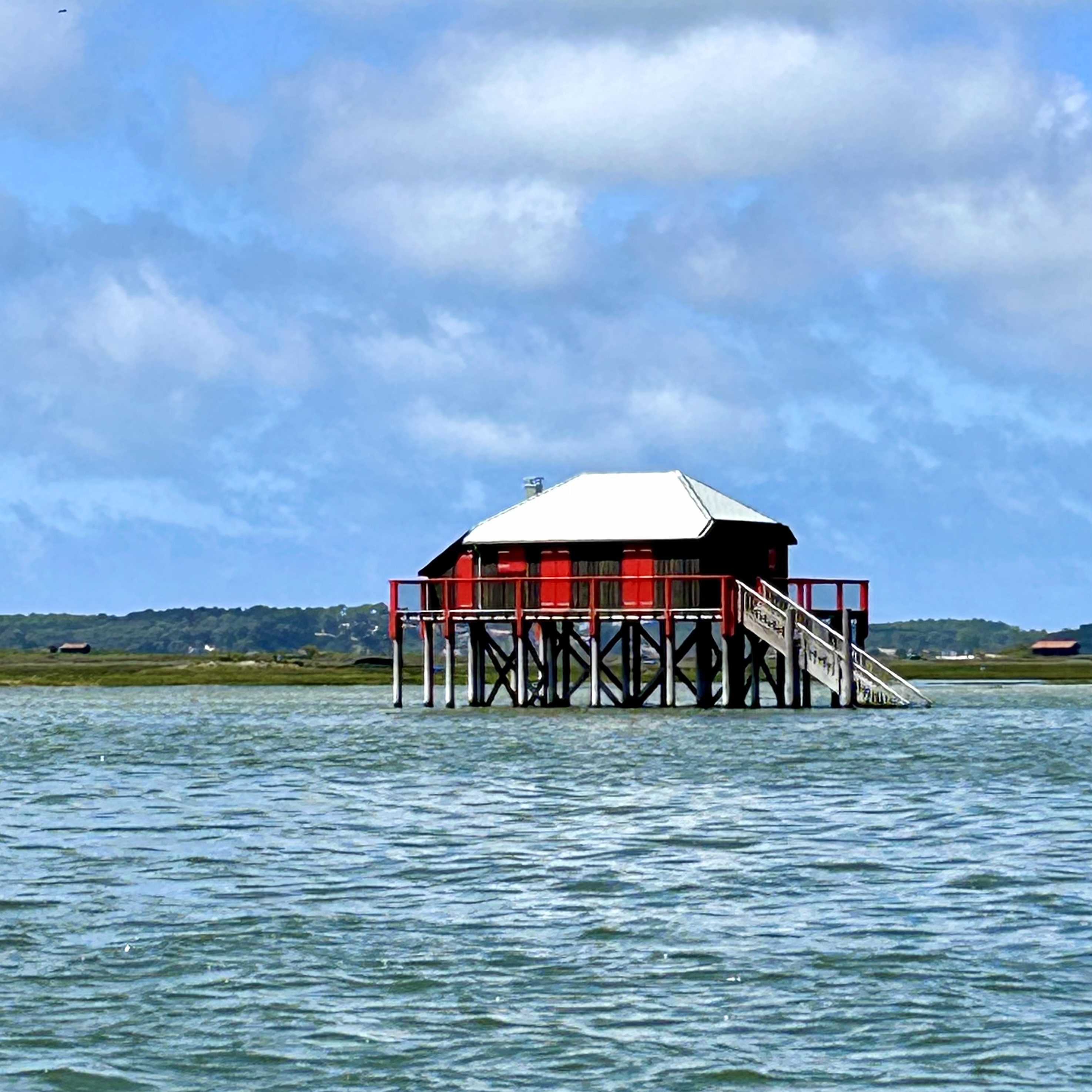
To explore the bay and its treasures, nothing beats a day aboard a pinasse. This flat-bottomed boat allows the captain to weave between the ever-shifting sandbanks. It offers the tourist a unique perspective on the Dune of Pilat, the Arguin sandbank, the Cap Ferret coastline, the Île aux Oiseaux (Bird Island), and the famous cabanes tchanquées. It also provides the perfect setting for savoring a seafood platter (even if it’s the 408th – nobody ever gets tired of them).


The Algerian Chapel is located in the commune of Lège-Cap-Ferret. It is the only remaining structure from a vast estate built by Léon Lesca – heir to a family of regional forestry and resin entrepreneurs and a public works contractor – after his return from Algeria in 1864. Completed in 1885, the chapel – listed as a French Historic Monument since 2008 – was accompanied by a Moorish-style villa nicknamed the Palace of the Pashas (now gone). It reflected the Orientalist architectural movement also seen in Arcachon, such as the Moorish Casino and certain villas in the Winter Town.


Historically, the first cabanes tchanquées (from Gascon: “built on stilts”) were erected on the sandbanks by oyster farmers in the Arcachon Bay to monitor their oyster beds without depending on the tides. Dating from the late 19th century, they eventually succumbed to storms and were rebuilt in the mid-20th century.


The cabanes tchanquées have become the iconic symbol of Arcachon Bay – but they are not the only wonders of the region, which is best enjoyed without the Summer crowds, in Spring or Autumn.
July 3, 2026
