
The outstanding novel by Adélaïde de Clermont-Tonnerre, Je Voulais Vivre (I Wanted to Live), recounts the all-too-brief life of a fictional character we all know: Milady de Winter.
Do we really know her, though? Hardly. Although Milady is the great antagonist of The Three Musketeers and d’Artagnan, one must admit that we learn very little about her upon finishing Alexandre Dumas’ 1844 novel.
For this major female figure, the novelist drew inspiration from a real-life person, whom he embroidered upon in his usual fashion: the Countess of Carlisle, born Lucy Percy.
Lucy is born in 1599 to two parents who have both suffered royal disfavour. Her mother, Dorothy Devereux, has experienced exile from court due to a first marriage that greatly displeased the Crown, before marrying Lucy’s father.
Her father, Henry Percy, 9th Earl of Northumberland nicknamed “the Wizard Earl” for his alchemical experiments, his humanist pursuits, and his patronage of the arts and sciences – has been imprisoned in the Tower of London for sixteen years for his supposed involvement in the Gunpowder Plot, aimed at assassinating King James I and attacking the English Parliament.
Lucy grows up in an educated and elevated environment, though somewhat rebellious toward royal absolutism. She marries, against her father’s wishes, James Hay, 1st Earl of Carlisle, in 1617.
She flourishes at the court of Charles I, celebrated for her beauty and wit, eventually gaining the Queen Henrietta’s friendship and being appointed Lady of the Bedchamber in 1626. She runs a literary salon, becomes a patron of numerous poets, and is painted many times – most notably by Van Dyck.
But Lucy Hay is not confined to the arts. Her political influence expands, along with the intrigues that come with it.
In the years leading up to the First English Civil War, the country is torn between supporters of absolute royal power and defenders of a parliamentary monarchy. Lucy Hay, widowed in 1636, becomes the mistress of Thomas Wentworth, 1st Earl of Strafford, a staunch supporter of King Charles I (who nevertheless condemns him to death) – and then of John Pym, the parliamentary leader advocating the balance of power through Parliament.
The First English Civil War begins in 1642, and Lucy Hay is fully involved in the intrigues that disrupt her country’s political life. That same year, she prevents the King from arresting five members of Parliament by disclosing crucial information. In 1647, in one of her characteristic reversals, she raises funds for the royalist cause and maintains extensive communications with the King and the Queen’s dispersed supporters.
Her motives in serving one side or the other remain unclear. Are they shaped by her upbringing under two cautious parents who have suffered from royal absolutism, or by the hesitations of many political actors of the time, wishing to preserve royal power without endorsing its tyranny? We shall never know.
In 1649, Charles I is executed. The country has no monarch, and parliamentary forces hold power. Lucy Hay is arrested for her royalist ties and imprisoned, like her father, in the Tower of London. Although she manages to maintain secret, coded correspondence with the King and is released in 1650, she never regains her former influence and dies roughly ten years later.
Lucy Hay remains remembered as a schemer and a spy.
François de La Rochefoucauld mentions her in his Mémoires (published 1662), recounting Lucy’s theft of diamond studs that King Louis XIII of France had given to his wife Anne of Austria, which she then gave to the English George Villiers, Duke of Buckingham. Louis XIII, who had a poor relationship with his wife and suspected an affair with Buckingham, wished to see the diamond studs on his wife – which seemed impossible – but somehow, the Queen managed to retrieve and wear them, thus saving her honor.
The historical accuracy of this event is not confirmed. It is known that the 1st Earl of Carlisle went to Paris in 1624 as second extraordinary ambassador to prepare the marriage of Prince Charles and Princess Henrietta of France. It is known that Lucy Hay accompanied her husband to Paris for the princely wedding in 1625. According to La Rochefoucauld, it is on this occasion that Richelieu entrusts Lucy Hay with the task of stealing the studs given by the French Queen to Buckingham.
Almost two centuries later, Alexandre Dumas takes up this anecdote, inspired by the sultry Lucy Hay, and adds the influence of Louis XIII’s powerful minister Richelieu, known for his extensive spy network, to create the evil character Milady de Winter.
Yet what do we really know of Milady de Winter from Dumas? Very little. She appears in the opening pages of the novel and becomes the lethal enemy of the musketeers and d’Artagnan, working with Richelieu against Queen Anne, whom the musketeers strive to protect.
Her career as a spy takes her both to France and to England, where she once married the first Lord de Winter, who died under mysterious circumstances.
She steals the diamond studs given by the Queen of France to the Duke of Buckingham but fails when he has copies made. D’Artagnan, never one to miss a flirtatious opportunity, tricks Milady by impersonating her lover, the Count of Wardes, and sleeps with her. On a second night, he reveals the ruse of the first night, prompting Milady to seek revenge.
She tries to have him assassinated twice, then receives orders in La Rochelle from the Cardinal to eliminate Buckingham, whose help to the French Protestants could spark an international conflict. To do so, Milady returns to England, is imprisoned by her brother-in-law the second Lord de Winter (who discovered her poisoning of his brother), seduces her jailer Felton, and manipulates him into assassinating Buckingham himself.
Back in France, Milady coincidentally arrives at the convent where Constance Bonacieux, d’Artagnan’s lover, is held on the Cardinal’s orders. Milady persuades Constance to escape with her to hold her hostage, but as the musketeers and d’Artagnan arrive, Milady poisons Constance, who dies in her lover’s arms.
Milady escapes again but is eventually captured by the musketeers, d’Artagnan, her brother-in-law Lord de Winter, the musketeers’ servants, and the executioner of Lille. She is beheaded and her body thrown into the water.
She is twenty-four years old.
Throughout the story, Milady’s troubled past is gradually revealed – first by Athos (Chapter XXVII) and later by the executioner of Lille (Chapter LXV).
According to the two men, she was once a teenager named Charlotte Backson, a former Benedictine nun at the Templemar convent, who seduced a young priest named Georges, leading him to steal sacred vases and flee with her.
The lovers were arrested, but Charlotte escaped by seducing the jailer’s son, while Georges was sentenced to ten years’ prison and royal branding – an afflictive and infamous punishment, consisting of a fleur-de-lys mark made with a hot iron on the condemned person’s shoulder – which was inflicted on him by his own brother… the executioner of Lille.
The latter, driven mad with grief and consumed by an unquenchable desire for revenge, tracked down Charlotte to brand her in turn.
Georges, however, managed to escape and reunite with Charlotte. They settled in Vitray. She presented herself as the daughter of a deceased Welsh gentleman and a deceased French noblewoman, Anne de Breuil – and presented Georges as her brother.
Soon, she left Georges for the young nobleman of the region who was madly in love with her, the young Count Olivier de la Fère, who married her.
Georges, wracked with grief, returned to Lille, where he took the prison post of his brother, the executioner of Lille, who had been suspected of complicity in Georges’ escape and had, in fact, been imprisoned. Georges committed suicide that very evening in his cell.
Count Olivier de la Fère, meanwhile, discovered by chance during a horse ride in the forest the fleur-de-lys branding on his wife’s shoulder. Furious, he hung her from a tree in the forest, and, broken, joined the Musketeers under the name Athos.
Charlotte, miraculously surviving the hanging, fled to England, where she married the first Lord of Winter. She poisoned her husband, to whom she had nonetheless given a son (Mordaunt, who will later be the antagonist of the musketeers in Twenty Years After), became an agent of Richelieu, and lived in grand style at Place Royale – our present-day Place des Vosges in Paris – under the name Lady Clarick (not unlike the spelling of Lucy “Carlisle”).
It is 1625 – d’Artagnan has just met Milady in the first chapter of the novel: she is only twenty-one, dazzlingly beautiful, and her taste for mystery and intrigue inexorably leads her toward the murderous and tragic destiny described above.
Yet, are Alexandre Dumas, Athos, and the executioner of Lille – who load Milady with all vices – reliable narrators? One may doubt it. Dumas knows that a successful story hinges on a compelling villain, and he clearly amuses himself by creating this very beautiful, wildly mysterious woman, whose intelligence often leave the musketeers powerless. Powerless, yes, but not for long, as Dumas also knows that a good adventure novel must ultimately give victory to the heroic protagonists.
But are these heroes really so virtuous?
This is clearly the question Adélaïde de Clermont-Tonnerre asked herself when she carefully reread The Three Musketeers by Dumas and The Youth of the Musketeers (dated 1849) by Dumas and Maquet.
I Wanted to Live (we finally get to it) is written as a counterpoint to The Three Musketeers, that is, from the perspective of the woman who will become Milady. Adélaïde de Clermont-Tonnerre displays undeniable narrative talent by respectfully occupying all the empty space that Alexandre Dumas left around the great female figure of his novel, weaving the rich biography of a woman who wants to live on equal footing in a world dominated by men.
(Stop reading here if you do not want to read spoilers.)
Her fate is hardly joyful. Orphaned of her father, she witnesses as a child her mother being murdered before her eyes.
Taken in by genuinely kind-hearted people, she nevertheless suffers the malice of certain adults and the vile desire of a thieving priest, whom she has no choice but to follow.
Anne meets the young Count de la Fère. She is noble and well-educated but can hardly tell her suitor, so deep are her personal wounds. Mystery, already.
Although Anne and Olivier love each other passionately and marry, their union is tarnished by Olivier’s uncontrollable jealousy. Upon accidentally discovering the fleur-de-lys brand mark on his wife’s shoulder, he decides, manu militari, to hang her without even listening to her protests and explanations.
Anne miraculously survives this hanging. Living in a constant state of survival, she navigates between England, where she marries the first Lord of Winter, who soon dies, before incurring the wrath of her brother-in-law, the second Lord of Winter – and France, where she becomes a spy for Richelieu.
Indeed, Anne, in concert with Richelieu, attempts to prevent the nascent Franco-English conflict threatening both nations by arranging the elimination of Buckingham. While the mission of the three musketeers and d’Artagnan may be to protect the Queen of France – who is rather frivolous, openly flirting with an English Duke who supports the French Protestant rebellion – Milady’s mission is to serve, alongside Richelieu, the greater interests of the Kingdom of France.
As a result, Milady finds herself in constant opposition to Athos, Porthos, Aramis and d’Artagnan.
Adélaïde de Clermont-Tonnerre’s Milady is by no means evil. She is a woman fighting against a sclerotic, patriarchal society, striving for a happiness often denied her, and determined to live, despite everything, in accordance with herself.
One can fully understand Adélaïde de Clermont-Tonnerre’s fascination with this great female figure, as she is the prototype of the misunderstood and ambivalent femme fatale, and also surrounded by a mystery begging to be unveiled.
Milady is by far the most captivating and hypnotic character for a female reader in The Three Musketeers.
Made of a nobler metal than Alexandre Dumas credits her with, Adélaïde de Clermont-Tonnerre’s Milady perceives perfectly the inconsistencies that plague her antagonists. Olivier de la Fère may love her madly, yet he leaves her no chance of survival when he prepares to hang her.
D’Artagnan, who proclaims throughout The Three Musketeers his love for Constance Bonacieux (who is already married, by the way), cheats on her with Milady (and abuses her by impersonating Milady’s lover) and with Milady’s maid, Ketty.
The three musketeers and d’Artagnan tirelessly protect a Queen who lightly jeopardizes the Crown, while Richelieu, in all his Machiavellian intelligence, tirelessly ensures the stability of the Kingdom of France.
The musketeers, d’Artagnan, the second Lord of Winter, and the executioner of Lille may boast of Justice when they organize a sham trial against Milady – the truth is, the trial is one-sided and can result in nothing but outright murder.
I Wanted to Live fits perfectly within the line of art works that rehabilitate great fictional villains (Maleficent, Cruella, Wicked, and to a lesser extent The Favourite) and, by extension, within a profoundly feminist tradition.
I Wanted to Live intelligently and delicately corrects the injustice of a paper murder that occurred over 180 years ago.
You will have understood: I Wanted to Live, French Renaudot Prize 2025, is my literary crush of the 2025 season, and it is highly likely that Milady’s profoundly moving fate will haunt you long after reading this beautifully written novel.
I hope its English translation will be available soon.
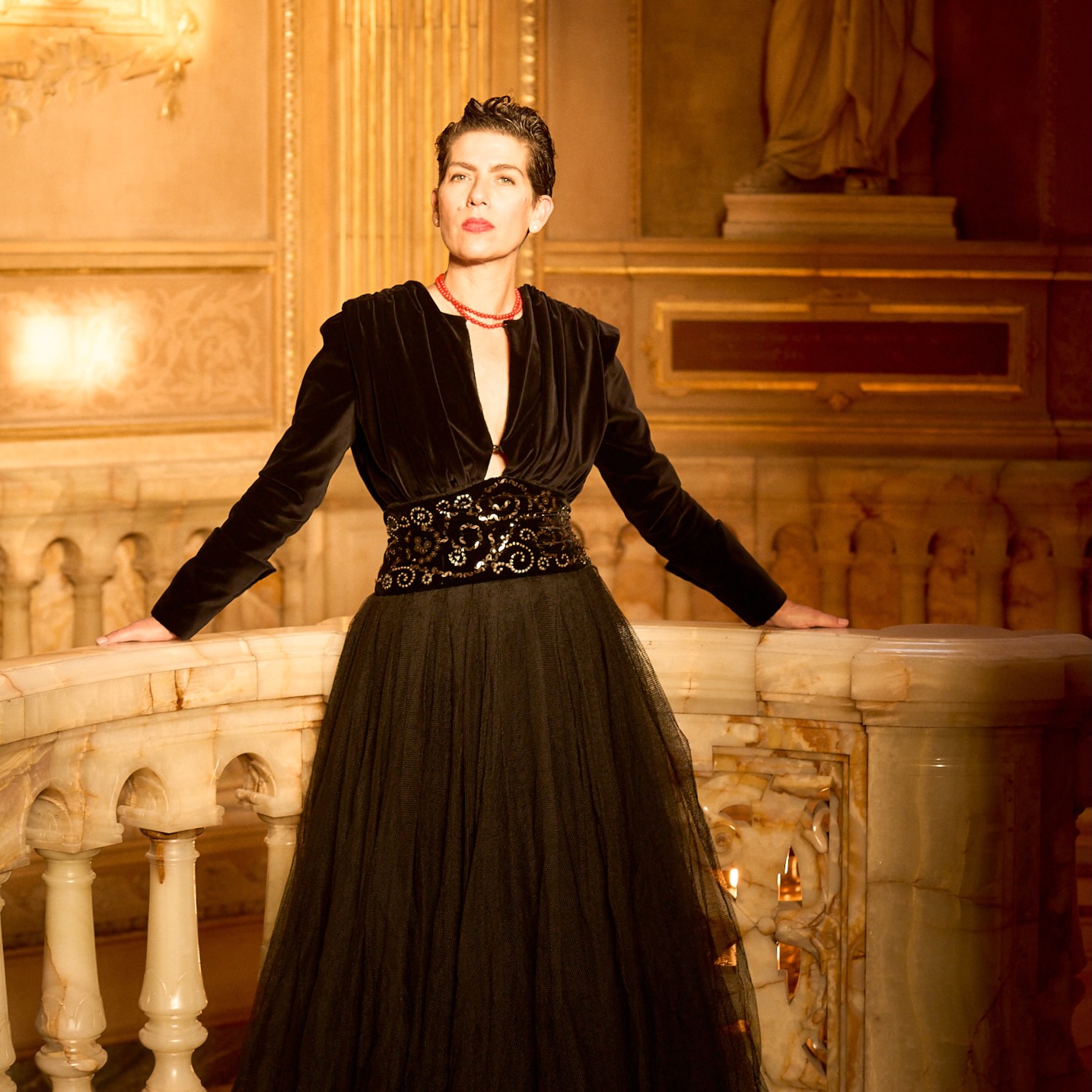
N.B. You will forgive me for not appearing in a Louis XIII-era costume – impossible to find – but one can surely appreciate the Musketeer-style cuffs adorning my dress and the veine of the stone behind me which seem, in certain pictures, to… be decapitating me.


Emilia Wickstead dress with an ancient dress already seen here transformed into a skirt – Vuitton heels
December 12, 2025
