
The enduring success of “Emily in Paris” compels my inner Parisian to wonder about the persistence of another phenomenon: that of Paris seen by Hollywood, since the French capital is by far the most represented foreign city in American cinema – almost 800 American movies are set in Paris.
I’m neither the only one nor the first to wonder about this phenomenon: Antoine de Baecque – historian and film critic – had already addressed the issue in 2012 with an excellent book and the City of Paris organized an exhibition dedicated to this theme the same year. Twelve years have passed between the publication of Antoine de Baecque’s book and the publication of this article – but in twelve years, social media, where Paris is over-represented, have exploded and “Emily in Paris” became a huge success.
The Parisian fantasy is still alive and well. I’m the first to be amused, but I’m also the first to be intrigued: what’s behind this powerful cinematic link between Hollywood and Paris? To answer this question, we probably need to go back to the special relationship between France and the US.
The two nations’ closeness can be traced back to the American War of Independence, and the support it receives from France, the main contributor to the birth of the US as a nation. The contribution is primarily military and diplomatic, but the philosophers of the Enlightenment and the French spirit also influence the drafting of the future American Constitution, written around the ideals of the enlightened philosophers. Later, French Louisiana is sold to the Americans by Napoleon the First in 1803, and France long remains the US preferred European diplomatic interlocutor.
The 19th century sees very little French immigration to America – and indeed, unlike Italian or Asian immigrant populations, the French are never assimilated to poor minorities – the only known “French quarter” being that of New-Orleans, and even that is for historical and therefore noble reasons.
Silent cinema in the ’20s takes its inspiration from French culture to produce adaptations of literary monuments such as Victor Hugo’s “Our Lady of Paris” – all set in a Paris recreated in studios.
Under the impetus of Ernst Lubitsch, the end of silent cinema and the beginnings of talking pictures present Paris as a place of desire, love, forbidden love, lightness and freedom through sentimental comedies (“Ninotchka” – 1939) that contrast with the puritanism which prevails on the American soil (as the saying goes: what happens in Paris, stays in Paris).
American expatriate literature in France – with Fitzgerald and Hemingway, to name the most famous – complete the construction of the Parisian myth.
Indeed, over the decades, Paris gains the status of a fantasized city of history, architectural beauty and French spirit – a status on which American airlines capitalize heavily. WWII doesn’t change this fantasy-city status – quite the contrary. The Marshall Plan strengthens the existing Franco-American ties and the 1946 Blum-Byrnes Agreements encourage Hollywood studios to reinvest in Paris the profits from the films shot there – given that, at the time, it is cheaper to shoot a film in Paris than in Hollywood.
The 50s see the success of American musicals (“An American in Paris” – 1952, “Moulin Rouge” – 1952, “Gigi” – 1958), in which French cultural elements are reinvented and enhanced by Hollywood, such as the French Cancan – a dance reserved for prostitutes at the beginning of the 20th century, but transformed under the American eye into an artistic dance emblematic of the French capital.
Until now, Hollywood’s Paris is shot… in Hollywood.
At the end of the 50s and beginning of the 60s, a real change takes place: Hollywood films set in Paris are shot in Paris, with a relative desire for realism, under the influence of the French New Wave movement which takes its cameras out into the street.
Paris may no longer be reconstructed, but it remains unrealistic because it is idealized.
Audrey Hepburn soon embodies the fantasized Parisienne – she is not American but European since she was born in Belgium, speaks French, is dressed by Hubert de Givenchy, and makes several films in France in which she takes on French roles (“How To Steal a Million” – 1966, “Love in the Afternoon” – 1957, both shot in Paris).
Paradoxically, she also plays several roles of American women living in Paris (“Sabrina” – 1954, filmed in the US, “Funny Face” – 1957, “Charade” – 1963, “Paris When It Sizzles” – 1964, filmed in Paris).
“Sabrina” is particularly illustrative of the magic that American cinema lends to Paris: Sabrina, the daughter of a chauffeur working for a wealthy East Coast family, is shy and invisible to the male population. It’s only when she’s touched by the Parisian grace during a stay in the French capital that men will look at her and desire her when she returns to the US.
Paris, the city of love, desire and mystery, imbues its permanent and temporary inhabitants with an irresistible aura.
After a thirty-year interlude in which Paris is destroyed (“Mars Attacks!” – 1996) or folded like an origami (“Inception” – 2010), an unrealistic, idealized Paris is reborn in “Emily in Paris”.
Lily Collins, the actress who plays the famous Emily who lives in Paris, is more Hepburnian than Audrey Hepburn herself (as evidenced by her face, her figure, her style, but also by the numerous references to Audrey Hepburn and one outfit in particular in episode 6 of season 4, which is exactly that of Audrey Hepburn at the start of the film “Charade”).
“Emily in Paris” makes a very real nostalgic return to a fantasized Paris as shot by Hollywood in the 50s and 60s and proceeds along fairly similar narrative arcs.
Clichés – which have become iconic pastilles – abound, whether of iconic locations or attitudes: the Eiffel Tower, café terraces, street strolls (not to mention croissants and champagne) make sure that we know the action is set in Paris. It’s often outré, archetypal and comical.


(Progression of vice: from cigarettes to cocktails and French fries)
Money is never a real concern: when Audrey Hepburn loses her fortune in “Charade”, her fate is still very enviable, and Emily’s lifestyle, in my opinion, requires at least 10K a month – which she obviously doesn’t earn. Incidentally, the heroine is always impeccably dressed, thanks to a very assertive style.
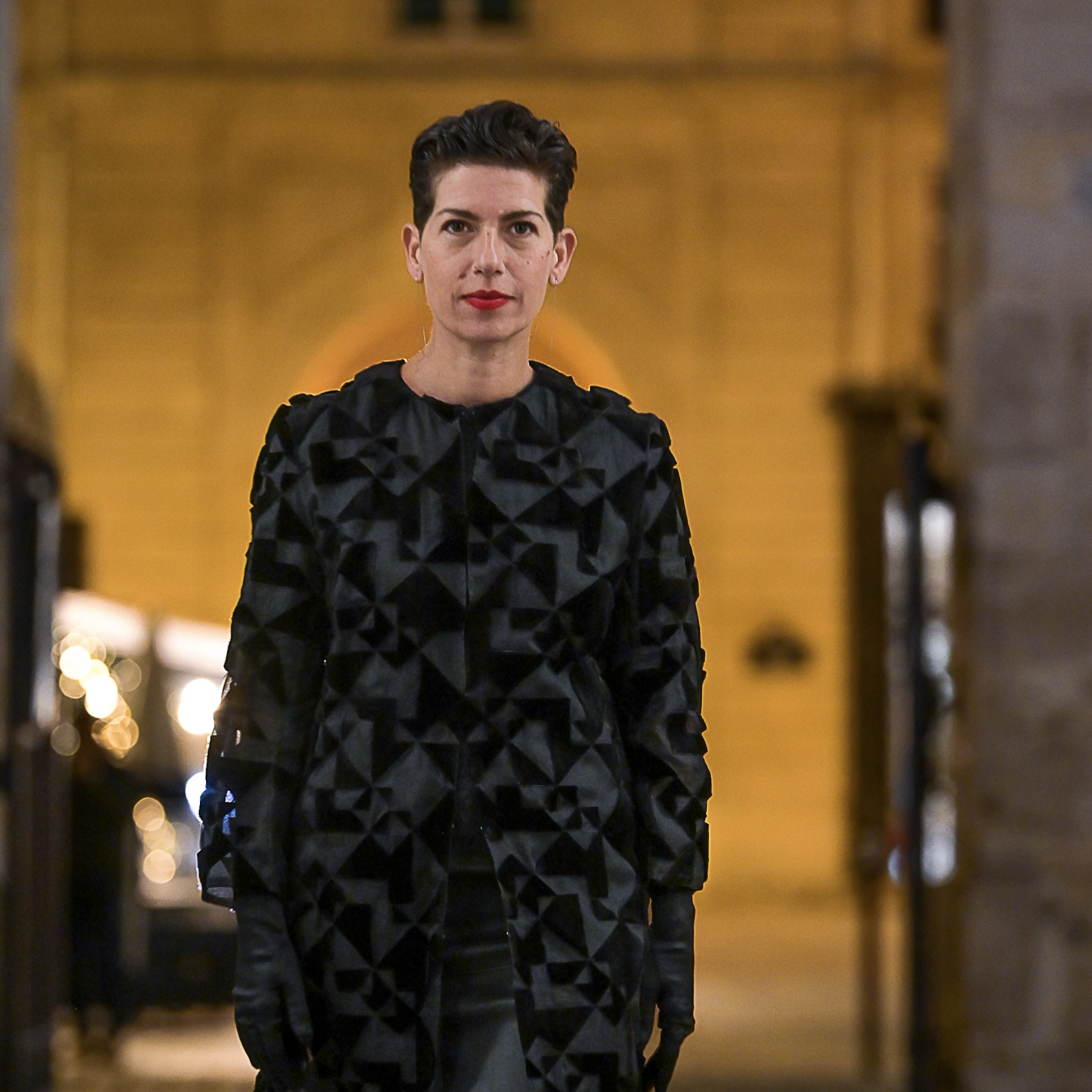
However, it is the French character of Sylvie, almost invariably dressed in black or neutral colours, who steals the show from Emily in terms of style (in this case, we will have photos that pay less homage to Emily than to Sylvie, with a leather skirt and an incredible organza and mink coat that I believe the latter would not have disowned).
Whether set in 50s-60s or 2020s, the protagonists’ misadventures are treated lightly, and the viewer is never overly concerned, knowing in the end that everything will turn out all right.
Finally, the romantic tone is omnipresent and represents the main narrative arc of all these cinematic objects, because, in the end, what else to do in Paris but love?
“We’ll always have Paris…” – Casablanca


Fendi coat – Vintage gloves and leather skirt – Sergio Rossi heels
December 13, 2024
