
If I tell you “pop art”, you think “Andy Warhol”, don’t you? The media exposure of the cantor of pop art will have surpassed all his congeners. Some of his works are exhibited at the Whitney Museum in New York. This museum, which is a major cultural institution for contemporary art, brings together a huge – perhaps the largest existing – pop art collection in the world.
However, I am in the gardens of the Rodin museum right now – you can’t see the connection (quite normal, but wait for me) and I will certainly not talk to you about Andy Warhol here, quite simply because neither the character nor his art particularly moves me.
Let’s talk about the Whitney Museum, which I must have visited twenty times, and especially about its founder, Gertrude Whitney, née Vanderbilt.
Gertrude Whitney led a double life: born an heiress, she saw herself as an artist. The two hardly go together, when you were born in 1875 and you are the great-granddaughter of the wealthy American businessman Cornelius Vanderbilt.
The extent of the Vanderbilt fortune at the time is almost impossible to conceive: when Gertrude comes into the world, her family – which is as wealthy as the American government – completely dominates this new business aristocracy born in the US.
Gertrude’s destiny is traced in advance and the rigorous education she receives has the sole purpose of making her a good investment to marry to the best possible match. She is raised by private teachers, enters the very exclusive Brearley School and navigates according to the seasons between the different family properties.
She marries without love at the age of 21 to Harry Payne Whitney, who is just another wealthy businessman. Their marriage will not be the happiest.
Thanks to a stay in Paris at the dawn of the 20th century, she fully realizes her passion for sculpture and develops her artistic talents: Rodin is her mentor and encourages her to perfect her art.
(And here is the connection).
Back in the US, she receives her first commission for a sculpture of a life-size male nude – which she signs under an assumed name.
She leads a double life, expecting absolutely no support from her family or husband when it comes to her artistic vocation. In her time, young brides may practice arts as social skills, but certainly not embrace arts to make a profession of it and become diverted from their marital and maternal vocation.
A spouse she is, a mother she will be, but her passions clearly develop elsewhere. In 1907, she takes up a studio in Greenwich Village in New York. This studio will become the embryo of the Whitney Museum.
If all art lovers of the time have their eyes fixed on European art, Gertrude is the first to focus on American art. Her studio, radically “avant-garde”, aims to receive and exhibit living American artists, ignored by traditional institutions.
To name a few, Edward Hopper, Peggy Bacon or Stuart Davis, who are now considered American masters, undoubtedly owe her their fine reputation.
Gertrude acquires and exhibits their works and thereby becomes the greatest patron of contemporary American art of her time.
A sculptor herself, unlike other patrons – I am thinking in particular of Abby Aldrich Rockfeller, Lillie P. Bliss and Mary Quinn Sullivan who founded the Metropolitan Museum of Art in 1929 – Gertrude fully understands the profession and the difficulties faced by young artists.
Recognized herself for the quality of her work, she receives numerous commissions and her monumental sculptures impose themselves in their sharpness, their strength and their purity in the US but also in Spain, Canada and France.
In 1910, she finally dares to sign her works with her real name, and her sculptures are presented at the National Academy of Design in 1910 and at the Salon Parisien in 1911. Her first solo exhibition takes place in 1916.
In 1929, she wishes to make a donation of 500 works to the Metropolitan Museum of Art – the MoMA – but the donation is refused. She then decides to create her own museum on the foundations of her studio, focused exclusively on American artists: the Whitney is inaugurated in 1930.
It’s amusing to think that this great institution was erected on the ashes of the refusal of a yet visionary MoMA.
The successful Whitney Museum moves for the first time in 1954, then again in 1963, and again in 2015. The road has been long and the moves numerous since the creation of the small studio in Greenwich in 1907, but as underlined so rightly by one of Gertrude’s heirs, the Whitney is more of an idea than a place.
Speaking of her heirs, four generations of Whitney women have served as presidents of the museum’s board. They follow the example of their ancestor: they know the artists, the employees, the programs and absolutely refuse to be locked into any figurative or honorary role. Today, the Whitney hosts more than 22,000 works and exhibits more than 3,000 artists. Among them, a certain Andy Warhol.
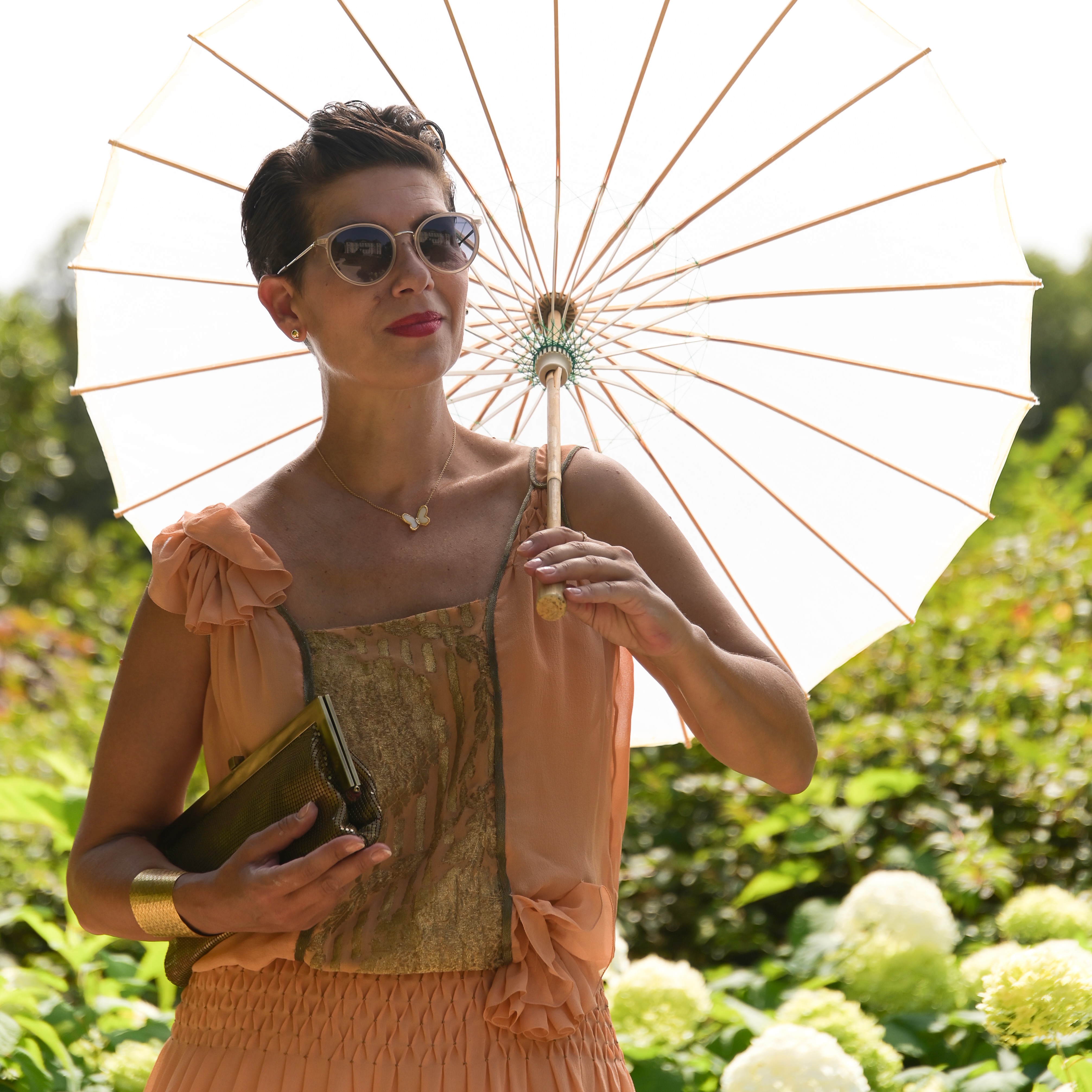
(Editor’s note. Now you understand why I am at the Rodin museum. But let’s talk about this dress which dates from 1925. On display in the Marcel and Jeannette shop of my best accomplice Virginie, the dress had been gradually ruined by the many fingers which had fiddled with the fabric and as a result the golden threads were found completely burned. Even damaged, it had nevertheless caught my eye (the work on the smocks, mamma mia!) and I knew it was perfect to talk about Gertrude Whitney. My dear mother, who is an outstanding sewist, spent several months repairing it – and I’ll be honest, we (well, “we”, way of speaking: I often have the ideas, but she clearly has the technicality) had to make choices: the original breastplate was too damaged to be kept, so she unstitched the reminder band at the bottom of the dress to save this breastplate by replacing it. It’s a “museum” dress as my dear Virginie says, and I completely agree with her and I would even outbid: it’s a museum dress that has been given a second life).


A 1925 dress found at Marcel et Jeannette, Saint-Ouen flea market – Armani heels – Louboutin clutch – Paul & Joe sunglasses – Vintage Van Cleef & Arpels necklace and umbrella
September 22, 2023
