
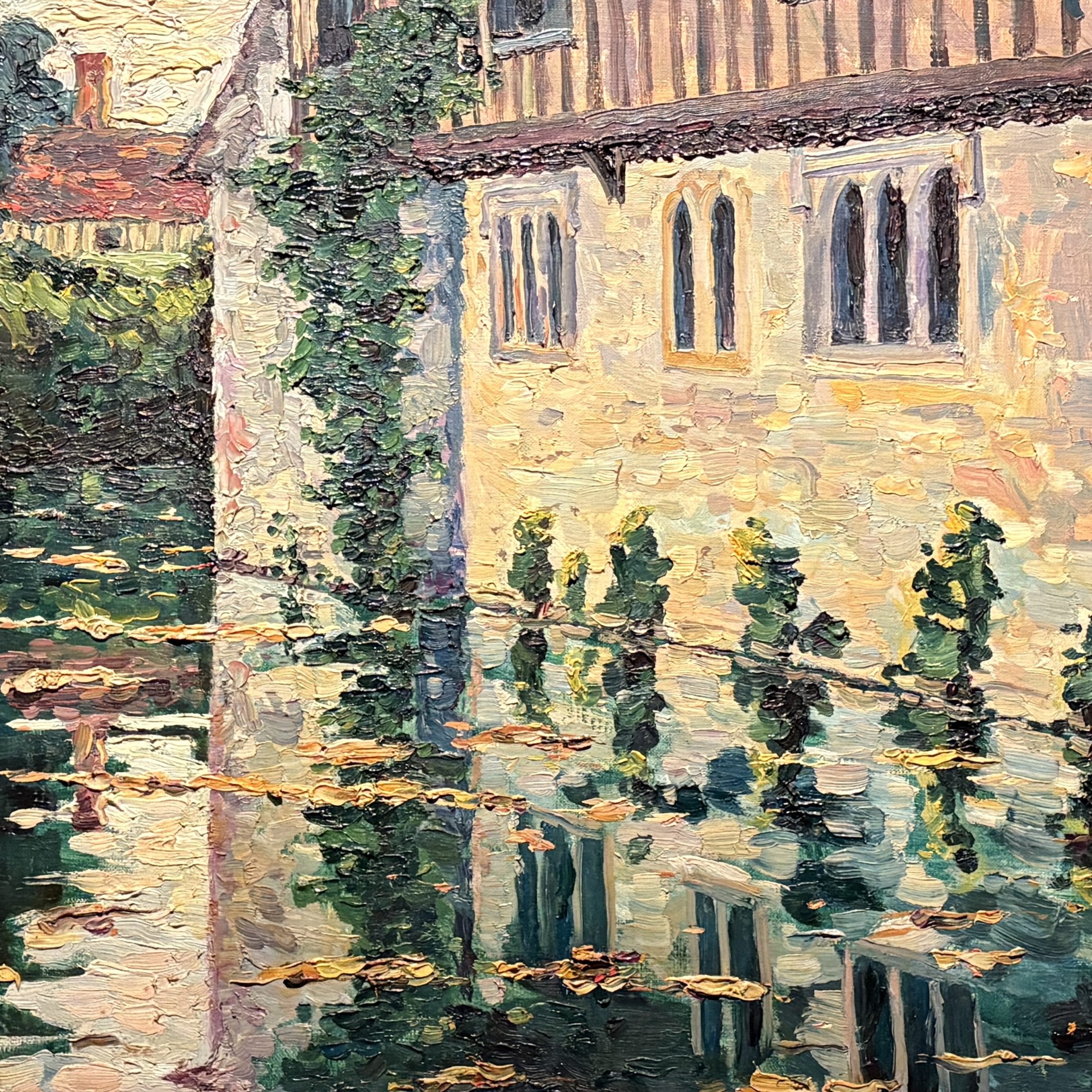
Winston Churchill is remembered as a statesman, a Nobel Prize-winning writer and one of history’s greatest orators. Far less familiar is Winston Churchill the painter. Yet his artistic output – more than 500 works – is substantial, even if it remains relatively little known today. Apart from two major exhibitions, one in London in 1998 and another in St. Louis in 2015, Churchill’s paintings have never been the subject of a recent retrospective. That has now changed. Until November, 29 2026, the Wallace Collection in London is presenting Churchill’s work.
Churchill discovered painting in 1915, at one of the lowest points of his political career. Following the disastrous Gallipoli campaign, for which he was widely held responsible, he was dismissed from his post as First Lord of the Admiralty and sank into a profound depression. During a family holiday, his sister-in-law, Lady Gwendoline Churchill, invited him to pick up a paintbrush. It proved a revelation. Painting became a lifelong passion and something he came to regard as the best antidote to the recurring melancholy he famously called his “black dog”. Painting compelled him to live in the present. It demanded complete attention to light, colour and shadow, leaving no room for anxious thoughts or despair.

Self-portrait – 1915

Churchill Painting in Lady Paget’s Garden – John Lavery – 1915
Churchill began with watercolours before quickly embracing oil painting. Even while serving on the Western Front during the WWI, he carried his painting equipment with him and captured the landscapes of Flanders. In the years that followed, he benefited from the encouragement and advice of several distinguished artists, including John Lavery, Walter Sickert, William Nicholson and Paul Maze.

Loggia, Warren House – 1916-1917

North Porch, Manor House – 1930s
During the 1920s, while holding a succession of ministerial offices, Churchill exhibited his paintings publicly for the first time in Paris under the pseudonym “Charles Morin”, hoping they would be judged on their own merits rather than through the prism of his political fame. Several works were sold. Around the same time, he wrote two essays celebrating the virtues of painting, later brought together in his now classic Painting as a Pastime.
After purchasing the Chartwell estate in Kent in 1922, the country house became the center of his artistic life. In the 1930s, he built a spacious studio there, while the gardens, ponds, surrounding countryside and landscapes of Chartwell provided inspiration for a significant proportion of his paintings.

Winter Sun, Chartwell – 1924
Another place exerted an irresistible pull on him: Morocco. From his very first visit to Marrakesh in 1935, Churchill was captivated by the extraordinary light of the Atlas Mountains and the warm ochre hues of the city’s ramparts. He returned many times, convinced that Morocco possessed some of the finest light anywhere in the world.

The Atlas Mountains from Marrakech – 1947

Mosque in Marrakech – 1948
Tower of the Koutoubia Mosque was painted in Marrakesh in 1943, following the Casablanca Conference, while Churchill was travelling with President Franklin D. Roosevelt. He later presented the painting to Roosevelt as a memento of their time together. It is the only painting Churchill will achieve during WWII – it is also the first time Churchill uses his paintings as a mean of soft power, as he persuaded FDR to open a front in Italy instead of an invasion of the European mainland via the Channel. In 2021 it sold at auction for more than £8 million, setting a record price for a Churchill painting.

Tower of the Koutoubia Mosque – 1943
After the war, Churchill pursued painting with renewed enthusiasm. Under a second pseudonym, “David Winter”, he exhibited several works at the Royal Academy, which elected him an Honorary Academician Extraordinary in 1948. That same year saw the publication of Painting as a Pastime, in which he reflected on the profound sense of balance and serenity that painting had brought to his life.

Bridge, South of France – 1935

Sunset on the Sea – 1923

Calanques, near Marseille – 1948

Cap d’Ail, from La Capponcina – 1952

La Mala – Cap d’Ail – 1921

The Beach of Saint-Jean-de-Luz – 1931

Plug Street – 1916

Jerusalem – 1921

Venice – 1951
Although he occasionally exhibited under assumed names, Churchill never ceased referring to his paintings with characteristic self-deprecation as mere daubs. He gave away many of them to friends and family and never sought recognition as a professional artist.
Despite having received no formal artistic training, critics have long acknowledged the sincerity of his vision and his instinctive choice of subjects. His paintings depict landscapes, gardens, ponds, mountains, Mediterranean scenery and Moroccan views. He painted very few portraits, finding in nature both tranquillity and solace. Writing engaged his intellect; painting spoke to his emotions. As Sir John Rothenstein, Director of the Tate Gallery, observed, Churchill’s true gift lay less in technical virtuosity than in his remarkable ability to communicate his delight in the simple beauties of the natural world: sunlight, water, trees, flowers and mountains.
His style as a painter bore more than a passing resemblance to his style as a politician. Entirely free of self-consciousness, he attacked the canvas with broad, confident brushstrokes, convinced that boldness was preferable to hesitation.
It reflected the philosophy that guided much of his public life: it is better to act imperfectly than to remain paralysed by doubt. Unlike many amateur painters who labour meticulously over every detail, Churchill painted quickly and instinctively.
Over the course of his life, Churchill produced more than 500 paintings. Long regarded as little more than an engaging curiosity created by a great statesman, they have gradually earned recognition as works of genuine artistic merit in their own right.

Winston Churchill: The Painter
September 25, 2026
