
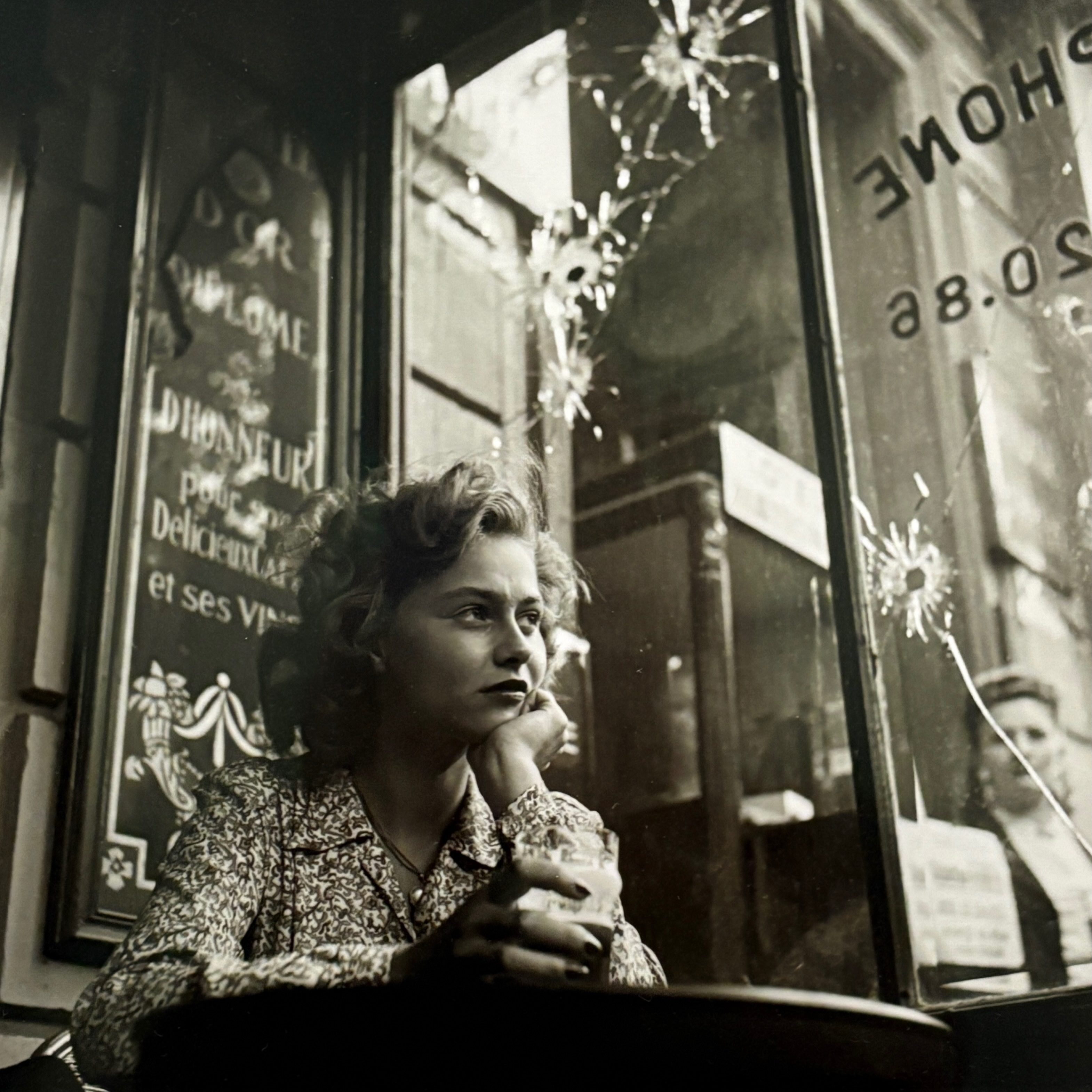
The Parisian Museum of Modern Art presents until August 2, 2026, the most important retrospective devoted to Lee Miller in France in the past eighteen years. The exhibition brings together more than 250 prints – some previously unseen – tracing the extraordinary journey of a woman who was successively a model, muse, Surrealist artist, portraitist, fashion photographer, and war correspondent confronted with the horror of the concentration camps.
Lee Miller spent her life moving between shadow and light – which is quite coherent for a photographer.
Born Elizabeth Miller on April 23, 1907, in Poughkeepsie, New York, she grew up in a wealthy and progressive family. Her father, an engineer and amateur photographer, introduced her early to the image and frequently photographed her during adolescence – an experience that would shape her complex relationship with the body and representation.
Her childhood, however, was marked by a major trauma: at the age of seven, she was raped, an assault that left her with lasting physical consequences (a sexually transmitted infection, gonorrhea) and deep psychological scars. Another tragedy followed in her teenage years when her boyfriend drowned before her eyes. These long-silenced wounds would haunt her throughout her life.
In 1927, while living in New York and narrowly avoiding being struck by a car, Lee Miller was rescued – and noticed – by Condé Nast, the founder of Vogue. She quickly became the magazine’s star model, posing for leading fashion photographers and embodying an angelic face and modern elegance perfectly aligned with the aesthetic of the Roaring Twenties.

George Hoyningen-Huene – Lee Miller in 1930
Yet Lee Miller did not wish to remain a model. In 1929, she left the US for Paris, where she met Man Ray, seventeen years her senior. She became his muse, lover, and assistant, and their relationship was both passionate and creatively fertile. Together they rediscovered the photographic technique of solarization, which soon became one of the hallmarks of Surrealist photography.

Man Ray – Lee Miller – 1929

Man Ray – Autoportrait With Lee Miller – Circa 1929

Man Ray – The Neck (Lee Miller) – 1929

Lee Miller – Corsetry – 1942
Very quickly, Lee Miller established herself as an artist in her own right. In 1930 she opened her own studio in Paris and produced photographs that were at times attributed to Man Ray.
I was very beautiful. I looked like an angel, but inside I was a demon”
Her relationship with Man Ray ended in jealousy and violence. Returning to New York in 1932, she opened a studio and in 1934 married the Egyptian businessman Aziz Eloui Bey. Settling in Cairo, she photographed the desert, but the city’s social life soon bored her.

Lee Miller – Draped Statue, Cairo, circa 1938
Her meeting with the Surrealist painter and poet Roland Penrose gradually drew her away from Egypt, and she spent increasing amounts of time in Europe with her Surrealist friends.
WWII marked a decisive turning point. Living in London with Roland Penrose, Lee Miller worked for British Vogue, initially as a fashion photographer.

Lee Miller – Vogue London – 1941

Lee Miller – Autoportrait With A Sphinx – London, 1940

Lee Miller – Vogue London – 1941
But the bombings and the ruins could not leave her indifferent, as demonstrated by her contribution in May 1941 to Grim Glory: Pictures of Britain Under Fire, documenting daily life during the Blitz.

Lee Miller – Revenge On Culture – London, 1940

Lee Miller – Photographer David Scherman Dressed For War – London, 1942
In the Winter of 1942, she obtained accreditation with the US Army and became a war correspondent for the Condé Nast group. She covered the conflict directly and produced numerous reports on women involved in the war – nurses, members of anti-aircraft defense units, and pilots – published in both British and American Vogue.

Accreditation card, 1942

Lee Miller – Pilot Anne Douglas – 1942

Lee Miller – The Parachute Folder – 1941

Lee Miller – Anti-fire Masks – Londres, 1941
From 1944 to 1946, she followed the Allied advance: the siege of Saint-Malo city, the liberation of Paris, and the push into Germany. In April 1945, she discovered the camps of Buchenwald and Dachau.
This was the breaking point.

David Scherman – Lee Miller, the only female correspondent during the siege of Saint-Malo – 1944

Lee Miller – Debris On The Sidewalk, Saint-Malo – 1944

Lee Miller – Surgeon And Anesthesist – Normandie, 1944

Lee Miller – Infantry Advancing – Alsace, 1945

Lee Miller — Buchenwald, April 11, 1945 — Liberated Prisoners Wearing Striped Uniforms Beside a Pile of Bones from Bodies Burned in the Crematorium

Lee Miller — Dachau, April 30, 1945 — American Soldiers Examine a Railcar Filled with Dead Prisoners

Lee Miller — Dachau, 1945 — A Dead SS Guard Floating in a Canal at Dachau
Her photographs – among the first to reveal the horror of the camps – deeply unsettled the editors of Vogue, who hesitated to publish such unbearable images. Lee Miller had to certify their authenticity with a desperate plea: “I beg you to believe that this is true”. The report appeared in June 1945 under the title “Believe It”.
A few days later, she was in Munich in Hitler’s private apartment, where photographer David Scherman captured the now-iconic image of her bathing nude in the dictator’s bathtub.

Lee Miller — May 1, 1945 — David Scherman in Hitler’s Bathtub

David Scherman — May 1, 1945 — Lee Miller in Hitler’s Bathtub

Contact sheet

Lee Miller — January 10, 1946 — László Bárdossy, Former Fascist Prime Minister of Hungary, Facing the Firing Squad, Budapest
After the war, Lee Miller was profoundly marked by what she had witnessed. She descended into alcoholism and depression, very likely the result of severe post-traumatic stress.
She married Roland Penrose in 1947 and gave birth to their son, Anthony. The family settled in the Sussex countryside at Farley Farm House, which became an important meeting place for artists, where Lee Miller also devoted herself to ambitious culinary experiments.

Lee Miller in her kitchen in 1973
She continued her photographic work intermittently, collaborating occasionally with Vogue and illustrating art books, before eventually turning away from photography altogether. The images she had seen in the camps never ceased to haunt her. She died of lung cancer on July 21, 1977, at the age of seventy, without ever truly promoting her own work.
After her death, her son Anthony Penrose discovered the work of her mother as journalist and war photographer through some sixty thousand photographs stored in boxes in the family home. Determined to bring his mother’s largely unknown work to light, he published her first biography, The Lives of Lee Miller, in 1985.
Today, Lee Miller is recognized as a major figure in twentieth-century photography and is no longer confined to her early glamorous roles as model and muse. A Surrealist artist and lucid witness to the violence of her time, she captured not only the beauty of the world, but also its darkest abysses.

Lee Miller — Champagne Bottles and Canisters on the Balcony of the Hotel Room — Hôtel Scribe, Paris, 1945

Lee Miller working on her photographs
June 19, 2026
