
Far from the crowds that haunt the Colosseum and the Trevi Fountain, the Colonna palace is defined by its deliberately aristocratic and almost inaccessible character. Open to the public only on Fridays and Saturdays, it escapes the massive flow of tourists that flood Rome – and for good reason: it is still today the residence of the Colonna family, one of the oldest and most powerful aristocratic dynasties in Italy.
Located at the foot of the Quirinal hill, the palace is made up of several wings, built over nearly five centuries, which explains the coexistence of varied architectural styles.
The Colonna family emerges on the Roman scene in the twelfth century. It takes its name from the village of Colonna, near Rome, and quickly establishes itself as one of the region’s great baronial families.
From the fourteenth to the sixteenth century, the palace more closely resembles a family fortress. Oddone Colonna, who becomes pope in 1417 under the name Martin V, intends the palace for the Papal See and lives there until his death in 1431. Beyond the fact that his pontificate marks the end of the Western Schism and the definitive return of the papacy to Rome, Pope Martin V makes the Colonna palace a major seat of power and develops there an ambitious project for the cultural, urban, and administrative renewal of the city of Rome.
Over the course of the sixteenth century, the architectural complex is gradually restructured in a Renaissance spirit. The Colonna family consolidates its territorial and political power, which translates into the palace’s progressive expansion.
The Battle of Lepanto in 1571 leaves a lasting mark on the family’s history – and on the palace – as Marcantonio II Colonna, who commands the papal troops against the Ottoman Empire, wins a resounding naval victory. This triumph would be celebrated in the following century in the Colonna Gallery.
During the seventeenth century, the palace is transformed into a grand baroque aristocratic residence, driven by the ambition and determination of three generations of the Colonna family.
It is in this period that the majestic Colonna Gallery is built.


Constructed between 1654 and 1665 under the patronage of Girolamo I Colonna and his nephew Lorenzo Onofrio, the Colonna Gallery exalts the glory of Marcantonio II and his victory at Lepanto, while simultaneously asserting the power of the Colonna family in baroque Rome.

Its scale, inspired by the great princely galleries of Europe, is commensurate with its purpose: it measures seventy-six metres in length.


Its spectacularly theatrical décor, created by artists such as Giovanni Paolo Schor, Antonio del Grande, Giovanni Coli, and Filippo Gherardi, combines polychrome marbles, monumental mirrors, gilded stuccoes, and allegorical frescoes celebrating the Colonna family.

The Gallery is inaugurated in 1700 by Filippo II, the son of Lorenzo Onofrio Colonna.


The reception rooms are each more impressive than the last.


Unlike other declining Roman families, the Colonna family retains its status under the successive regimes of the Papal States, the Napoleonic occupation, and Italian unification in 1870.


The apartments of Princess Isabelle offer a striking contrast with the reception rooms.


Isabelle Sursock was born in 1889 in Beirut into a prominent Greek Orthodox family, which grew wealthy in the nineteenth century through trade and finance. The Sursock family played a major role in the economic and cultural life of the Levant, and notably built several emblematic palaces in Beirut.
Having become a Roman princess through her marriage to Prince Marcantonio Colonna, Isabelle settles in the Colonna palace. A member of an international aristocracy shaped by alliances between major European, Levantine, and American families, Isabelle nevertheless comes to embody the transition from a traditional aristocratic world to a modernity in which noble families have to adapt their social and economic role.
Despite turbulent times marked by the fall of the Ottoman Empire, WWI, the rise of Mussolini, WWII, and the birth of the Italian Republic, Isabelle succeeds in preserving the family heritage, maintaining the palace, and ensuring its transmission within the family. At her death in 1984, she leaves the image of a discreet yet absolutely central figure in the historical and familial continuity of the Colonna palace in the twentieth century.


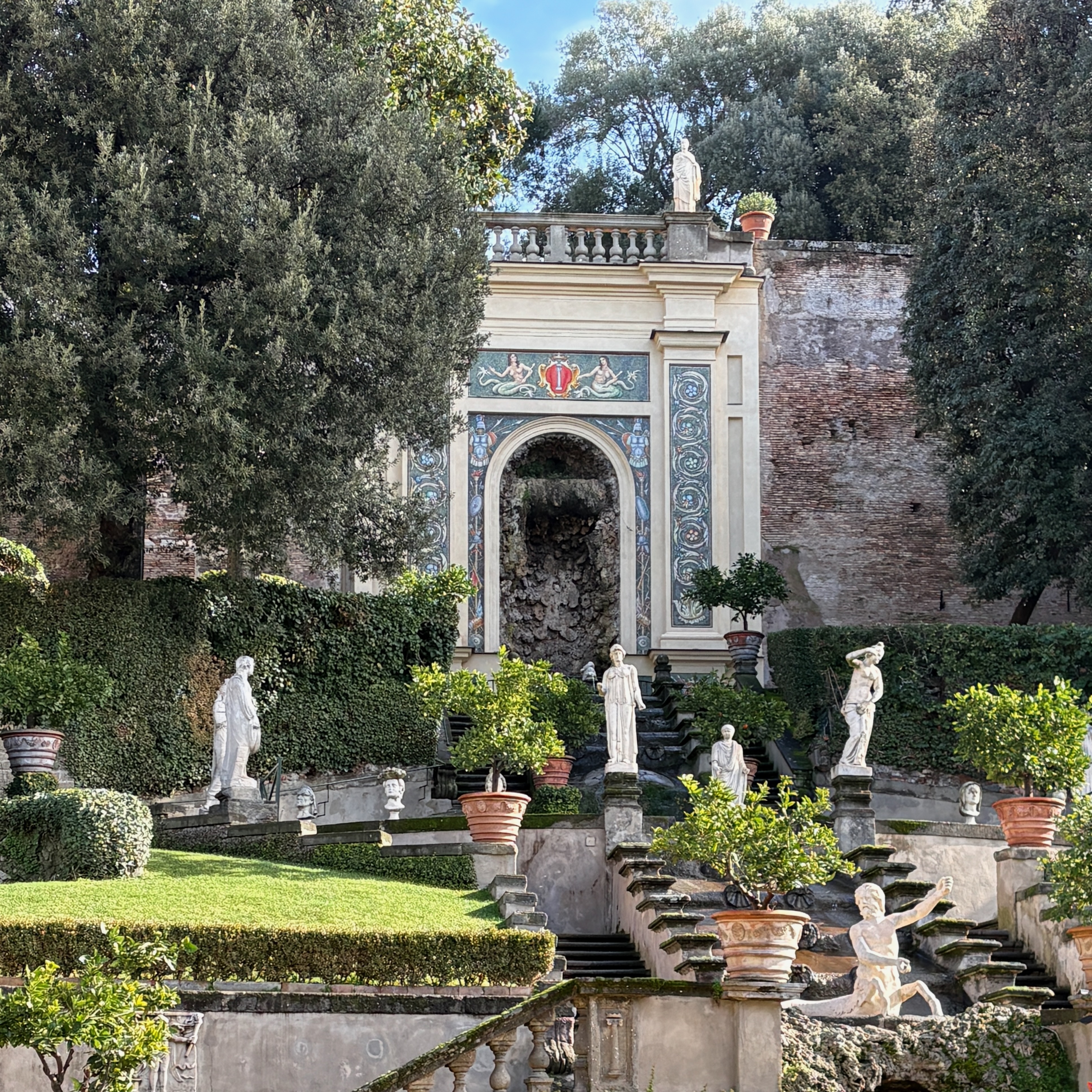
Let’s move on to the hanging gardens. A street below separates them from the palace, and the connection is made by small bridges. One might be surprised by the gardens’ location – the reason is historical. In the Middle Ages, the slopes of the Quirinal hill played a particularly important strategic role, which explains why the Colonna family built its earliest residences there, fortifying the entire area that today stretches between the Colonna palace and its garden.


Cardinal Ascanio Colonna (1560–1608) oversees the landscaping of the terraces on the hill. The construction of the great nymphaeum with its fountain, placed between the two staircases leading to the upper part of the garden, is one of his initiatives. This ensemble is designed by the architect Girolamo Rainaldi, who completes the works under the supervision of Filippo I Colonna..


Around 1710, Filippo II Colonna commissions the architect Alessandro Specchi to build the bridges linking the palace to the gardens, as well as the small pavilion adorned with three statues: at the centre, Marcantonio Colonna, victor of the Battle of Lepanto, flanked by Fabrizio and Prospero Colonna.

The Colonna palace offers a breathtaking concentration of Roman history – the place is absolutely spectacular.
February 20, 2026
