
The stunning exhibition “Marie-Antoinette Style” presented by the V&A Museum in London until March 22, 2026, offers a dazzling overview of 18th-century French fashion and the highly personal style created by the now legendary figure of Marie-Antoinette.
18th-century French fashion may seem frivolous to the uninitiated, yet the economic stakes behind it are anything but light. King Henri IV and later Colbert, minister to King Louis XIV, spent decades developing French craftsmanship – particularly through the Royal Manufactories and the protectionist ordinances of the “Grande Fabrique” of Lyon silk industry – which is flourishing when Marie-Antoinette arrives at Versailles in 1770 as a young Dauphine of France at the age of fourteen.

Embroidery sample for the train of a court dress – 1780-1792

Fragment of a court gown probably belonging to Marie-Antoinette – 1780-1791
The Court of Versailles is then the most brilliant on the continent. Versailles Court influences the fashion of foreign Courts and European elites, and it is the silk producers of Lyon who export their silk fabrics across Europe, renowned for their quality and beauty.
Technical advances allow them to weave complex patterns, chemical innovations ensure dyes hold better, and a whole textile industry develops. Beyond silk fabrics, this includes stockings, hats, lingerie, and the fashion merchants.
The most famous of these is probably Rose Bertin, who is introduced to Marie-Antoinette in 1774 and will become, in the Queen’s own words, her “Minister of Fashion”.
Marie-Antoinette, who has been a rather simple Dauphine of France, becomes Queen of France and Navarre in 1774.


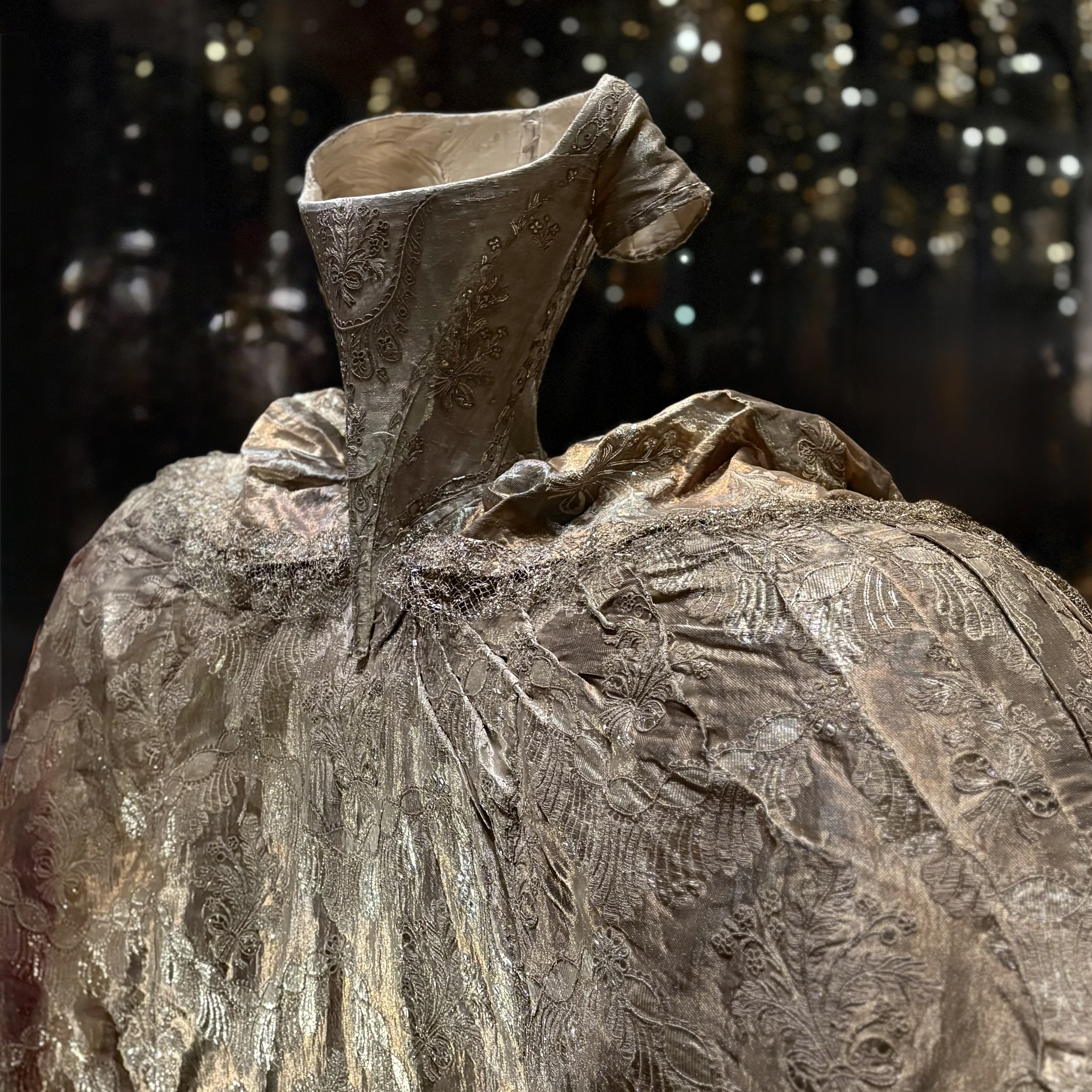
Wedding gown of Duchess Hedwig Elisabeth Charlotte, future Queen of Sweden – 1774. Marie-Antoinette wore a similar model, namely a robe à la française featuring Watteau pleats – flat pleats falling from the shoulders and flowing freely to the floor. The spectacular gown presented here, made of brocaded silk woven with silver threads, is a replica of the dress worn by Marie-Antoinette’s sister-in-law, the Comtesse d’Artois, for her wedding in 1773

The dress worn by the future Queen of Sweden

Perhaps she sees clothing as an armor within a Court she does not like and which hardly likes her, or perhaps she simply indulges in a realm of fashion that is the only one allowed – we do not know – but in any case, she is so captivated by Rose Bertin’s creations that she has a workshop built for her at Versailles, producing ever more extravagant designs.
The designs created for the Queen are made a second time on small figurines, sent across Europe, and copied in the Courts of London, Venice, Vienna, and Lisbon – further reinforcing France’s hegemony over European fashion.
It must be said that every well-born lady at Court is expected to shine – not with wit, but with appearance. This is no small task: etiquette imposes strict codes for every moment of the day, it’s out of the question to wear the same outfit in the morning and evening, or repeat a dress without significant modifications.


Grand corps – 1760 – Rigid whaleboned bodice with silver lace

Robe à l’anglaise – 1787. The English style is more informal and features no Watteau pleats at the back. The gown has smaller panniers, and the back pleats define the silhouette more closely than the French style

Details of a domino – 1765–1770. The domino was worn over the outfit for evening outings or at masked balls

Brunswick – 1765–1775. The Brunswick is a two-piece ensemble: a shortened version of the robe à la française with a hood and removable sleeves, worn with a matching mantlet. Inspired by Prussian travel dresses, the Brunswick became an informal garment in France in the 1760s. Marie-Antoinette and her sisters wore it in Vienna
Marie-Antoinette, not an intellectual salonnière, organizes her days around festivity and display. She defies Versailles and its oppressive etiquette. Her marriage, sexually distant in the early years, has become a distant companionship with a husband having different passions and social circles. She often goes incognito to Paris to the opera or balls – actions considered entirely improper by the nobles of the Court she ignores.
She indulges in dresses, hairstyles, perfumes, and jewelry, and her extravagant wardrobe only reinforces her image as a spendthrift and frivolous sovereign – an image promoted not by the bourgeoisie or the people but by the Court nobility she despises and keeps separate from her life, official or personal.

The infamous diamond necklace – Replica of the 60s of the necklace originally designed by Bassenge and Boehmer in 1772-1778. With diamonds totalling to 2842 carats, it is the most expensive necklace ever made in France at that time. The necklace is offered to the Queen who refuses it, but a con artist, Jeanne de la Motte, tricks a courtier, the Cardinal de Rohan, into paying for part of it, supposedly on behalf of the Queen. La Motte then disappears with the diamonds. Although entirely innocent, the fallout is fatal for Marie-Antoinette’s reputation

Marie-Antoinette’s jewelry casket by Carlin – 1770. Marie-Antoinette received this casket, adorned with Sèvres porcelain plaques, as a wedding gift upon her arrival in France
She also longs for the simplicity of her childhood at the Viennese Court and has the Petit Trianon built to escape the official palace, creating at the same time a fashion style more aligned with her desire for freedom – even if scandalous, such as the “chemise à la reine” (a simple, loose, flowing gown made of lightweight cotton muslin, often white or pastel-colored, worn without a stiff corset but adorned with a ribbon belt and a straw hat) – a precursor to the simplicity of revolutionary and post-revolutionary fashion.

Marie-Antoinette in a Muslin Dress by Élisabeth Vigée Le Brun – circa 1783. The painting causes a scandal, as the Queen is depicted in one of her beloved white cotton chemise dresses, worn at Trianon, rather than in a formal robe à la française or ceremonial gown. The uproar is such that Élisabeth Vigée Le Brun has to repaint the portrait almost identically within a few days. The style is decidedly natural, relaxed, and spontaneous, far removed from the stiff and affected portraits fashionable at the time

Muslin Dress – 1780–1790. This is one of the two surviving dresses of Marie-Antoinette. By wearing such simple and informal gowns, the Queen launched a fashion that became wildly popular among noblewomen

Pierrot and petticoat – 1790

Marie-Antoinette by Adolf-Ulrik Wertmüller – 1788. Marie-Antoinette is likely wearing a Pierrot in this portrait. Ironically, this type of striped fabric would later become emblematic of revolutionary style

Details of the petticoat


Toile de Jouy fabrics
She is fleeing her life. Yet she is sensitive to Enlightenment ideas, the return to Nature, and personal fulfillment. But confined in a gilded cage she rarely leaves, with limited curiosity and discipline, she neither anticipates nor understands the revolutionary tsunami coming.
She is arrested, imprisoned, judged unfairly, and dies a martyr, beheaded.
The succession of brilliance and darkness is striking.
Is it this martyrdom that binds us to her? Possibly. France, which has never ceased to be viscerally monarchical, even today, has never truly come to terms with having decapitated its sovereigns. The injustice and violence of the revolutionary period remain a strong cultural and historical marker, even for very republican-minded people like me, and I remain convinced that the tragic fate of Marie-Antoinette largely explains the lasting impact this now legendary figure continues to have today.


Evening gown of Empress Eugénie (the skirt is a replica) – Circa 1855. The floral style is reminiscent of that of Marie-Antoinette

Evening gown with an apron – 1840-1850

Bodice and Skirt – 1774–1780, later alterations 1870–1910. In the 19th century, women who inherited their grandmothers’ wardrobes continually recycle dresses, as the fabrics are elaborate and remain fashionable

 Worth – 1897

Félix de Gray – 1920-1930

Boué sisters – 1923

Galliano for Dior – 2000-2001

Lagerfeld pour Chanel – 2006
Because her influence endures.
Nearly seventy films have been dedicated to her, and I will never stop insisting that Sofia Coppola’s is the most sensitive, not to mention the numerous biographies.

Costume from the film of Sofia Coppola

Costume designed by Maria Grazia Chiuri for Dior for actress Emilia Schüle in the role of Marie-Antoinette – 2023
Fashion designers have long sought to capture the spirit of this queen, revolutionary without knowing it, whether it be Vivienne Westwood, John Galliano, Manolo Blahnik, or Moschino.
And when I see the number of articles, directly or indirectly devoted to this queen with a tragic fate on my website, I fully grasp her influence: the Petit Trianon, her biography by Stefan Zweig, her portraitist, Sofia Coppola’s film, and the Expiatory Chapel.
Her influence? Yes, of course.
But more than that, her mystery, which everyone attempts to unravel in their own way.
V&A – Marie-Antoinette StyleModifier cette traduction en Français
February 6, 2026
