
The French tradition of luxury, today predominant with 130 luxury brands out of 270, is several centuries old, dating back to King Henry IV and developed by his grandson King Louis XIV, and its historical aim has always been to prevent the French capital outflow abroad.
The nobility’s craze for precious fabrics, silks and laces dates back to the Renaissance era. Annoyed to see the nobility getting supplies from abroad, King Henri IV encourages the cultivation of mulberry for silkworms in the South of France and establishes in 1601 the foundations of a monopolistic tapestry factory which is supposed to compete with Flemish tapestries.
The tapestry factory becomes in 1662 under the reign of his grandson King Louis XIV, the royal Gobelins factory (Manufacture des Gobelins).
The Sun King, with his protectionist super-minister Colbert, institutionalizes the French luxury sector. Colbert will never stop uncovering the secrets of foreign know-how to repatriate them to France, be it oriental silks or Venetian lace stitch.
Louis XIV and Colbert are provided with the ideal laboratory for promoting luxury: the Court, within which each noble person is ready to spend fortunes to appear before the King.
The royal glass factory (Manufacture des Glaces) is created in 1665 – it would become Saint-Gobain – in order to compete with Venetian glass and mirrors.
The French East India Company, created in 1664, is created to compete with the powerful English and Dutch companies and allow direct access to exotic products – very rare and highly desired at the time, whether parrots or spices.
The royal porcelain factory (Sèvres Manufacture), which is created in 1740 under the aegis of Louis XV and Madame de Pompadour, competes with Chinese porcelain.
Bringing together the best craftsmen, the royal factories develop unique know-how and expertise and give birth to French luxury, but the French Revolution leaves them destitute. The nobility, arrested or on the run, is discreet, as are their expenses.
In the following decades, a new social class gradually supplants the nobility and soon claims its right to luxury: the bourgeoisie. New luxury houses appear to meet this new clientele: Hermès in 1837, Cartier in 1847 and Vuitton in 1854.
Charles Frederick Worth, a French couturier of British origin, invents the codes of what would become haute-couture as we know it, no longer creating models on demand, but seasonal collections presented during fashion shows.
During the interwar period, Gabrielle Chanel further redefines the notion of luxury: she sells junk jewelry which becomes the new chic and allows women to wear as many necklaces as they want. She diverts the clothes of workers and sailors by establishing jersey and sailor tops as luxury pieces.
Chanel is, by her own admission, not a seamstress but other designers are coming to flesh out the world of French luxury – and they are technicians: Madame Grès, Madeleine Vionnet and Christian Dior restructure with audacity the female silhouette.
Others will follow, with just as much talent, like Yves Saint Laurent and Azzedine Alaïa.
The Colbert Committee is created at the end of WWII in 1947 to defend French luxury.
Today, the French luxury sector is no longer faced with the French capital outflow abroad. On the contrary, the two largest French luxury groups, LVMH and Kering, are constantly expanding their international reach – starting from Paris. The brands owned by these two luxury groups are both French and foreign.
Colbert would be very proud.

On the other hand, the paradigm shift that has shaken up the French luxury sector in recent years is obvious.
Exclusivity – induced by the monetary power of the consumer – knows today a strange reversal of the situation: it is no longer the wealthy consumers who decide if they purchase and what they purchase, it is the luxury house.
Hermès, Vuitton and Chanel only authorize a very limited number of bag purchases per year, arguing that the grey resale markets harm their brands but such quota policy thereby creates an artificial increase in demand and a feeling of exclusivity taken to the extreme.
Vuitton sports long line-ups in front of its stores, arguing the need to offer a unique experience to its customer – understand being followed throughout the store by a person who will be totally dedicated to the client.
Hermès extremely regulates the possibility of seeing its emblematic bags and asks for infinite patience from its customers who wait many months before receiving their Birkin or their Kelly. The economic model has become so unbearable for the potential customer that the luxury house is currently being sued for tied selling, that is to say the fact of imposing without saying it a certain number of purchases which have become, always without saying it, obligatory before accessing the possibility of acquiring a Birkin bag.
Gabrielle Chanel’s junk necklaces are now selling for fortunes – and we’re talking about thousands of euros for plastic beads.
The prices of French luxury houses have continued to increase while the quality of their products has continued to decline. And between us, if one wants to acquire a Chanel or a Hermès, a better option would be to go to the auction houses to acquire one that is vintage and avoid the current kind of cardboard leather which adorns the handbags of these two houses.
This is all ridiculous.

It could be argued that luxury houses preserve craftsmanship.
This is partially true. Thanks to a vertical integration model, large luxury groups enable the sustainability of certain crafts which would have great difficulty surviving without the financial back-up offered by such groups. I am thinking in particular of Gripoix who created the enamels for Gabrielle Chanel necklaces or of Lesage, the embroidery house which was already working for Charles Frederick Worth and which is now integrated in a Chanel subsidiary, with the shoe maker Massaro, the hat maker Michel, the feather maker Lemarié and the jeweler Goossens.
However, let us not deceive ourselves: the dominant position of the luxury house which is the customer allows the imposition of terms and conditions which are not always fair.
According to an investigation conducted by Bloomberg in March 2024, Loro Piana – owned by LVMH – pays a ridiculous amount of money for its wool, supplied by villagers in the Peruvian Andes who live in extreme poverty while they provide a luxury house which has the arrogance to sell a Vicuna sweater for $9,000. Loro Piana denies the allegations but there is no doubt that the price paid to the villagers has no common measure with the sales prices charged by this luxury house which wants to be über-exclusive.

It’s revolting. Apart from the fact that luxury products are social markers and obvious reflections of the desire to belong to a social class – which is of concern as such – this paradigm shift according to which the quality falls, the prices rise, a so-called exclusivity is imposed on the consumer has, for me, nothing to do with my idea of luxury.
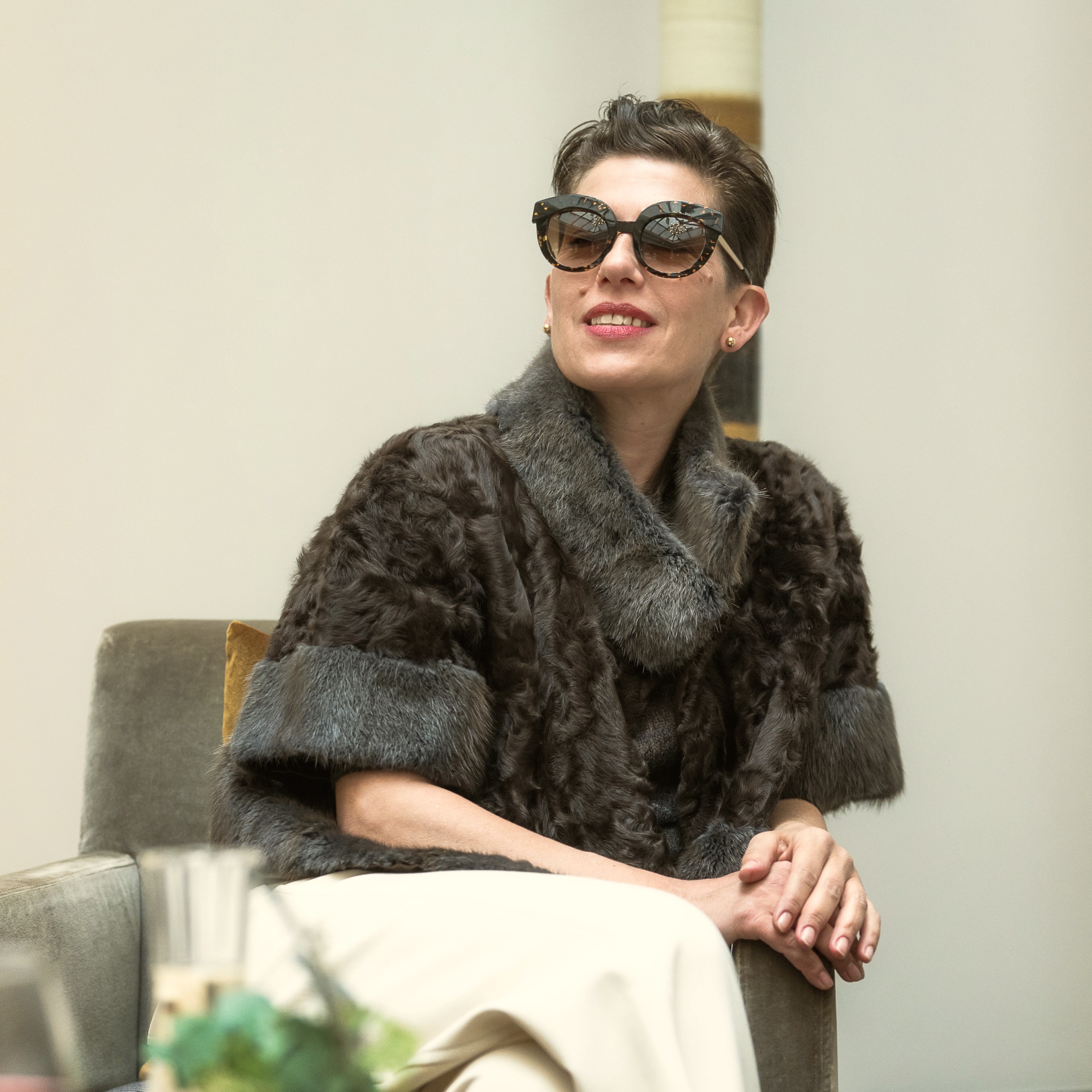
A reasoned approach involves asking ourselves what the notion of luxury calls for in us. As far as I am concerned, luxury is synonymous with quality, excellence and creativity. People who meet me have no idea what brand my clothes or shoes are, because nothing is visible, there are no logos and the models I choose are not the most publicized.


As I like the idea of quality, I often turn to vintage because the quality of the finishes, fabrics or leathers is significantly better than that of today. I also like the idea of sustainability that vintage implies – I am so done with current overconsumption, four-billion-dollar bags and the world of appearances.


Tara Jarmon jacket bought 25 years ago – Second-hand trousers with no tag but suspected to be from Ralph Lauren on the basis of the buttons – Nina Ricci flat shoes – Moreau Paris tote bag – Face À Face sunglasses – Vintage gloves from the 40s, a gift from my dear friend Virginie, co-founder of Marcel & Jeannette, Saint-Ouen Flea Market
May 10, 2024
