
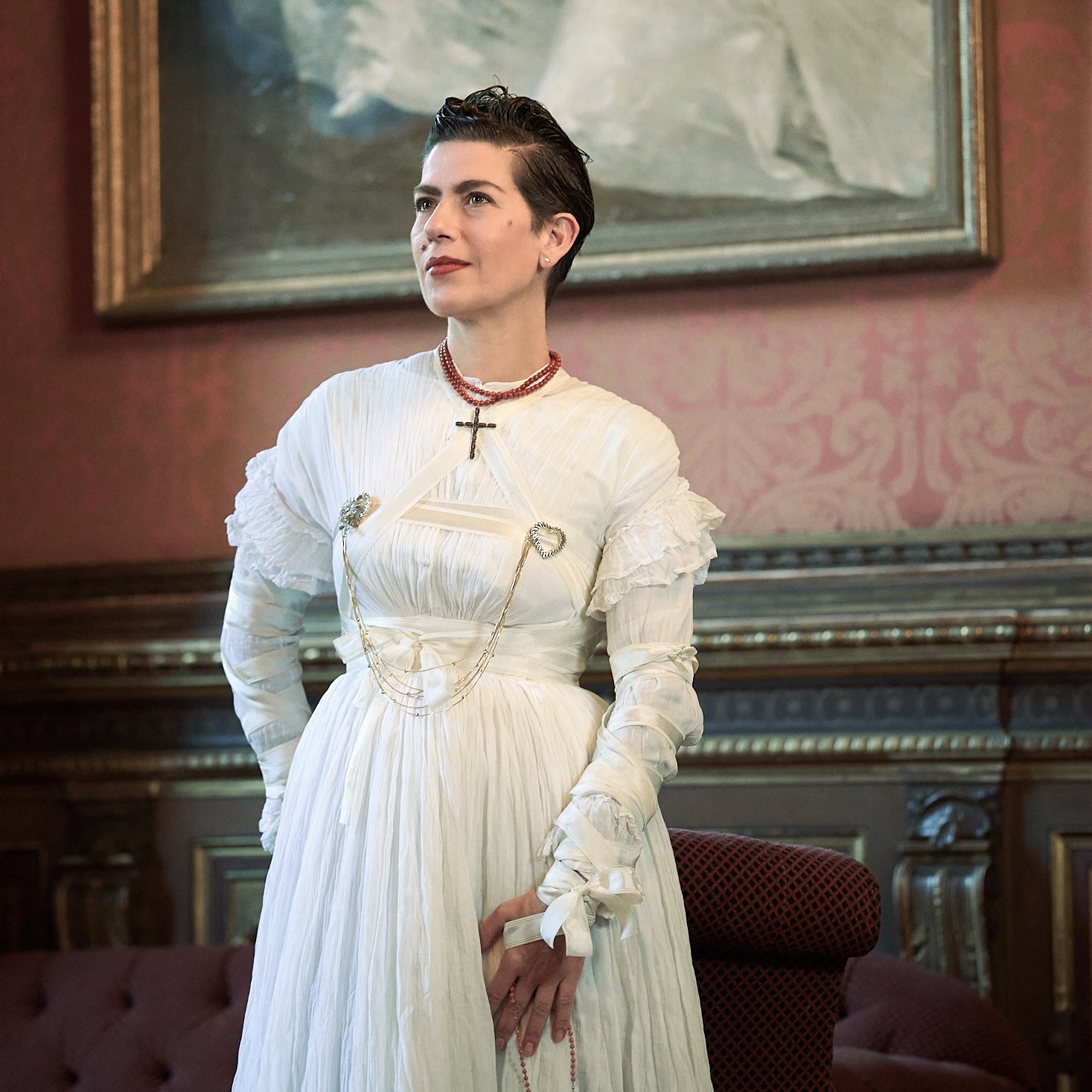
Victor Frankenstein and his creature are coming back into fashion in November 2025, thanks to Guillermo del Toro – which is hardly surprising – and to… Netflix. The film, which is the result of a partnership between the Mexican director and the streaming platform, offers on the one hand a reinterpretation of Mary Shelley’s original novel and departs on the other hand from a collective imagination shaped by previous film adaptations, which turned the creature into a green monster with a cylindrical head, an oversized forehead, and very limited intelligence.
Guillermo del Toro’s film is built around two major parts: Victor Frankenstein’s narrative followed by the creature’s narrative.
Victor Frankenstein’s story (played by Oscar Isaac) initially wins the audience’s sympathy: a child broken by the unexpected death of his beloved mother (played by Mia Goth) and by his father’s hatred, Victor, who has become a surgeon, wishes to unlock the secret of life by recreating it in adulthood – since he could not save his mother as a child. He discovers love when he falls for Elizabeth (also played by Mia Goth), his brother’s fiancée – and he also discovers the secret of life when he succeeds in creating from scratch a superhuman creature built from the limbs of soldiers who died at the front. The creature (masterfully portrayed by Jacob Elordi), powerful but unintelligent, terrifies Victor, who decides to chain it up before setting his laboratory on fire – hoping to erase all traces of his experiment.
The creature’s story is entirely different: born in the body of a superhuman creature, it is as emotionally equipped as a newborn. It does not understand Victor’s lack of love and tries – once it has escaped the burning laboratory in which it nearly died – to learn how to live. Driven by benevolent feelings, the creature soon encounters the cruelty of the world and the loneliness imposed by its repulsive appearance. Its painful learning process reveals great intellectual and emotional intelligence. It wishes to die but cannot, since it continuously resurrects and is tragically condemned to an eternity that resembles Hell on Earth.
The flaw in Guillermo del Toro’s film lies in its heavy-handed Manichaeism.
De Toro’s Victor is utterly detestable – a man-child with an unresolved Oedipus complex, who has never worked through his childhood trauma, who reproduces the violence he himself endured, who shamelessly flirts with his brother’s fiancée for whom he feels only superficial attachment, who calls “love” the pitiful desire he has for an Elizabeth he does not even bother to see for who she is; and finally, a man who plays the sorcerer’s apprentice by creating catastrophic situations and who, instead of owning up to them, runs away. “After me, the flood” could be his epitaph – but no, wait, he still tries to win the sympathy of his audience.
The creature, by contrast, is presented as a poor vulnerable being, sensitive, who acts only out of goodwill and harms or kills only in situations of imminent danger. The deaths that punctuate its path are in fact caused by external elements (wolves, men, Victor), yet it is wrongly blamed for them.
This is to forget rather quickly that the original version of Mary Shelley’s novel is far more nuanced.
Guillermo del Toro unfortunately does not trust his viewers: everything is mapped out, everything is signposted, and the Manichaeism that runs through his film inevitably places the viewer on the creature’s side after the two hours and thirty-four minutes of viewing.
Sign of the times? Very likely.
Sign of the times amplified by the fact that the movie is broadcast on the world’s largest streaming platform, which offers a globalized and thus flattened film culture to viewers who, at home, half-watch films while simultaneously glancing at the notifications on their phones? Most certainly.
All the same, Guillermo del Toro’s Frankenstein remains well-crafted.
It is often said that the horror film genre frequently reflects its time. In this case, the parallels between the 2025 Frankenstein and the current developments surrounding artificial intelligence are striking. Today’s tech companies have nothing to envy Victor Frankenstein, since they play, like him, the sorcerer’s apprentice by creating, without any regulation, programs and algorithms whose harmful consequences for the environment are already very real and potentially disastrous for humanity. “After me, the flood” could be the epitaph of these tech companies – but no, wait, there is too much money at stake for any regulation to be imposed on them.
Visually sublime, Guillermo del Toro’s film has the merit of rehabilitating a creature that has been badly mistreated on screen for several decades but that bears little resemblance to its original literary version.

Let’s now speak of Mary Shelley, the true paper mother of Victor Frankenstein and the creature.
Mary Shelley – then named Mary Wollstonecraft Godwin – is born in 1797 in London and educated by a loving father and a far less affectionate stepmother, in an intellectual household that is nevertheless often short of money.
Mary Shelley’s ancestry is somewhat overwhelming: her mother is the acclaimed feminist philosopher Mary Wollstonecraft, who has the poor taste to die ten days after her daughter’s birth, and her father is the renowned philosopher and political theorist William Godwin.
At seventeen, Mary falls in love with a twenty-two-year-old poet and philosopher, Percy Bysshe Shelley. Although he comes from a wealthy noble family, although he is already recognised in literary and political circles as a valuable Romantic and radical poet, and although he enjoys an excellent relationship with Mary’s father, nothing helps: Godwin disapproves of the relationship forming between his daughter and Percy.
And for good reason: Percy is already married.
At nineteen, after a rather romantic and scandalous elopement, he married Harriet Westbrook, the sixteen-year-old daughter of a wealthy hotelier. The marital life Percy offered Harriet likely had little to do with her expectations, as Percy, a staunch defender of free love, invited his best friend Thomas Hogg to share both his home and… his wife. Later, the arrival of Harriet’s sister in the household further strained the already fragile relationship.
It is 1814, and Percy just met Mary Wollstonecraft Godwin. She knows of Harriet, of the first child born from the marriage, and knows that Harriet is pregnant with a second child.
Mary is nevertheless troubled by the disapproval of a father she adores and who seeks to protect her reputation, even though Percy seems to her the embodiment of her father’s reformist ideas that considers marriage nothing more than a tyrannical monopoly.
Godwin’s efforts are in vain.
In July 1814, the illegitimate young couple runs away to France, taking with them… Mary’s half-sister Claire, and leaving behind a pregnant Harriet.
A ménage à trois that is becoming familiar.
Percy Shelley’s radicalism has completely alienated him from his wealthy aristocratic family, and the trio endures great financial hardship – which does not prevent them from continuing to write, whether in their shared journal or in their personal works.
They return to London.
Godwin refuses to see his daughter again, and Mary finds herself without family support, pregnant, avoiding creditors by moving through a succession of shabby lodgings with Percy and Claire. Hogg is never far, and Percy seems to encourage an affair between Mary and Hogg, while he himself became Claire’s lover. In theory, Mary also advocates free love, but in reality she is exclusively and passionately in love with Percy, and his relationship with her half-sister must have deeply wounded her.
Meanwhile, Harriet gives birth to a son, and Mary had to endure Percy’s joy at the news, while she herself gives birth to a premature daughter who dies when the baby is only seven months old.
The loss of her child plunges Mary into deep depression, and she is haunted by visions of her little girl.
She becomes pregnant again and gives birth in January 1816 to a second child, William.
Mary, Percy, Claire, and the child spend the Summer of 1816 in Switzerland, in a modest villa next to the far more luxurious Villa Diodati, rented by Lord Byron – Claire’s lover, who has also impregnated her.
The incessant rain confines the small group indoors at Byron’s villa, where he has invited one of his friends, the nineteen-year-old Dr. Polidori. Their discussions revolve around Darwin’s experiments attempting to reanimate dead flesh, galvanism, and ghosts.
Out of boredom, Byron proposes that each person write a horror story.
From Villa Diodati emerges The Vampyre – the first vampire in literature – written by Dr. Polidori (although initially published in early 1819 under Byron’s name, only to be corrected later that year. After all, The Vampyre has been born from one of Byron’s drafts, developed by Polidori).
From Villa Diodati also emerges Frankenstein, by Mary Shelley, who believed she was writing a short story but will go on to create the founding novel of gothic and science-fiction literature.
Mary drew inspiration from her unconscious desire to revive a dead, a very small dead being: her own daughter who has died at seven months. She documented in her journal her impossible grief and her desperate, feverish dream of restoring life to the tiny corpse by vigorously massaging it in front of the fireplace.
Mary also drew inspiration from the era in which she lives. The period is troubled and violent, calling for heroic, adventurous, bold figures tinged with Romanticism. Napoleon, the illegitimate heir of a French Revolution that horrifies and fascinates Europe at once, is setting the continent ablaze with varying degrees of flair and sentiment.
Back in England, Mary, Percy, and Claire face the suicide of one of Mary’s half-sisters, Fanny, and then Harriet’s suicide – Percy’s first wife.
Both suicides are kept secret by the families, and Mary and Percy marry in December 1816, thus ending the family dispute that has torn the Godwin household apart.
Claire gives birth to Byron’s daughter, but Byron soon takes the child away and places her in a convent. The little girl will never see her mother again and will die alone there at age six.
Mary gives birth again in 1817 and finishes her novel, conceived during that Swiss Summer with Byron, Shelley, and Polidori.
The novel Frankenstein or The Modern Prometheus, after being rejected by Byron’s publisher and Percy Shelley’s publisher, Is finally printed by Lackington, Allen & Co. in 1818.
Anonymously.
Critics and readers assume that Percy Shelley Is the author, since he has written the preface.
Mary herself remains hesitant about this first version, which she revises for months. A revised edition is published in 1823 – this time signed by Mary. Some critics lament that she has forgotten, in writing such a text, “the inherent sweetness of her sex.”
It is only with the definitive 1831 edition that she feels fully satisfied with her work, assisted by Percy, who constantly reread the various manuscript versions and contributed ideas.
The strength of Mary’s epistolary novel lies in its multiplicity of dimensions: a fantastic and horrific tale, the work also explores philosophical considerations. It is no coincidence that it was born on the lands of Jean-Jacques Rousseau, and the only question which comes in mind once the novel is finished is: what is it that makes a being truly human?
The story is told in epistolary form: Robert Walton, on an expedition to the North Pole, writes to his sister Margaret. He recounts his encounter with Victor Frankenstein – whom he found drifting on an ice floe – and the incredible life Victor told him about, from his creation of the monster to the mutual hatred between him and his creature.
There is, in Mary Shelley’s novel, neither a childhood trauma to explain Victor’s obsession with creating life, nor any heavy-handed Manichaeism that would oppose an egotistical, cruel scientist to his innocent and pure creature.
On the contrary, when Robert Walton meets Victor, he describes him in his letters to his sister as a superior being – kind, gentle, wise, and consumed by grief. Raised lovingly by parents he adores, Victor certainly plays the sorcerer’s apprentice when he brings the creature to life, but there is in him no trace of egotism or cruelty toward it. And yet, when a servant is wrongfully accused and then sentenced to death for the murder of a young child, Victor lacks the courage to provide the evidence that would exonerate her – since he knows that the creature is the true killer.
These two deaths are then followed by those of his childhood friend Clerval, of Elizabeth, and of his father.
Because Mary Shelley’s novel is a mise en abyme, the narratives of Robert Walton, Victor, and the creature nest within one another as the events unfold (unlike Guillermo del Toro’s film, which presents two successive narrative blocks). This structure allows the reader to slowly discover and appreciate the full ambivalence of both Victor’s and the creature’s personalities – both intelligent, sensitive, and human, despite their glaring flaws and their clearly destructive obsessions.
Victor’s great fault is that he never truly takes responsibility for the suffering that afflicts the creature or for the tragedies that befall those around him. Victor believes himself innocent of all these disasters. Worse, he sees himself as the victim.
The creature, for its part – confronted with the cruelty of humanity and the rejection of its creator – ceaselessly seeks murderous revenge. It has learned to speak, and even her language – marked by extreme eloquence and seduction – is used as a weapon intended to persuade its audience, inevitably recalling the deceptive and beguiling persuasion of the diabolical discourse. Through the harsh apprenticeship of life, it has also learned to be overtly manipulative (it arranges for the innocent servant to be accused of the child’s murder) and malevolent (it knows perfectly well how to make Victor suffer, and pursues this goal relentlessly).
Even though the corrosive poison of revenge animates both the creature and Victor, the theme of brotherhood runs throughout the novel – whether through Walton, who longs for a brother, a double, a friend, or through Victor, who maintains a deep friendship with his childhood companion Clerval. In contrast, the theme of solitude is first hinted at and then fully developed through the creature’s total isolation and later Victor’s progressive withdrawal from the world.
To paraphrase Stephen King, uncertainty persists throughout the novel: is the fault Victor’s, in his excessive ambition in usurping a power belonging only to God, or is the fault in his refusal to take any responsibility for the education of a creature he alone brought to life?
Frankenstein, abandoning horror for terror and the supernatural for interiority, is immediately acclaimed by critics and announces, despite its strong gothic tone, the emergence of English Romanticism applied to the novel, a domain previously dominated by poets.
Mary does not yet know it, but with the creation of Victor and the creature, she has invented two archetypes (even proto-types: the mad scientist and the monstrous creature), equal to a Dracula.
Yet the couple’s situation does not improve: pursued by creditors and threatened with prison for unpaid debts, they leave England with Claire for Italy. There, Mary loses her two children in 1818 and 1819, plunging her into profound depression.
She gives birth to her fourth child, Percy Florence, in late 1819. Italy grants political freedom impossible in England, and this Italian period becomes one of intense intellectual and creative activity.
Mary becomes pregnant again in 1822 but miscarries and nearly dies. That same year, Claire’s daughter dies of typhus in a Swiss convent, without her parents. Meanwhile, Percy’s affairs with other women wound Mary deeply. Worse still, Percy drowns while sailing. Ten days after the fatal storm, his body washes ashore at Viareggio, between Livorno and Lerici.
Back in England, Mary devotes herself to publishing Percy’s poems and a biography of her husband, which greatly displeases her father-in-law, though he does grant her a pension that allowes Mary and her only surviving son to live modestly. She also publishes her father’s letters after his death.
Mary will also publish under her own name, at last. She has a prolific career: she publishes around twenty short stories, six novels, one dark work published posthumously (Matilda), a travel book, biographies, and an edited collection of Percy Shelley’s writings.
She never remarries and keeps Percy’s heart, preserved, with her until the end of her life. She is also, on three occasions, the victim of blackmailers threatening to publish personal letters or a damaging biography of Percy.
Mary dies in 1851, at fifty-three, probably of a brain tumour.
What a life, my friends, what a life.
Editor’s note: Here I am in period costumes embodying the beautiful Elizabeth from Guillermo del Toro’s film. Let’s be honest: Mary Shelley publishes Frankenstein in 1818, the novel takes place in 17… something and the film’s costumes are 1850 – so we had to adapt. The “we” includes your humble servant and her soul-sister, Virginie, a costume historian who owns several shops at the Saint-Ouen flea market, Marcel & Jeannette. Virginie has passion and talent: costume designers from films and series often visit her. One understands why when looking at the photos that follow.


1850s dress, old rosary and antique coral cross found in Marcel and Jeannette’s Ali Baba cave – Jimmy Choo heels – Small good-luck scarab beetles from the late 19th century on the book
December 26, 2025
