
Built between the end of the 18th century and the beginning of the 19th century, the covered passages of Paris prefigure the transformation of Parisian commerce – between the progressive abandonment of tiny shops and haberdasheries and the phenomenon of department stores that would revolutionize the consumption pattern of Parisian women.
Pedestrian shopping arcades covered with glass roofs, the Parisian passages that pierce certain real estate complexes and link two streets are innovative in their very structure and in their social role: systematically lined with boutiques, they are places of great diversity where luxury shops, toy merchants, booksellers and restaurants rub shoulders. They also offer a clientele, often female, a haven of peace that allows them to buy serenely, sheltered from the elements in varied shops.
Almost all of Paris’ covered passages are located on the right bank of the Seine, within the perimeter of the future Grands Boulevards, which attracted a wealthy clientele even before they were built – and close to theaters that offer entertainment conducive to spending.
The main areas where covered passages are built were the Madeleine, the Palais-Royal, the Grands Boulevards, the Portes and République districts.
The Madeleine district develops not far from the Opera Garnier house, at the junction of two other already famous thoroughfares: the Champs-Élysées and the rue du Faubourg Saint-Honoré lined with imposing private mansions. The district boasts two covered galleries: the Passage Puteaux and the Galerie de la Madeleine.
The Village Royal, formerly the Cité Berryer, is one of the rare open-air Parisian passages.


The opening of the Galerie de la Madeleine in 1845 is linked to that of the eponymous square and the construction of its church. The facades of the building opening onto the square are imposing. Two superb caryatids, works by Jean-Baptiste Klagman, frame the main entrance to the passage


The Village Royal. Called the passage du marché d’Aguesseau until 1837, this open passage becomes the Cité Berryer in 1877, named after a famous French lawyer and politician. In 1994, it is restored and renamed the Village Royal. The Ladurée tea room, opened in 1871 by Louis-Ernest Ladurée, is not far away
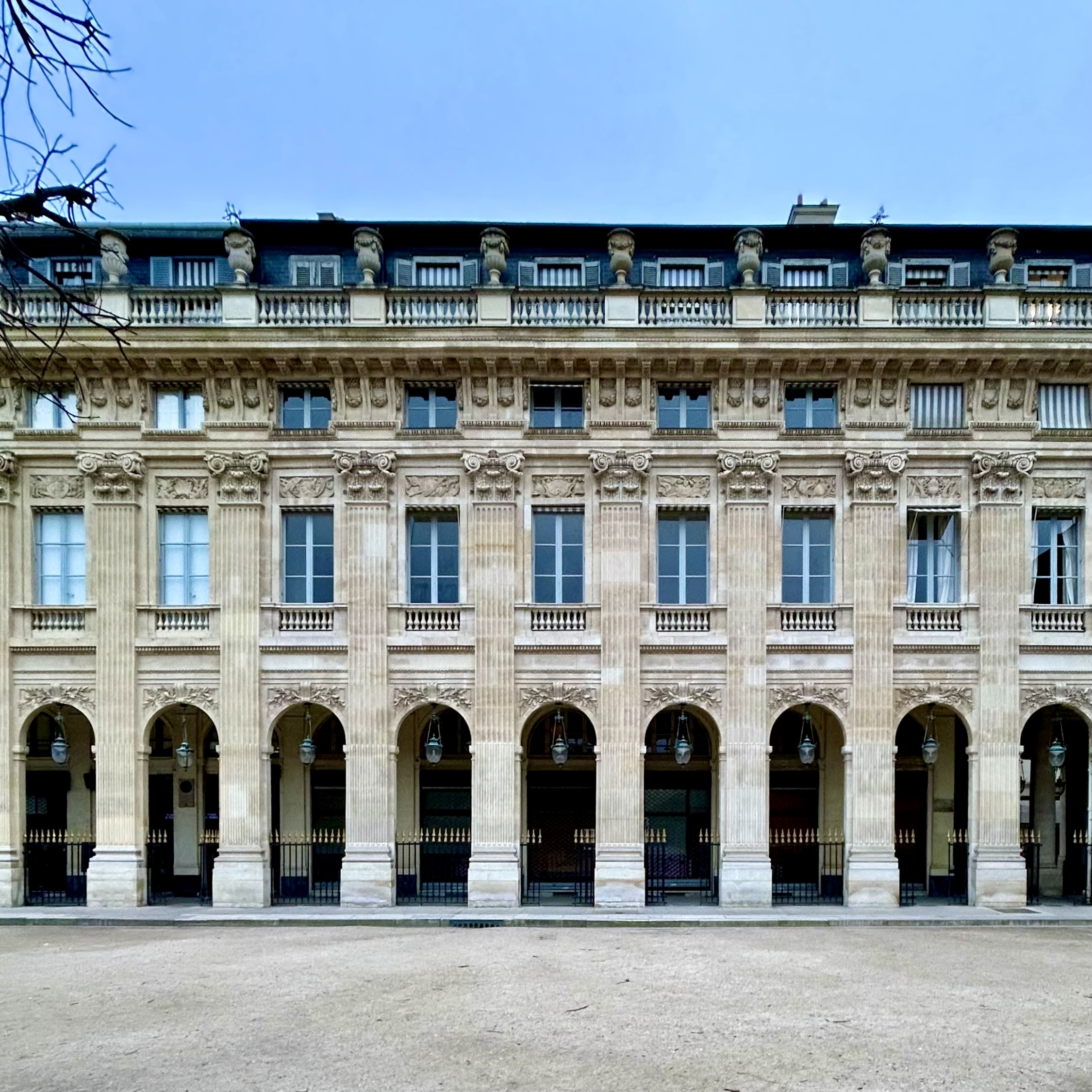
The Palais-Royal, more in the center of the city, cultivates its difference from the business districts of the West and capitalizes on its historical and literary character.


The galleries of the Palais-Royal. The galleries of Valois, Beaujolais and Montpensier surround the gardens of the Palais-Royal. The Duke of Orléans, Philippe Égalité, enlarges the Palais-Royal to meet the costs of his court, and rents the ground floor to merchants, owners of gambling dens, thus transforming the Palais-Royal into a real bazaar


The Galerie Vivienne. The President of the Chamber of Notaries, Maître Marchoux lives in this district. He wants to build the most beautiful covered passage of Paris. He calls on the architect François-Jacques Delannoy, and the covered passage opens in 1823. From the Second Empire onwards, the passage loses some of its appeal with the move of prestigious businesses to the Madeleine and the Champs-Élysées


The Galerie Véro-Dodat. Created in 1826 by two butchers, Véro and Dodat, this gallery has a beautiful layout thanks to an illusion of depth due to the diagonal pattern of the black and white marble slabs and the continuous facade of the shops. The actress Rachel lived there
The Grands Boulevards district experiences its advent with the early hours of the Second Empire, before sinking in the face of competition from department stores. There are the Passage Choiseul, the Passage des Princes, the Passage des Panoramas, the Passage Jouffroy and the Passage Verdeau.


Passage Choiseul. Originally, the Mallet bank had a large quadrilateral bordered by four streets. At that time, there were four mansions and their gardens. The four mansions are destroyed and only a few elements of one of them, the Gesvres mansion, are preserved (including the porch that today forms the Northern entrance to the passage de Choiseul) as part of the construction of the passage, which dates from 1827

Passage des Princes. The Mirès bank opens the passage in 1860 on one of the busiest and most elegant boulevards in Paris and communicates with the business street, the Richelieu street. It is the last covered passage built in Paris in the 19th century


Passage des Panoramas. Built in 1800, it is the first public place in the capital to have gas lighting in 1817 and has several luxury boutiques, such as the Café Véron, the Félix pastry shop and the engraver Stern, whose shop still exists


Passage Jouffroy. In 1882, Arthur Meyer, director of the newspaper Le Gaulois, has the idea of teaming up with Alfred Grévin, then a famous caricaturist, to create a gallery of wax figures. The Passage Jouffroy, inaugurated in 1847, is the first passage built entirely of iron and glass. The Grévin Museum has been the district’s main attraction since 1882


Passage Verdeau. Established in 1846 by the Société du passage Jouffroy, the Passage Verdeau is located in the extension of the Passages des Panoramas and Jouffroy
The Portes (the Doors) district develops around theaters with daring programming but also around the historical tradition that made it one of the hearts of the capital, with its axis towards Saint-Denis which is a royal road. A little further east, the République place is created under the Second Empire and is called Place du Château d’Eau until 1879, changing its name on the occasion of the centenary of the French Revolution. From the Portes district to the République district, there are several covered passages, such as the Passage Vendôme (1827), the Passage du Bourg l’Abbé (1828), the Passage du Grand Cerf (1826), the Passage du Ponceau (1826), the Passage du Caire (1799), the Passage du Prado (1785) and the Passage Brady (1828).
Mid-19th century, Paris has around 150 covered passages and exports the model to several other cities in France (Nantes, Bordeaux) and abroad (Liège, Milan) but the advent of department stores from 1852 will lead to the gradual disappearance of most Parisian passages.
Many have completely disappeared – the Galerie Bergère, the Galerie de la Bourse to name a few – but others still exist, as we have seen, to our great pleasure.
September 12, 2025
