
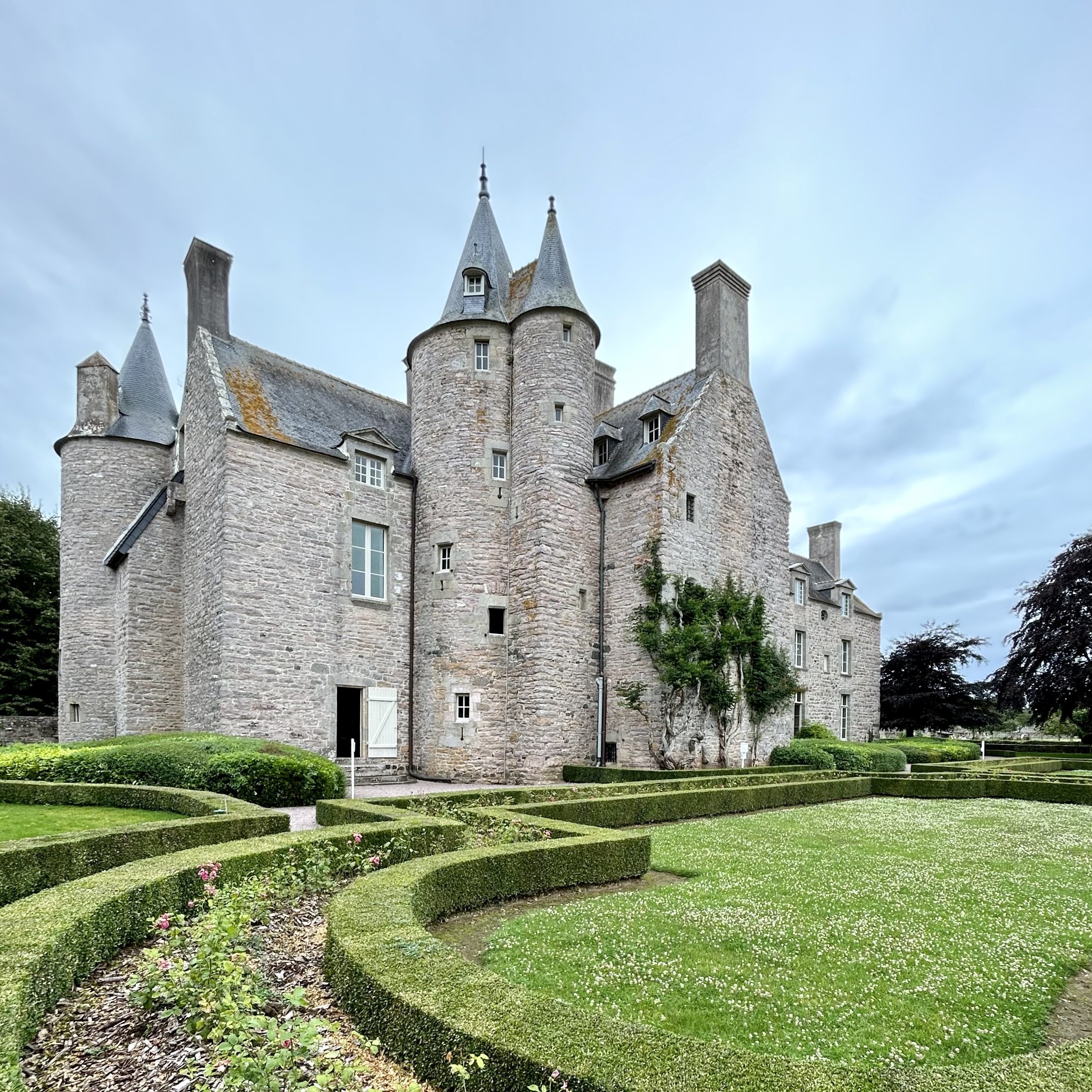
The Bienassis castle presents a very complete set of stately buildings, transformed over the centuries by their various owners. The first Bienassis mansion was a 12th century manor surrounded by a moat. It was replaced by a castle in the 15th century then transformed and enlarged in the style of the Renaissance during the 17th century.


The small bridge, which has replaced a drawbridge, allows to cross the moat and access the main courtyard. The crenellated wall is the only vestige of the 15th century enclosure. Its corner towers and turrets were added in the 17th century, when the castle was rebuilt.


The main building, built in pink Erquy sandstone, is made up of a medieval part, with a staircase tower and a Renaissance part, with a monumental staircase and a large living room.
The large living room, the guard room, the kitchen and the dining room – where Chinese and Japanese porcelain, Louis XIV and Renaissance style furniture are displayed – are open to visitors, as well as the small chapel which is located in the buildings of the surrounding crenellated wall.
Before the Revolution, the Bienassis domain included 39 farms, 7 mills and extended over more than 1000 hectares. Confiscated during the Revolution, then sold as a national property, it was used as a prison.

The exteriors of the castle, composed of a forest, a French garden and a vegetable garden, now form a whole of more than 60 hectares.


The Kerjégu family has been working since the end of the 19th century to restore and revive the estate, and as a matter of fact, the Bienassis castle offers many Summer activities.
August 1st, 2025
