
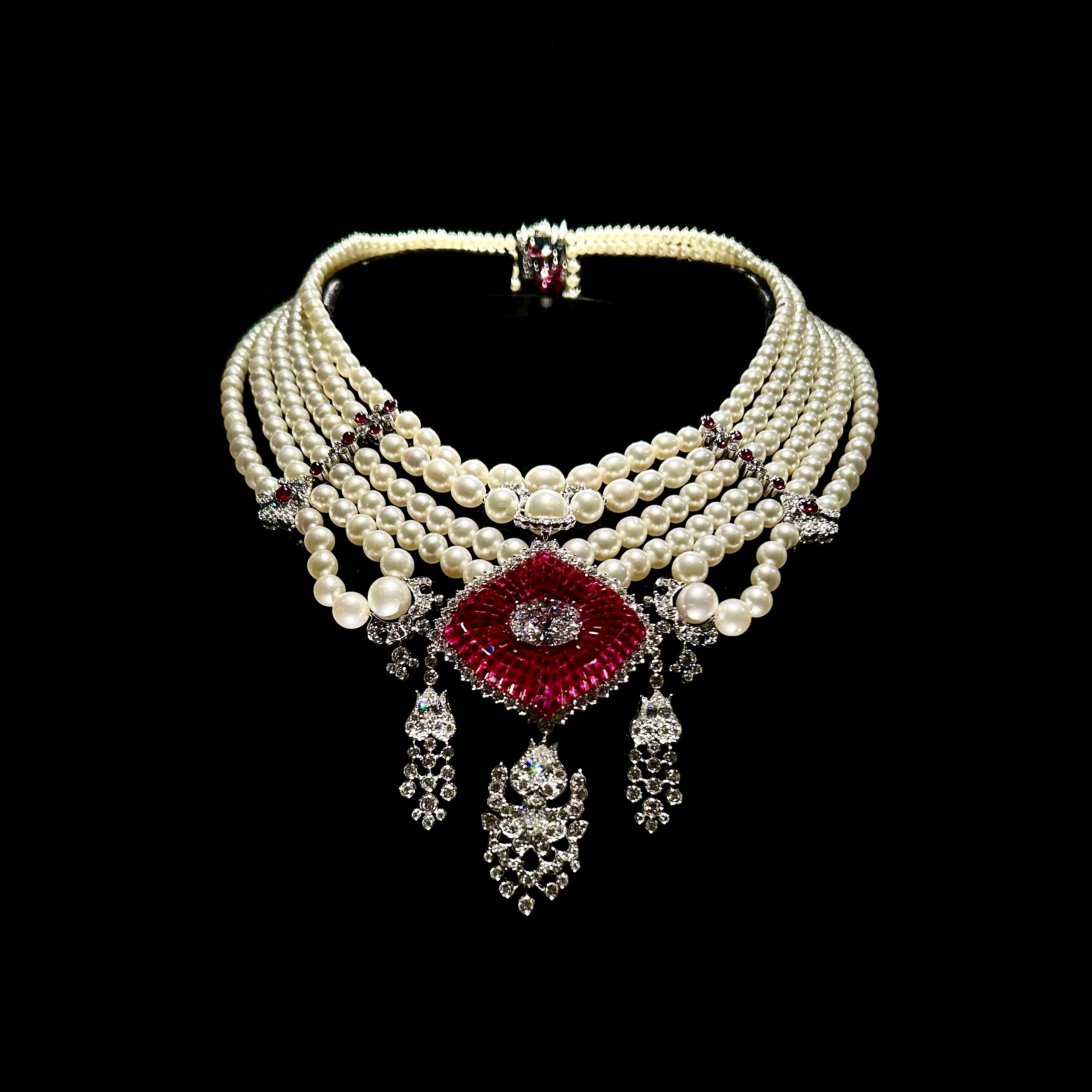
The exhibition “Paris, City of Pearls” proposed by the Parisian School of Jewelry Arts (L’École des Arts Joailliers) until June 1, 2025 presents a hundred pieces of jewelry from the collections of the museum of Decorative Arts, Albion Art, the Petit Palais museum, Cartier, Fred and Van Cleef & Arpels.
Van Cleef & Arpels’ participation is even broader since the School of Jewelry Arts, which aims to spread jewelry culture throughout the world by offering courses, conferences and temporary exhibitions, was founded by the Parisian jewelry house. Building on its success, the School of Jewelry Arts moved to a bigger space in 2024, within the Mercy-Argenteau mansion, an 18th-century townhouse.
The exhibition “Paris, City of Pearls” traces the history of the intense pearl trade in the 19th century, between the Arabian-Persian Gulf and France.
Lacking an understanding of the pearl creation process, humanity has long seen it as a sign of divine intervention. Named “Aphrodite’s tear” by ancient Greece, it was considered in ancient Rome as a symbol of wealth and power held by the richest Roman families, who bought one to two pearls per year for their daughter, who was offered a pearl necklace when she reached her majority.
A symbol of power that invaded Catholic churches as well as royal courts, the pearl experienced its golden age in Europe in the 16th-18th centuries.
In Paris, the pearl was closely associated in the second half of the 19th century with orientalist aesthetics. Since the end of the 1860s, the majority of pearls fished in the Arabian-Persian Gulf were gradually transported to Paris, where they were then pierced and then strung or mounted by the most prestigious jewelry houses on Rue de la Paix and Place Vendôme.
Inspired by Far Eastern forms and nature, Art Nouveau seized upon the pearl and was interested in its most baroque varieties.
The 1910s were marked by the explosion of the Parisian pearl market. The Rosenthal brothers were the very first Parisian merchants to go to Bahrain, reigning supreme over the region until the arrival of the jeweler Jacques Cartier in 1912, who was welcomed as a true dignitary.
While the value of pearls in France has never been higher, it is in the US that the demand for pearls was strongest. In 1917, Pierre Cartier obtained his New York mansion on 5th Avenue in exchange for a necklace of two rows of 65 and 73 pearls.
After WWI, the pearl frenzy continued in Paris. While some merchants found themselves at the head of real commercial empires, new players emerged, attracted by the insolent boom of a market that nothing seemed able to shake.
A true symbol of the Roaring Twenties, the pearl never ceased to inspire all Parisian jewelers but also artists in the broad sense: from opera to literature, music and painting, all seemed to be affected by the same pearlmania.
The international exhibition of modern decorative and industrial arts organized in Paris in 1925, revived the pearlmania that was then feverish in Paris.
Initiated by the economic crisis of 1929, the twilight of the Parisian reign of the pearl would truly come with WWII and the deportation of Jewish merchants from rue La Fayette in paris. WWII harshly impacted the pearl trade between France and the Gulf. Many French merchants then redirected their activities towards cultured pearls.

Mellerio – 1865

Froment-Meurice – 1870


Vever – 1900


1920

Van Cleef & Arpels – 1924

1925

Van Cleef & Arpels – 2011

Van Cleef & Arpels – 1930 – Templier – 1936

Dusausoy – 1930

1890

Cartier – 1907

Templier – 1900
May 9, 2025
