
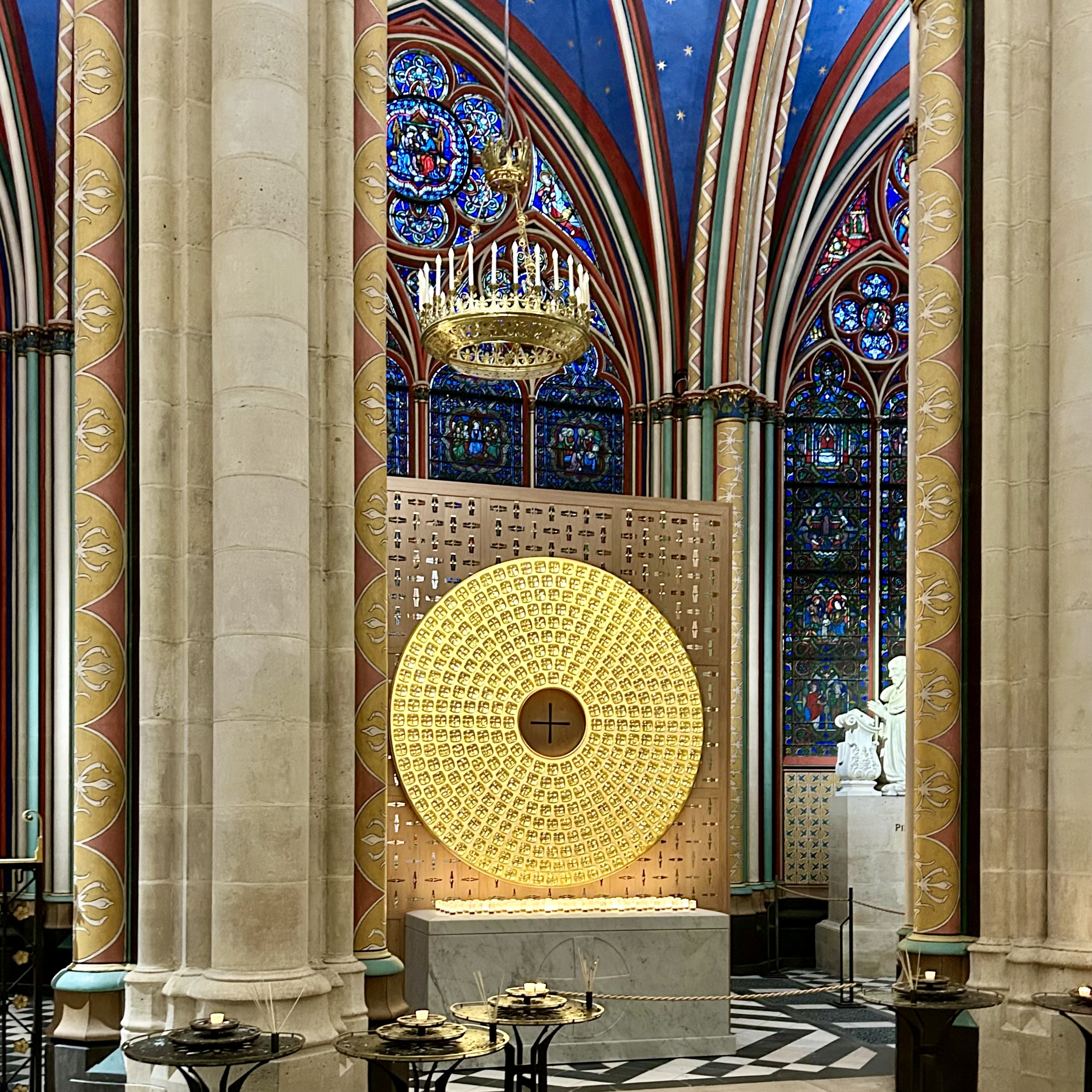
Notre-Dame de Paris, as we know, has come a long way. Ravaged by a violent fire on April 15, 2019, the building lost that night its immense medieval oak roof nicknamed “the forest,” its lead roof and its 96-meter spire which, as it collapsed, destroyed the vault of the transept. The damage was colossal, yet the structure itself resisted. While the fire was not yet completely extinguished, the French President of the Republic evoked the restoration the cathedral and appointed on April 17, 2019 the very competent General Jean-Louis Georgelin, former Chief of Staff of the Armed Forces who died in 2023 without seeing the happy result of his involvement – promising a reopening of the building in 2024.
The project brought together more than 250 companies and donations amounting to more than 846 million euros were collected thanks to a national subscription.
The first phase of the restoration project, dedicated to securing and consolidating the monument, began just after the fire and took place in an apocalyptic setting: the scaffolding that was being installed at the time of the fire to restore the spire was partly melted and threatened to collapse and take with it what remained of the cathedral.
The principle of an identical restoration was established, and the reconstruction project favored a reconstruction of the cathedral in its last complete, coherent and known state and an identical restitution of the oak roofs in their 19th century state for the transept and the spire, and in their medieval state for the nave and the choir.
Work on the building began during the Summer of 2022, with the reconstruction of the collapsed vaults and the consolidation of the weakened masonry. The following year, the medieval ook roof – the famous forest – was rebuilt identically in oak. In December 2023, the spire stood again at a height of 96 meters. In 2024, the vault of the transept crossing was completed. In November 2024, the eight bells of the North belfry were reinstalled after being cleaned.
During these five years of restoration, another project was carried out, that of the collections. The statues and sculpted decorations were repaired. As for the stained-glass windows, they were miraculously spared, which did not prevent them from being cleaned by the master glassmakers. The restoration of the wall decorations allowed to find golden fleur-de-lys motifs dating from the Middle Ages, previously unknown.
Reopened for worship and visits on December 8, 2024, the cathedral regains the forgotten whiteness of its stone and is brighter and more colorful than it has ever been in modern times.
Some visitors have been offended on social media by the brightness and shimmering colors of the cathedral’s interior, regretting a tasteless modernity that is not conducive to spiritual contemplation.
This is to forget a little too quickly that Notre-Dame, which was built in the 12th century and then modified in the 18th century, was restored – thanks to the renewed enthusiasm for the building by Victor Hugo’s novel – between 1845 and 1867 by Eugène Viollet-Leduc during a restoration campaign that was itself very controversial at the time.
The Revolution had indeed left the cathedral in an advanced state of disrepair and Viollet-Leduc added a spire to the building that had not existed since the end of the 18th century, built a sacristy and incorporated new elements and motifs.
The South rose window was rotated fifteen degrees in order to consolidate the structure, whose masonry had collapsed.
A few statues from Viollet-Leduc’s imagination were built, such as the chimeras of Notre-Dame that contemplate Paris from the top of the façade.
13th century stained-glass windows destroyed under Louis XV by the canons who considered them too dark were “pastiched” by master glassmakers and placed at the level of the cathedral choir.
On the façade, Viollet-Leduc replaced the trumeau – the central pillar supporting the portal of the Last Judgement – which had been amputated to facilitate the passage of processions.
Viollet-Leduc’s work was long seen as a set of arbitrary and extravagant restorations and the expression “to do Viollet-le-Duc” has long had pejorative connotations. The Saint-Sernin Basilica in Toulouse, for example, was “de-restored” in 1996 to return to the state it was in before Viollet-Leduc’s restorations – but the reality is that his restorations often saved many buildings from ruin or collapse.
Today, Notre-Dame de Paris has probably regained the splendor it had in 1867. To be completely honest, it is neither the brightness nor the shimmering colors of the cathedral’s interior that prevent spiritual contemplation. It is rather the influx of the many tourists who wander around the worshippers, since visits are permitted during church services.
Editor’s note: Do not even try – at the time of writing – to book your visit ticket on the Notre-Dame website. No slots are available. The visit is free and it is better to go, without a ticket, very early in the morning or very late in the evening.


Reliquary shrine designed by architect and designer Sylvain Dubuisson for the Crown of Thorns


1,500 chairs were designed by Ionna Vautrin and produced by the manufacturer Bosc, in the Landes


The altar, the ambo, the cathedra, the tabernacle and the baptistery were designed in bronze by Guillaume Bardet


March 28, 2025
