
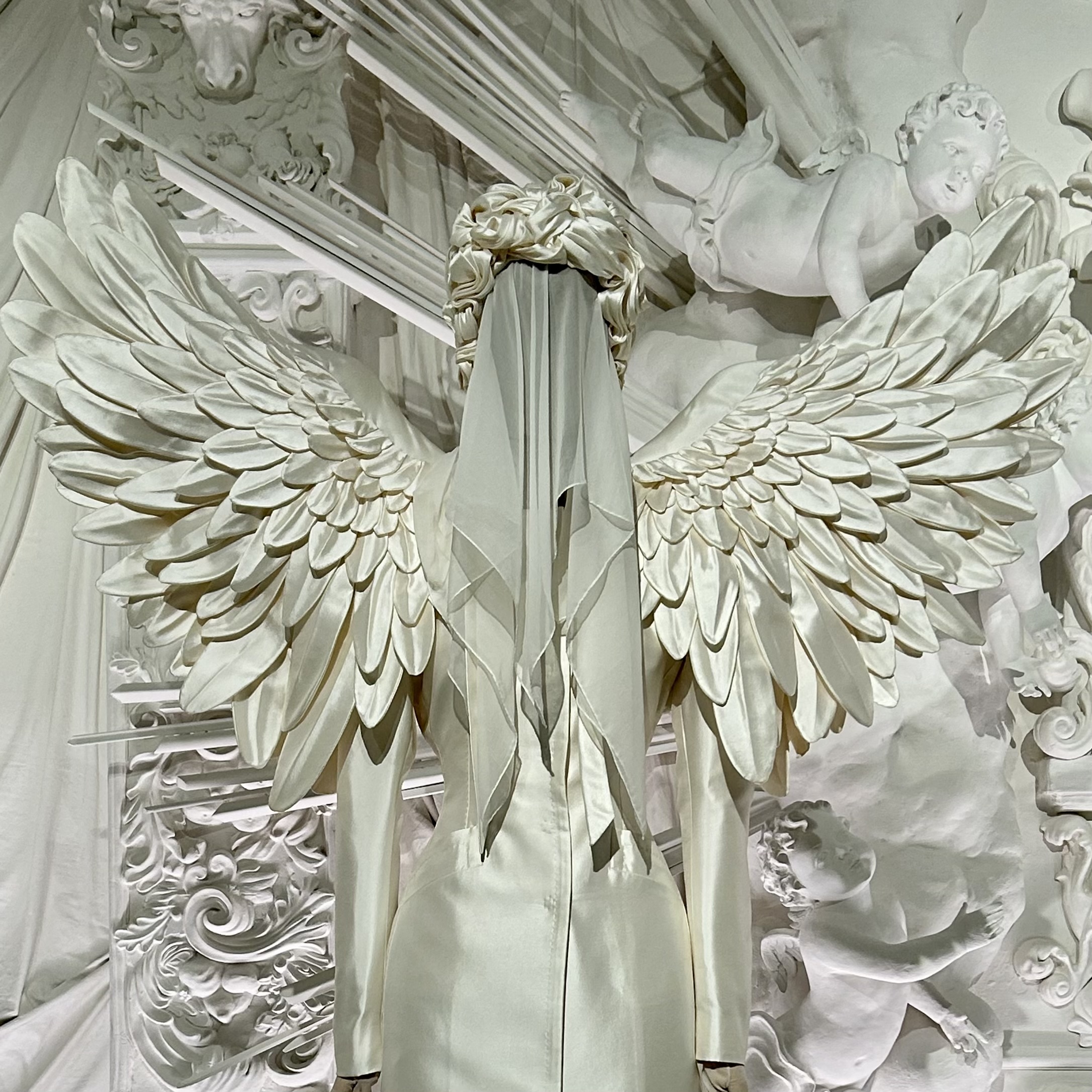
The travelling exhibition “From the Heart to the Hand: Dolce & Gabbana” presented at the Grand Palais until March 31, 2025, follows its immense success when it was launched at the Palazzo Reale in Milan. The two hundred and twenty haute couture pieces presented trace the Italian cultural and artistic influences that permeate the work of the two designers.
Each piece pays homage to a facet of Italian culture, whether it be architecture, art history, dance, opera, cinema or cuisine.
Born in 1983, Dolce & Gabbana celebrates the meeting of the Sicilian Domenico Dolce and the Milanese Stefano Gabbana. Although it was Dolce who grew up in a household focused on fashion – his father was a tailor and his mother sold fabric – it was Gabbana who taught him drawing and the functioning of the fashion industry. Their alliance was initially formed within a design consultancy studio and ended up with the creation of the house in 1985.
Their autumn-winter 1986 collection seduced fashion critics and investors. They drew their inspiration from Italian cinema and their favourite fabrics quickly became lace and silk, which are still the case to this date.
Their creative identity is more due to the exuberant and opulent heritage of the Sicilian Dolce than to the demure elegance of Milan. In fact, Sicily irrigates their creations, like lemons or majolica ceramics. Their detractors consider that Dolce & Gabbana constantly plays on the archetypes of a dreamlike Italy, dolce vita, farniente and a callipygian and desirable Italian woman – which is not totally untrue.
It is often decadent – like them, who are used to controversy.
The two designers were sentenced in June 2013 for tax fraud, for an amount estimated at nearly one billion euros, to one year and eight months in prison and a fine of 500,000 euros. In response to this verdict, the designers closed all their Milan boutiques for three days, displaying “Closed for indignation” on their storefronts. They were finally sentenced on appeal to 18 months in prison and a fine of 500,000 euros.
Their 2018 advertising campaign was a tad racist, since it featured a Chinese model clumsily trying to eat a pizza and a cannolo with baguettes, accompanied by a salacious male voiceover. The reactions were virulent and Dolce & Gabbana took several years to come back to the Chinese market that had closed its doors following the scandal.
Should we separate the man from the artist, as the now famous formula requires? No, on the contrary: one must know how to marvel at creative beauty while remaining perfectly aware of what may lie behind it.


March 14, 2025
