
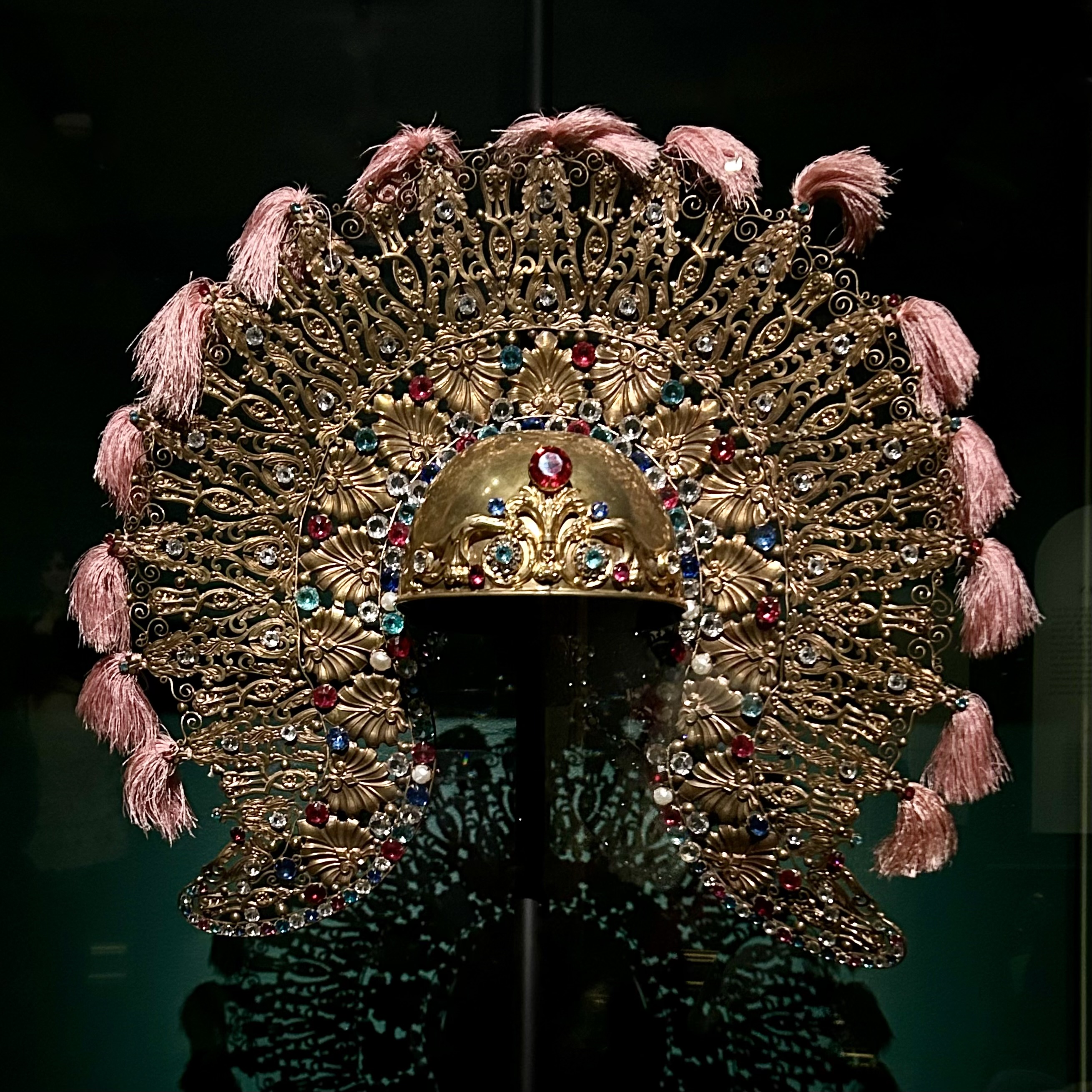
“Scintille, diamant, miroir où se prise l’alouette” – “Glitter, diamond, mirror that catches the lark”: this line from Offenbach’s “Tales of Hoffmann” perfectly reflects the deceptive fascination that jewelry exerts, and this is the whole point of the exhibition organized by the Paris Opera and the French National Library the BNF, until March 28, 2025.
The fascination is doubly deceptive when it comes to stage jewelry since their very function is to give the illusion of reality.
Stage jewelry contributes, along with makeup, costumes, wigs and accessories, to the transformation of the artist into a character. Just like makeup, stage jewelry is often exaggerated and larger than life so that it can be seen from afar – that is, from the last row where the spectator will be taken in by the shimmering stones.
In the 19th century, the Paris Opera creates internal “costume decoration” departments that make stage jewelry. The know-how of these workshops adapts to the constraints of singing and dancing and transform the most ordinary glass beads into shimmering diamonds.
It was not always like this. The revolution took more than a century to see the artists going on stage with their own jewelry to disappear, sometimes in defiance of any dramatic adequacy. The reform of staging and costume was nevertheless underway and was supported by the Romantic movement, in search of historical accuracy. A second period saw the manufacture of stage jewelry by renowned Parisian jewelers who gave these fakes jewels the same finish as for real pieces of jewelry. With the construction of the Opéra Garnier house in the second half of the 19th century, the Second Empire wanted its own workshops and spared no expense in showcasing the institution and attracting the wealthy subscribers to the new Opéra. For each production, the sets had to be new, as did the costumes, and the element of surprise had to be accompanied by dazzlement and strong emotions.
Jewelry served the prestige of the institution, but it also served that of the artists, and the divas in particular, who were painted or photographed in their spectacular finery.
Ah, I laugh to see myself so beautiful in this mirror!“
“Faust” by Charles Gounod but also “Tintin” by Hergé and his ineffable Castafiore
At a time when surtitles did not exist, it was crucial that the spectator immediately understood the action and the position of the characters. Jewels have always been clues given to the spectator about the role, the social status, or the motivation of this or that character.
But jewels are sometimes the theatrical plot of the show itself: often objects of temptation, they precipitate certain heroines towards their fatal fate. This is the case of Marguerite who succumbs to Mephistopheles because of a box of jewels in Gounod’s “Faust” or Manon in the opera of the same name by Massenet – she flees the convent for a life of pleasure (male heroes are not left out if we refer to Wagner’s “The Ring of the Nibelung” where the coveted gold ring symbolizes wealth certainly, but above power or even to Delibes’ “Lakmé” where the jewel represents in the eyes of man a quest for an ideal).
Those who resist are rare: Bizet’s Carmen wants only love and freedom and throws in Don José’s face the ring he had given her.
Jewelry is sometimes the main theme of the show and in the case of “Jewels”, the ballet created by Balanchine, the harmful effect of the jewels being absolutely conjured away to remain only sublime.

La Bayadère – 1992

L’Histoire de Manon – 2023

La Walkyrie – 1893

La Walkyrie – 1893

Bacchus – 1909

Boris Goudounov – 1908

Le Roi d’Ys – 1941

Esclarmonde – 1889

Cendrillon – 1899

Salomé – 1926

Salomé – 1926

Le Grand Mogol – 1895

Le Fils de l’Étoile – 1904

Boris Goudonov – 1984

Boris Goudonov – 1984

La Bayadère – 1992
January 31, 2025
