
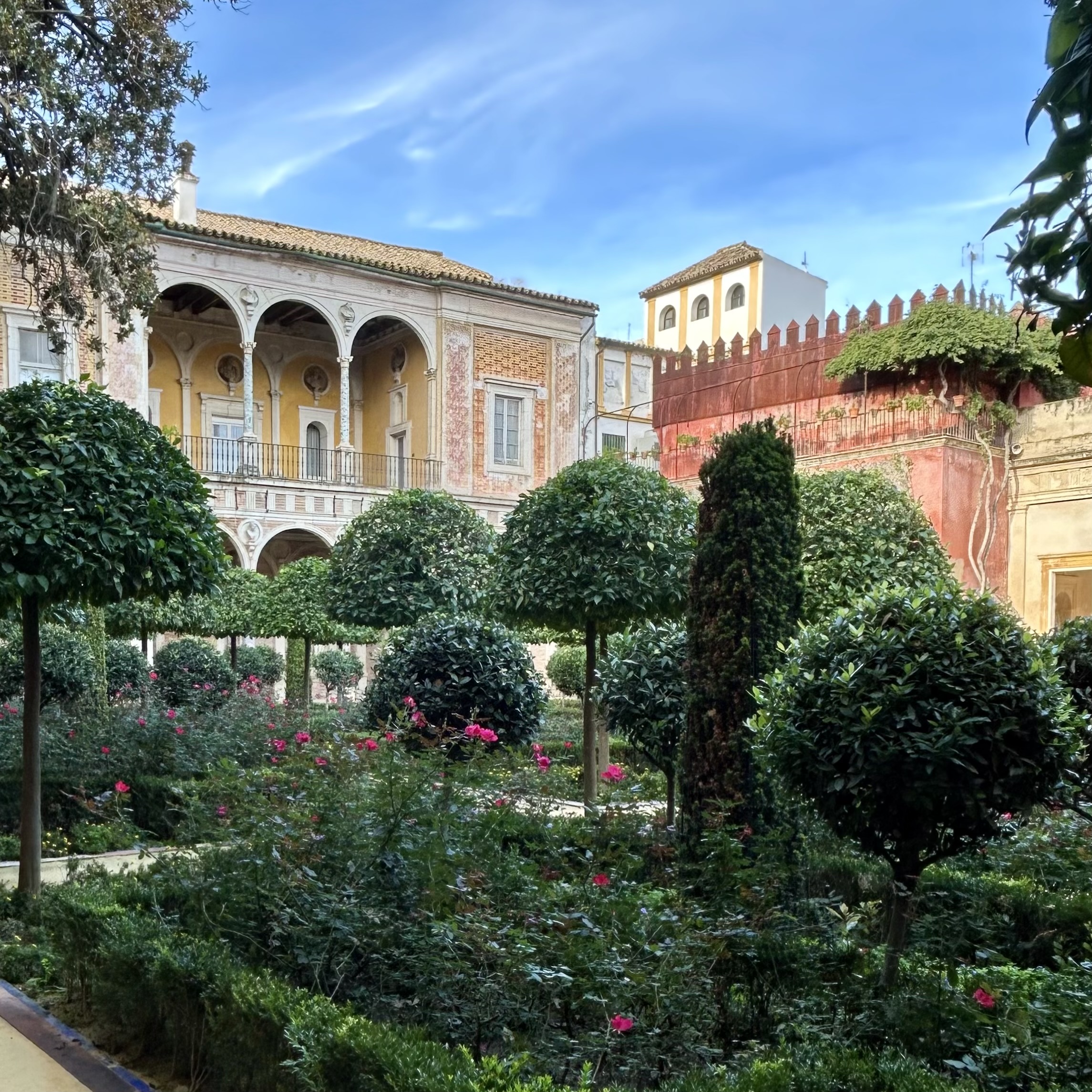
The Casa de Pilatos is a beautiful aristocratic palace from the 15th and 16th centuries, nestled in the middle of the old Jewish quarter of Seville. The name of the house, which may come as a surprise since it translates as “Pilate’s house” and has nothing to do with the name of the historical owners, the Enríquez-Ribera, refers to a trip to Jerusalem by Fadrique Enríquez, who is said to have reproduced Pilate’s palace in the Holy City in Seville.
As always in Andalusian architecture, the austerity of the exterior walls gives no hint of the extreme refinement of the interior spaces. Built around several patios, the Casa de Pilatos harmoniously combines Mudejar, Gothic and Renaissance styles, so much so that many see it as the very prototype of the Sevillian palace.
At the end of the 15th century, the city of Seville experiences considerable development: ideally located on the estuary of the Guadalquivir River, the city becomes the exclusive port for trade with the New World, which opens up prospects for phenomenal enrichment for Spain. Among the Andalusian aristocracy, the adelantado mayor enjoys a privileged position since he is the King’s representative in the region. Don Pedro Enríquez becomes adelantado mayor when he marries Catalina de Ribera in 1474. The couple begins to build a noble residence on a land located within the city’s fortified walls. The palace is at that time known only as the Palacio de la collación de San Esteban.
The fierce desire to acquire land led by Pedro Enríquez and Catalina de Ribera explains, in an area that is already strongly urbanized, the formidable extension of the palace, to the point that the surface area of the residence makes it the second residential complex in the city, after the Alcázar. The death of Pedro Enríquez in 1492 does not slow down the expansion of the residence: Catalina de Ribera, who has become one of the most influential figures in the city, continues the construction of the palace and buys new plots. When she dies in 1505, the first phase of construction is completed, leaving a strong Gothic-Mudejar testimony.
The second phase of work, which is the most decisive, is led by the son of the Enríquez-Ribera couple, Fadrique Enríquez. He continues his parents’ expansionist policy by acquiring new plots. After a travel to the Holy Land via Italy between 1518 and 1520, he makes significant changes to the residence: the first Italianate additions, reflecting a transition from the Gothic and Mudejar styles to the Renaissance style, appear and the fountain, the first columns and the azulejos of the central patio are installed.
When Fadrique Enríquez dies – without an heir – the third phase of construction begins. His nephew Pedro Afán de Ribera devotes himself mainly to the gardens and the patio.
Although the palace has since undergone various modifications, its general layout and architecture have hardly been altered since then, knowing that the Casa de Pilatos has remained part of the heritage of the Enríquez-Ribera family and its descendants for more than five centuries.
Since 1980, the Casa Ducal Medinaceli Foundation has been responsible for protecting the historical and cultural heritage of the palace complex, which was declared a national monument in 1931.

In 1490, Pedro Enríquez and Catalina de Ribera make a new acquisition of land around the original property. This time, the land is not used to enlarge the residence, but to open an esplanade in front of the main door of the palace, in order to give perspective to the façade. The walls are still austere – as per the Muslim tradition of reserving wealth for the interiors – but the monumental wooden door and the sculpted marble portal are built in Genoa between 1529 and 1535.

The main patio is the heart of the palace and provides access to the residential areas. The patio is Renaissance in style in its composition, however, it has remarkable Mudejar and Gothic elements.
Around the central patio run two series of arches spread over two levels, each opening onto a gallery providing access to the rooms.
The first level of arcades completely surrounds the patio. The second level of arcades, on the upper floor, only surrounds three sides of the patio. An openwork Gothic-style balustrade runs the length of this second level.
In the centre of the patio, paved with marble slabs, stands an Italianate marble fountain with a double basin. Two statues of Athena adorn the corners of the patio.
The walls of the patio’s galleries are decorated with remarkable azulejos.


Like most Andalusian residences of this type, the Casa de Pilatos has gardens. These reveal a rather intimate conception of green spaces, and serve as a setting for varied plant species.
The large garden is the largest and oldest. Despite some alterations made in the 1850s, it largely retains its original appearance. Organized around a fountain, it is dominated by a gallery and a loggia.


The small garden is much more recent.


The staircase, built at the time of Fadrique Enríquez, structures the residence and its dual use: the rooms on the ground floor are dedicated to public activities, those on the first floor are reserved for private activities. The originality of this monumental staircase lies in the association of a wide variety of azulejos in very diverse colors.

Rejecting the Muslim tradition of single-storey buildings, the original project by Pedro Enríquez and Catalina de Ribera includes a first floor dedicated to private activities. Enlarged and redecorated between 1526 and 1539, the first floor responds to the new comfort needs of the Sevillan nobility.


The Tower’s room


The dining room


The smoking room


A first living room


The loggia overlooking the small garden

A second living room

The fresco room


The upper level gallery
The perfect and refined alliance of Mudejar, Gothic and Renaissance styles that runs throughout the Casa de Pilatos makes it an architectural and decorative ensemble of great splendor.
October 25, 2024
