
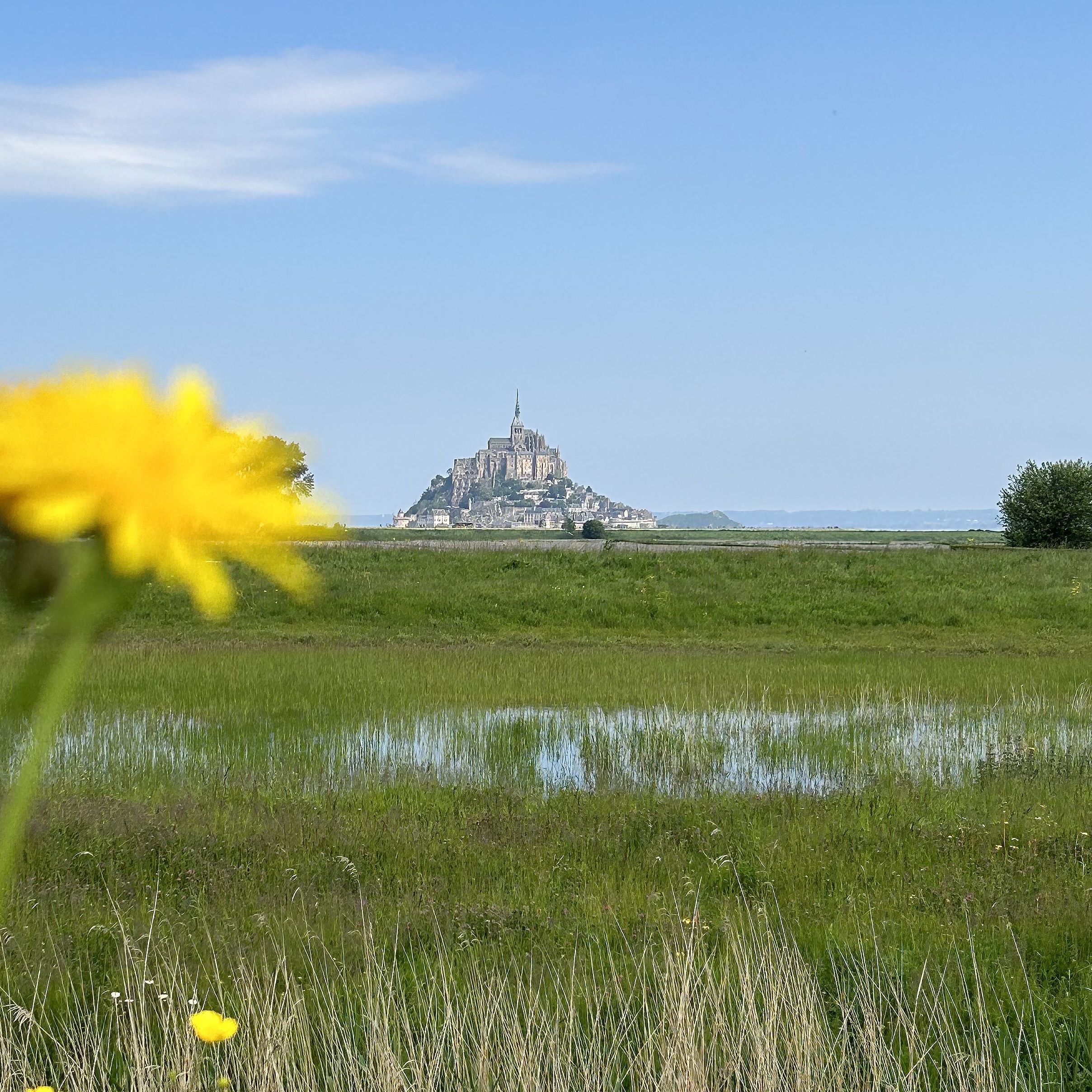
“The Couesnon river in its madness put the Mount in Normandy. And when the Couesnon river regains its sanity, the Mount will become Breton again”.
The Breton proverb is beautiful but the belonging of Mont-Saint-Michel to one or the other of the two regions according to the geographical changes of direction of the Couesnon river has no basis, the Mont having always been Norman.
The history of Mont-Saint-Michel begins around the year 708 when the bishop of Avranches, Aubert, builds a sanctuary in honor of the archangel Saint Michael. Mont-Saint-Michel quickly becomes a major place of pilgrimage.
In the 10th century, the Benedictines settle in the abbey while the village, which offer board and lodging to the pilgrims, develops in the shadow of the abbey, until reaching the foot of the rock during the 14th century.
A fortified place, Mont-Saint-Michel proves impregnable during the Hundred Years’ War and its ramparts resist English assaults.
After the dissolution of the religious community during the French Revolution, the abbey is used as a prison until 1863 and this is probably what saves it from destruction or sale as national property.
Becoming a historic monument under Napoleon III in 1874, the abbey is the subject of several restoration campaigns and the disciples of architect Viollet-Le-Duc install the spire which crowns the Mount in 1899.
Listed as a UNESCO World Heritage Site since 1979, Mont-Saint-Michel today suffers from its success and overtourism. The Grand-Rue – the main street – must absolutely be avoided: the houses, which have a medieval air, date mostly from the end of the 19th/beginning of the 20th century and the numerous poor-quality shops are named by connoisseurs as Temple merchants.
The maritime museum and the historical museum must be avoided in the same way: they are private establishments, expensive and of poor quality.
Successive mayors Patrick Gaulois and Éric Vannier both have significant commercial interests on the Mount and it shows. La Mère Poulard, which belongs to Éric Vannier, has made creamy omelettes a local specialty that can be avoided. My Norman grandmother, who worked there during the Occupation period, spat in the omelettes when she knew they were served to Germans soldiers.
Anyway. It is important to quickly leave the Grand-Rue to take the stairs which lead to the cemetery and the abbey. Once up there, the place is absolutely beautiful.


The spire was only added in 1899, giving the Mount its typical triangular appearance

Originally the only entrance to the village, the Porte du Roi (the King’s door) is built around 1415. Preceded by a drawbridge and a ditch filled with water during high tides, it is surmounted by the King’s dwelling, an apartment which served as accommodation for the officer representing the royal power and charged by the sovereign with guarding the entrance to the village. The rectangular frame above the door was formerly decorated with a now faded relief, which represented the coat of arms of the king, the abbey and the city


The cemetery


The abbey is a unique monument: its plan cannot be compared to any other monastery since, taking into account the pyramidal shape of the Mount, the architects of the Middle Ages wrapped the buildings around the rock. The abbey rests on lower crypts which create a platform ensuring the stability of the whole building. Outside, the buttresses are powerful and the buildings become lighter and lighter as you progress towards the summit


The abbey church


The wonderful cloister. Suspended between land, air and sea, it is par excellence the place of meditation for monks and at certain times had a box garden in its middle


The Crypt of the Big Pillars. It is built to support the choir of the abbey church, from 1446. The pillars are so close together that they seem to touch each other and this room is probably not a place of worship, rather a place of waiting of the abbey’s litigants


The gardens of the abbey


Purchasing a guide is imperative to visit the place, whose history is incredibly rich. Once cleared of tourists, the Wonder of the West is a magical place, which combines the beauty of an absolutely exceptional natural space with wildly daring architecture.
July 19, 2024
