
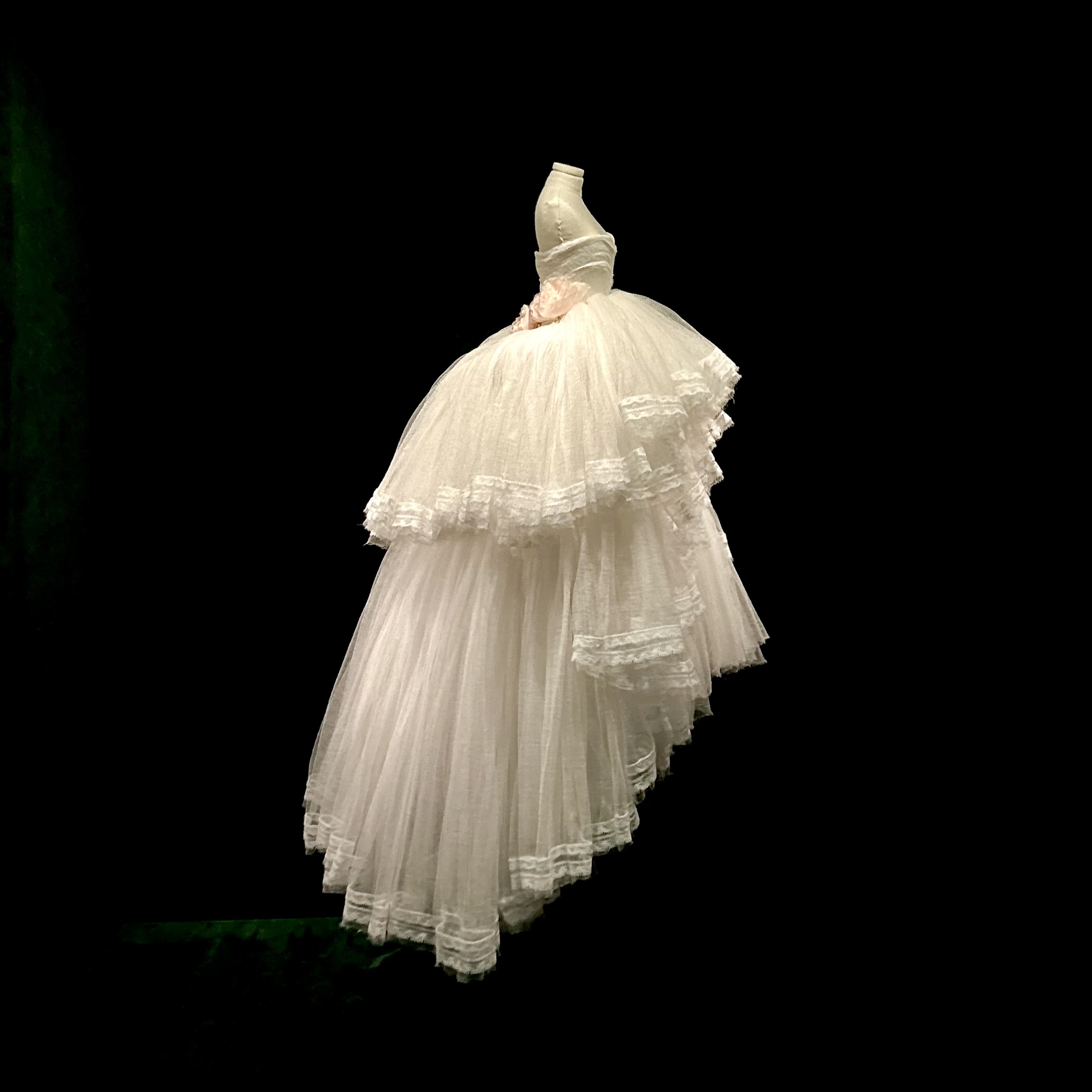
We already mentioned here the childhood of Christian Dior and the Rhumbs villa in Granville, in which he grew up and which has always been an immense source of creative inspiration.
To conclude this series of articles dedicated to Christian Dior and his sister Catherine, the journey continues in Paris, 30 avenue Montaigne, where the couturier has continually brought to life inspirations imbued with nostalgia.
The Dior fashion house could never have seen the light of day: Christian Dior by chance becomes aware of the project of Marcel Boussac, a French textile tycoon, who is looking for a stylist to revive the Philippe et Gaston fashion house.
Christian Dior’s idea is instead to ask for Marcel Boussac’s financial support for the creation of his own fashion house. On the way to the meeting, Christian Dior stumbles in the street and sees a metal trinket in the shape of a star on the sidewalk and puts it in his pocket.
The meeting is a success: the Philippe and Gaston house will never see the light of day again, but the Dior house is inaugurated at 30 avenue Montaigne a few months later, on December 16, 1946.
And the star, which a very superstitious Christian Dior sees as a talisman (as a child, a fortune teller predicted to him that his future success would be ensured by women), will be a recurring motif in his haute couture and jewelry collections.
30 avenue Montaigne initially has nothing to do with the huge corner building that we know today.
This is the small private mansion which is adjacent to it, and which lives to the rhythm of two “flou” workshops and the “tailor” workshop.
In haute couture, the workshops are of two types: the “flou” brings together fluid models made in light fabrics, the “tailor” is dedicated to suits and coats. The workshops are very hierarchical: each workshop may bring together thirty workers, but only has three sewing machines and is made up of a “first”, two “seconds”, qualified “first hands”, “second qualified hands”, “beginner second hands”, “small hands” and, finally, apprentices.
It is well-known, success is immediately here for Dior: the presentation, on February 12, 1947, of the “Corolle”, “En Huit” collections and the Bar suit leads to the birth of the New Look.


The Bar suit, presented on February 12, 1947, marks the return of ultra-femininity after the years of wartime austerity. Composed of an ivory shantung jacket fastened with five buttons, with a narrowed waist and pronounced hips and a wide pleated black woolen skirt, it is made by workshop leader Pierre Cardin. The Bar suit will subsequently be constantly reinterpreted by the six successors of Christian Dior
The immense staircase is the backbone of this haute-couture house, overwehled by its huge success and which struggles to properly welcome all the guests, journalists and buyers on show days. They sit on the steps of the stairs!


But long before the collection is presented, the master’s creative process is immutable. Christian Dior retreats to his country house in Milly-la-Forêt to design his collection, two months before its presentation. Brought back to Avenue Montaigne, the sketches are rejected or approved.


A canvas is soon created and presented to Christian Dior on two or three mannequins.


At the same time, the collection charter is made up of large paper sheets. The chart has a limited number of sections for a specific number of day dresses, suits, coats or evening dresses and it also allows to have an overview of the collection.
The fabric in which the model will be made is chosen, as well as the model who will wear it during the fashion show.
The first fittings begin. The model, worn by the chosen model, is presented to Christian Dior, who examines it through the large mirror which adorns the studio. The dress is adjusted, retouched and modified and leaves, clad in pins, for the workshop.
Three days before the show, the dress rehearsal is held, which includes the jewelry and accessories.
The collections are presented in the ceremonial rooms lit to reproduce the conditions in which the dresses would be worn.

Following the frenzy of the presentation, during which customers, journalists and buyers are invited, comes the sales.
The models are made to measure, on mannequins adapted to the measurements of each client, who will have to come for three fittings before the final creation of her dress.
Fashion being nothing but renewal, the models are either offered to models at very exceptional conditions, or sold at a discount to certain customers, six months after their presentation.
A trinket shop, adorned with “toile de Jouy” fabric – very French, very Marie-Antoinette – proposes a large choice of jewelry, scarves and small objects selected by Carmen Colle, who will soon have other ambitions.
As early as the summer of 1948, Carmen suggested adding little dresses which, while respecting the general line of the collection, would be simpler and more modest.”
Christian Dior in “Christian Dior and me”, 1956
The success is such that Christian Dior imagines a “boutique” line.
The expansion of the Dior house leads to the closure of the trinkets boutique, which is replaced in June 1955 by a larger boutique at 15 rue François Ier. The style of the new “Louis-XVI-Belle Époque” boutique is that desired by Christian Dior, for whom the Belle Époque during which his mother Madeleine shined, has always been an immense source of inspiration. The gray which adorns the armchairs inevitably recalls the gray of the gravel of the Rhumbs villa, while the faded pink, a recurring color of the collections, recalls that of the villa.

The inauguration of the boutique on rue François Ier offers twenty-two shades of lipstick.
The Christian Dior Parfums company is created on March 4, 1947 and the Miss Dior perfume is launched in December of the same year.
Custom-made shoes are made by Roger Vivier, who first works for the “Christian Dior Delman” company, then for the “Christian Dior company by Roger Vivier”.
International subsidiaries and branches are multiplying in New York, Caracas and London. The models, adapted to the tastes of the client and the local weather, are created by Christian Dior but are executed by local workshops.
Licensing agreements are multiplying in Canada, Mexico, Australia and Japan, where exclusive contracts are signed with department stores or local manufacturers.
From 1950, the Dior house alone represents nearly 50% of French haute couture exports.
Christian Dior receives the Legion of Honor and publishes his first book “Talking about Fashion” in 1951, followed by “Christian Dior and I” (or “Dior by Dior”) in 1956.
On the eve of his death on October 24, 1957, Christian Dior realized his dream of dressing women from head to toe, whether in hats, clothes, jewelry, scarves, perfume, lipstick or even… stockings.
His latest collection is created with his first assistant, Yves Saint Laurent, who succeeds him at the head of the fashion house, in accordance with the master’s wishes.
Marc Bohan, Gianfranco Ferré, John Galliano, Raf Simons and Maria Grazia Chiuri will in turn take over the reins of the house. Victoire de Castellane, for jewelry, will continue to bring to life the flower-jewelry and star-jewelry so dear to the heart of Christian Dior.
Catwalk models were rarely kept by haute couture houses for their archives – unlike today – yet the Dior Gallery, which opened in 2022, has managed to bring together magnificent pieces, old and recent.


June 28, 2024
