
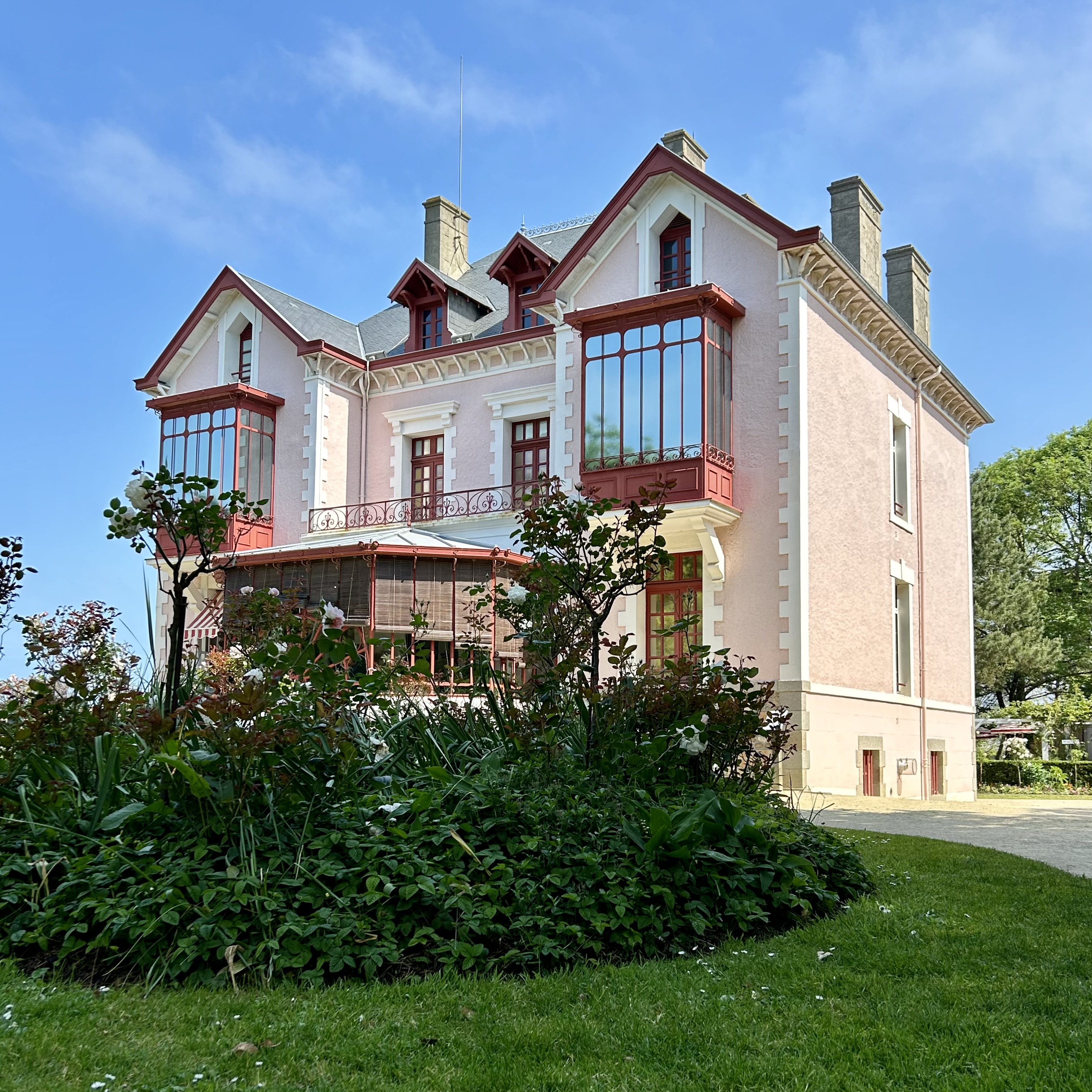
The villa Les Rhumbs, which takes its name from the thirty-two points of the compass rose, is a beautiful pink Belle-Époque building which overlooks one of the cliffs of Granville in Normandy, France.


It is today the Christian Dior museum, since the French fashion designer, who was born in 1905 in Granville, grew up there with his brothers and sisters.

Painted in a very soft pink, mixed with gray gravel, its two colors have remained my favorite hues in couture.”
Christian Dior, in “Christian Dior et moi”, published in 1956, a year before his death

His mother Madeleine and his father Maurice belong to the upper bourgeoisie of Grandville: the education is strict, the children are surrounded by a large household staff. Maurice inherited the fertilizer factory founded by his grandfather in 1832 (“Dior fertilizer is gold!”) and his three boys are destined to do the same.

We know Christian’s fate and he will be far away from the scent of guano.
His brothers Raymond, born in 1899, and Bernard, born in 1910, soon suffer from mental health problems. Raymond returns from the battlefields of WWI in a state of shock and gradually moves away from his family. Bernard gradually shows signs of dementia.
Madeleine is constantly arranging the park and the flower beds – with particular attention paid to the roses which she prefers above all.

A remarkable botanist, very knowledgeable about the climate and soil of Granville, Madeleine tames the wild nature of a very unwelcoming and windswept coast. The rocky ground is made fertile by tons of soil and walls of conifers are planted to protect the flowers from bad weather.


Is it through the much-loved garden that her sensitive children attempt to establish a relationship with a cold mother passionate about botany? We will never know, but this landscape vision will have a major influence on Christian Dior: there are more than fifty models bearing the name of a rose in his collections.

And after all, isn’t the “New Look” a sublime and nostalgic reinterpretation of the Belle-Époque dresses worn by the slender Madeleine?


Scented memories are not left out. Roses and lilies of the valley will serve as the base for Miss Dior and Diorissimo perfumes.


At the age of six, Christian moves with his family to Paris but he stays every Summer and throughout WWI at the Rhumbs villa, developing a passion for botany, drawing the pergola and developing what would much later be the Christian Dior Garden.


In 1931, Madeleine dies, she is 51 years old, probably crippled with grief over the state of dementia of her son Bernard, and Maurice is soon ruined by bad business decisions. Bernard is interned in 1933 and the splendor of the Dior family is no more.
Christian Dior, who sets up an avant-garde art gallery in Paris, sees his business quickly decline. His little sister Catherine follows their father, who flees far from a Granville which was the scene of his success to a remote farm in Provence – before joining Christian who lives a bohemian life in Paris, wandering from sofa to sofa when his friends welcome him for the night.
He draws fashion sketches and soon manages to support his younger sister and his father. He moves in with Catherine. Of the siblings, they will be the only two to remain close.
In the meantime, the Rhumbs villa is bought by the town of Granville, which plans to raze the building, but the project is fortunately abandoned and a public garden is inaugurated there in 1938.
In Paris, supported by a few artist friends, Christian Dior creates theater and cinema costumes and besieges major fashion houses in order to see his sketches accepted. He is hired in 1938 by the great fashion designer Robert Piguet as a model maker. He designs a black and white houndstooth suit which is a resounding success.
But WWII extinguishes the country and the hopes of the young model maker, who works as a farm worker.
He returns to Paris in 1942 as a stylist assistant at Lucien Lelong’s.
Catherine, involved in the Resistance, is arrested and deported to Ravensbrück in 1944 but is fortunately freed in 1945.
In 1946, Christian accidentally hears about Marcel Boussac’s project, nicknamed “the king of cotton”, who wants to relaunch the Philippe et Gaston fashion house and who is looking for a stylist.
Christian Dior instead asks Boussac to financially support the creation of his own fashion house. The Philippe and Gaston house may never see the light of day again, but the Dior house is inaugurated at 30 avenue Montaigne, Paris on December 16, 1946 and on February 12, 1947, the New Look collection is presented to the world. The rest is history.


Christian gains a lot from the alliance with Boussac but Boussac, who sells fabric, even more: it used to take three meters of fabric to make a dress, it now takes twenty to make a Dior dress.
It’s quite a revolution, dear Christian! Your dresses are wonderful, they have such a new look!”
Carmel Snow, editor-in-chief of Harper Bazaar’s
At the end of WWII, Christian Dior perfectly understood the desire of women to be feminine again: the waists are marked, the breasts plump and the full skirts twirl around the hips.


In eleven years of career, his success extends to fifteen countries and ensures the employment of more than two thousand people.
No Dior, no Dietrich”
Marlène Dietrich in 1949, to Alfred Hitchcock who considered her for “The Great Alibi”
Christian Dior dies in 1957, at age 52, after presenting a final collection designed with a young assistant with obvious talent… Yves Saint-Laurent.
Catherine will never stop preserving the artistic legacy of her older brother, a generous, funny and secretive man, who became a French monument after the war. When Christian Dior dies, his house represents more than half of French couture exports.
Catherine’s involvement will be decisive in the creation of the Granville museum, which will see the light of day in the 1990s. Thanks to her memories, the gardens and the Winter garden, where the ghost of Madeleine hangs out as much as that of Christian, will return to their original state and she will never stop corresponding with the museum curators.


The house of my childhood […] I keep the most tender and amazed memories of it. What did I just say? My life, my style owe almost everything to its location and its architecture.”
Christian Dior, in “Christian Dior and I”, published in 1956, a year before his death


Christian Dior Museum – Granville
June 14, 2024
