
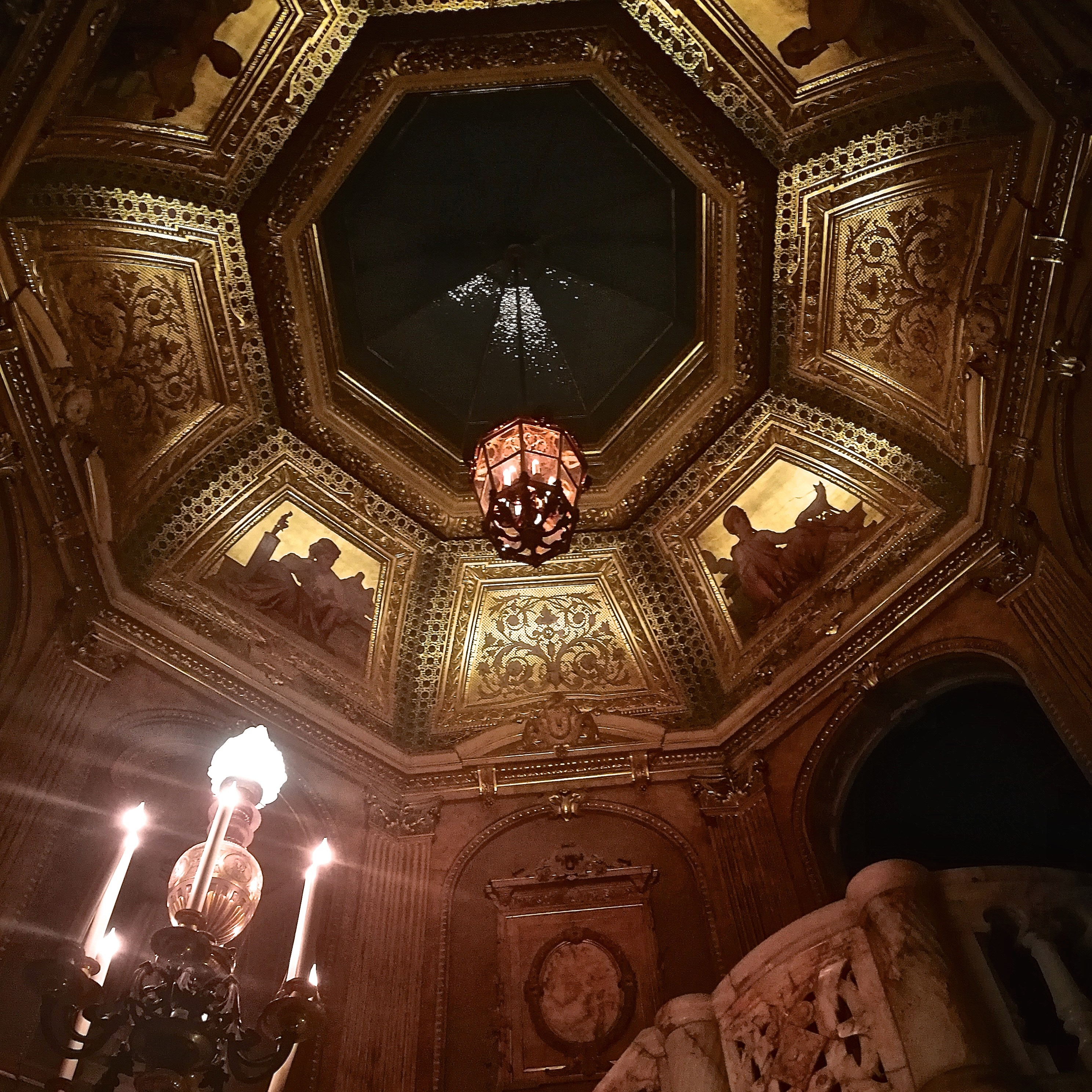
The Païva hotel is a Parisian townhouse built between 1856 and 1866 on the Champs-Elysées avenue. Its owner was a famous courtesan, Esther Lachman, better know under the exotic name “la Païva”.


The Music Room

The Salon des Griffons


The legend goes that the young and poor Esther was pushed out of a cab by a gentleman and left slightly injured. She then promised to herself to build a townhouse on the avenue where she fell.
But let’s return to the facts.
Esther is born in 1819 in the Jewish ghetto of Moscow. In 1836, she marries a French tailor living in Russia, Antoine Villoing, but within a year she runs away with a stranger, beginning a journey across Europe that leads her to Paris. She settles in the district of Notre-Dame-de-Lorette, where she becomes a lorette – that is to say, a prostitute. She becomes the mistress of a famous pianist, Henri Herz, who introduces her to the Parisian artistic circles, where she meets Liszt, Wagner, and Théophile Gautier.
Esther, who renamed herself Thérèse, becomes one of the most elegant women in Paris – and with reason, as she is squandering the fortune of her lover, who has left on tour in the US. The Herz family takes advantage of his absence to expel her in 1848.
Other equally wealthy lovers follow. Her husband Antoine Villoing dies in 1849, which allows Thérèse, now a widow, to marry in 1851 the Marquis Albino Francisco de Païva-Araujo, who offers her a private mansion in the New Athens district on Place Saint-Georges.
She lives there until 1852. The couple separates, the marquis returns to Portugal, but Thérèse continues to call herself the Marquise de Païva. That same year, she becomes the mistress of a cousin of the German chancellor Otto von Bismarck, Guido de Donnersmarck, who has a sumptuous Renaissance-style mansion built for her on the Champs-Élysées avenue. The cost is absolutely exorbitant, and the construction causes a sensation because of the sheer decadence of its luxury.
Thérèse’s spectacular bed – shaped like a conch shell made of Cuban mahogany, adorned with a mermaid and flanked by swans – is, along with the staircase, the centerpiece of what the Goncourt brothers dub “the Louvre of lust”.

The former bedroom
In 1871, her marriage to the Marquis de Païva is annulled, and, like his predecessor, he has the good taste to die the following year. Thérèse marries her lover Guido de Donnersmarck, who is soon appointed governor of the Lorraine area, newly annexed by the German Empire.
She becomes involved in politics: she connects her new husband with wealthy Parisian circles, intervenes in negotiations with the German Empire, receives Gambetta, and facilitates France’s early repayment of the war indemnity demanded by Bismarck after the conflict.
Soon suspected of espionage, she is declared undesirable and leaves France in 1877 with her husband for Silesia, where she dies in 1884.
Since 1904, the townhouse became a private club, the Travellers Club, open to gentlemen only.

But let’s go back to La Païva. She made it a habit to welcome her guests in the vestibule before leading them into the Grand Salon, where champagne was served.


The Grand Salon
She then led them into the dining room, where dinner was served. The decorative elements are filled with references to the courtesan: she is represented everywhere – in paintings, in sculptures, in medallions.


The former dining room
If the dinner was intimate, the luckiest – or the wealthiest – were invited to the first floor, where La Païva’s private apartments were located, reached by ascending the extraordinary staircase. The townhouse is indeed renowned for its staircase – supposed to be made of onyx but actually made of travertine. The legend – again – goes that the staircase was inspired by a play by François Ponsard, which reads : “ainsi que la vertu, le vice a ses degrés” : “like virtue, vice has its degrees”. Degrés means both steps in French and levels of a hierarchy. So witty from a courtesan, right. Those less lucky – or wealthy – could still enjoy the winter garden and the patio.


March 5, 2020