
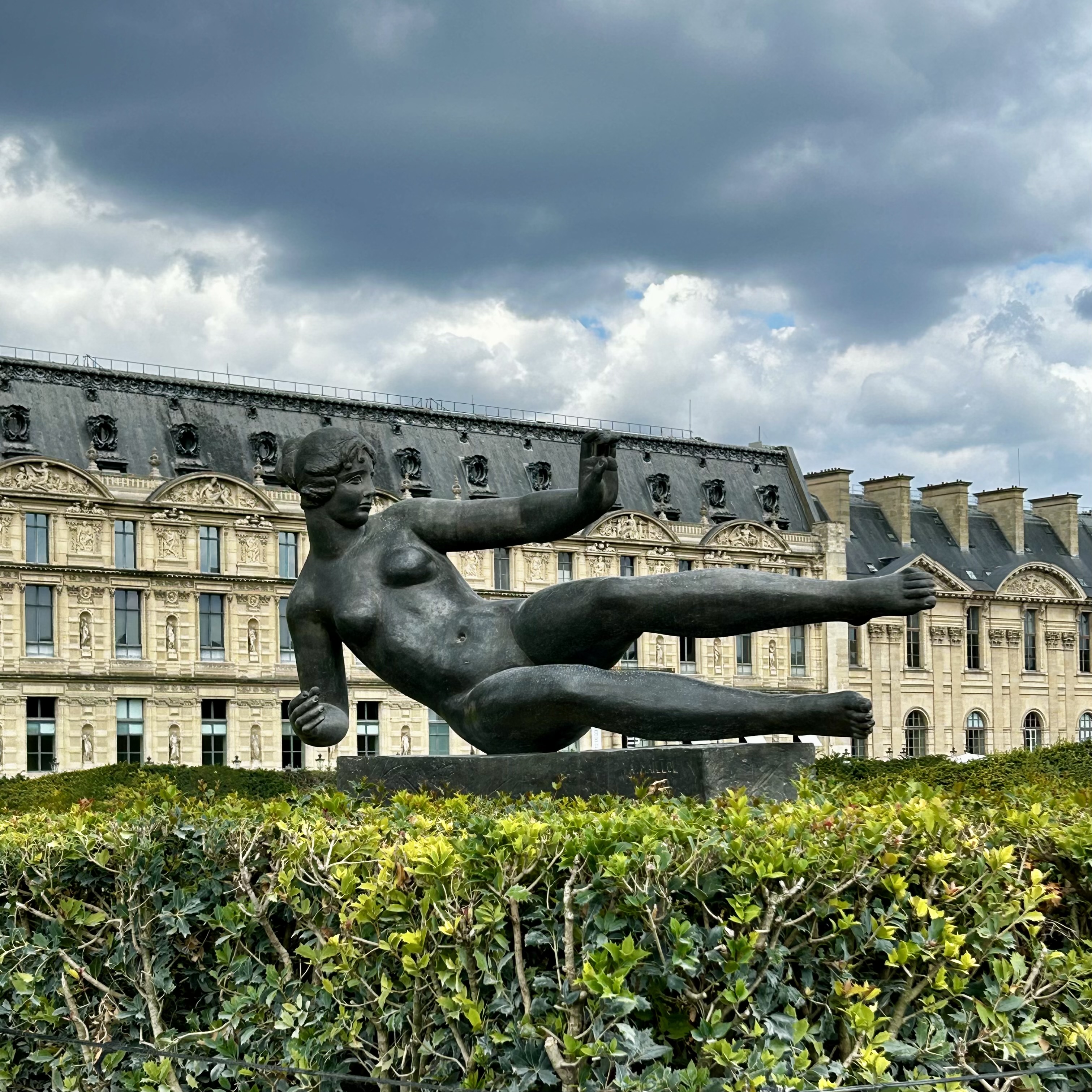
A famous sculptor during his lifetime, Aristide Maillol nevertheless begins his career as a painter, engraver, ceramicist, and tapestry artist before fully devoting himself to sculpture around the age of forty.
Born in 1861 in the southwest of France into a relatively modest family, he moves to Paris in 1882 and enrolls at the École Nationale des Beaux-Arts. Despite living in extreme poverty, being undernourished and in fragile health, Maillol gives himself completely to his art: he meets Antoine Bourdelle, discovers the Lady and the Unicorn tapestries at the Cluny museum, and forms friendships with the Nabis group led by Maurice Denis.
In 1905, he exhibits the plaster sculpture Mediterranean. Monumental in scale, the sculpture – structured like a piece of architecture – depicts a seated woman in a meditative posture and is met with resounding success. Count Kessler, a German patron, commissions a stone version and becomes Maillol’s lifelong supporter.
Maillol’s work, filled with female nudes of full yet refined forms, represents a true artistic revolution that anticipates abstraction and will go on to inspire Picasso, Brancusi, and Matisse.
When Rodin dies in 1917 – an artist often stylistically contrasted with Maillol – Maillol is considered the greatest living French sculptor.
In 1934, he meets a young woman with Mediterranean features, Dina Vierny. He is 73, she is 15. Though their relationship remains platonic, she becomes a source of renewed artistic inspiration for him: Dina becomes his main model, his muse, his collaborator, and later the most faithful guardian of his work.
She notably poses for the sculpture The River, a female body struggling against a current that seems to drag her away. It is the first representation of a figure lying on its side in an unstable balance – an allegory for the troubled times coming with WWII.
Maillol’s work receives its crowning moment at the 1937 Universal Exposition in Paris, where his sculptures are prominently displayed in the newly opened National Museum of Modern Art at the Parisian Tokyo Palace.
Maillol dies in 1944, without news of Dina, whom he believes arrested – she is in fact a member of the French Resistance, helping people escape fascism through Spain, and has already been arrested, imprisoned, and tortured in 1943.
He has named her his executor, and she is immediately entrusted by Maillol’s only son, Lucien (from his marriage to his wife Clotilde), with managing and promoting the great sculptor’s legacy. She would dedicate the rest of her life to this mission.
Maillol’s work is vast and deeply impactful. Its power lies in its rejection of the frenetic dynamism that characterized much of late 19th-century sculpture. Maillol’s nudes are serene, calm, full, rounded, timeless, free of tense muscles or veins. His style draws from classical antiquity yet reveals the seeds of modern abstraction.
Dina Vierny works tirelessly to keep his art alive and on display, notably at the museum dedicated to him in Paris, inaugurated in 1995, and in the Carrousel Garden, where eighteen of his sculptures have stood since 1964.

The majestic Fountain of the Four Seasons, built between 1739 and 1745 to the glory of the City of Paris by sculptor Edme Bouchardon, now forms a magnificent foreground to the façade of the Maillol Museum

The Crowned Child – 1892

Woman with an umbrella – 1895

Nymph – 1930
 Torso of the Chained Action – 1905

Harmony 1st stage – 1940

The Mediterranean

Desire – 1907
Present throughout the French capital, Parisian statuary deeply fascinates photographer Robert Doisneau.
On June 29, 1964, while on his way to a professional meeting at the Rapho agency, he sees the unpacking of Maillol’s sculptures. Their installation had been decided by French Culture Minister André Malraux and Dina Vierny, Maillol’s last model. The opportunity is too good to pass up, and Doisneau forgets his professional meeting: he spends the entire day photographing the placement of the statues in the Carrousel gardens.


Today, the Carrousel garden is the largest open-air museum dedicated to Maillol, featuring eighteen statues.
Yet Maillol’s presence there doesn’t date only from 1964 – it goes back to 1929, when his Monument to Cézanne was installed in the Tuileries Gardens near the Orangerie museum. Made of pink marble, the sculpture gradually deteriorated due to weathering. In 1959, Dina Vierny, devoted to preserving Maillol’s legacy, proposes casting a lead version of the statue, moving the original to the Museum of Modern Art in Paris.
To speed up the process, she requests a meeting with André Malraux, who famously said: “You give me the art work, I give you the Tuileries!” The space is too vast, so they choose the nearby Carrousel garden instead, punctuating it with eighteen monumental sculptures in bronze and lead.
Dina Vierny designs the entire layout, applying the lessons Maillol has taught her on how best to showcase sculpture.

The Dawn

Nymph

The Mediterranean

The Méditerranean

Venus

Venus

The River

The Air

The Air
March 6, 2026
