
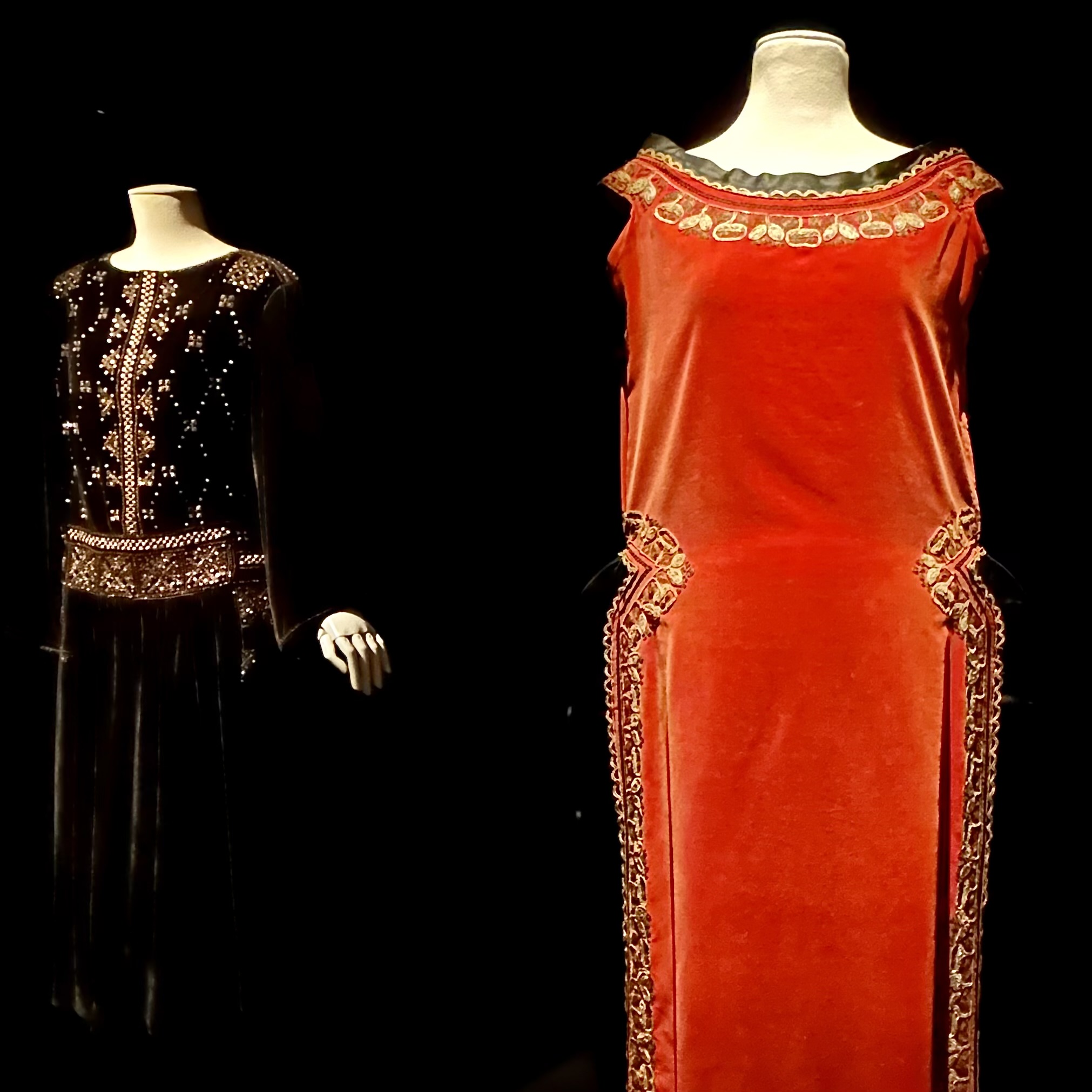
The exhibition running until January 11, 2026, at the Parisian Musée des Arts Décoratifs, titled “Paul Poiret – Fashion is a Feast” recreates the world of the great couturier Paul Poiret and showcases some of his creations.
Poiret begins his career as a fashion illustrator with Doucet in 1898, then works with Worth from 1901 to 1903 before founding his own fashion house in 1903. Where Worth adds extravagance, Poiret simplifies. The silhouette becomes lighter, more refined.
Poiret discards the corset – thanks to the boldness of Madeleine Vionnet who works for him (and is soon fired because of such audacity) – and becomes one of the forerunners of the Art Deco style. His silhouettes are straight – depending on the era, the waistline is either Empire-style just under the bust, or low on the hips – and the fabrics are shimmering and surprisingly colorful.
The success is immediate, as the designer has a perfect sense of the times and soon dresses all of fashionable Paris.
Poiret carefully cultivates his public image. The book he commissions in 1908 from illustrator Paul Iribe, “The Dresses of Paul Poiret as Told by Paul Iribe” is a kind of personal advertising ahead of its time and a great success. The lavish, sometimes costumed parties he hosts are famous.
His fame crosses borders and oceans. He gives lectures, publishes books. Bold, epicurean, provocative, and exuberant, he has opinions on everything and attracts everyone’s attention.
He draws inspiration from his many travels, especially to Morocco and Russia – and brings to fashion the Orientalism that is then all the rage in Paris with the success of the Russian Ballets.
Art is both a source of personal joy and constant inspiration. Artists are his friends: Raoul Dufy with whom he creates iconic prints, Max Jacob, Isadora Duncan, André Derain who paints his portrait, the Fauves painters who delight him – just to name a few. He becomes a mentor to Schiaparelli, quickly recognizing her artistic talent.
In 1911, he creates the first designer perfume, Rosine, named after his eldest daughter. Between then and 1929, about forty perfumes are launched from his factories. The names are sometimes unusual – Shakhyamuni (1913), Hahna the Strange Flower (1919) – the bottles often elaborate, but their success fades with the rise of the minimalist style and packaging introduced by his new rival, Gabrielle Chanel.
A tightrope walker of Parisian life, he is full of contradictions: the man who has thrown away the corset will later invent the girdle, which once again molds the female body.
After WWI, Paul Poiret’s star begins to fade, as clients turn toward the simpler clothing styles pioneered by Chanel.
Serious financial trouble first appears in 1923 and ultimately leads to the collapse of his fashion house, which closes for good in 1929.
The son of drapers, born in Paris in 1879, who had once known immense glory thanks to his creations, ends his life penniless and forgotten, dying in 1944.
There came a time when he was declared bankrupt. And Paul Poiret, the man of those unforgettable parties, who spent millions, found himself without a cent and without a friend. Instead of showing the slightest despair or humiliation, he became a tramp. Not a fake tramp. Not a hobby tramp. Wearing a large woolen cloak left over from his glorious days, he slept on park benches. I saw him there. His beard, once neat and trimmed short, had become that of a troglodyte.”
Georges Simenon

1911

Poiret/Dufy – 1911

1919

1921

1922

1912

1922

1910

1911

1912

1920
November 7, 2025
