
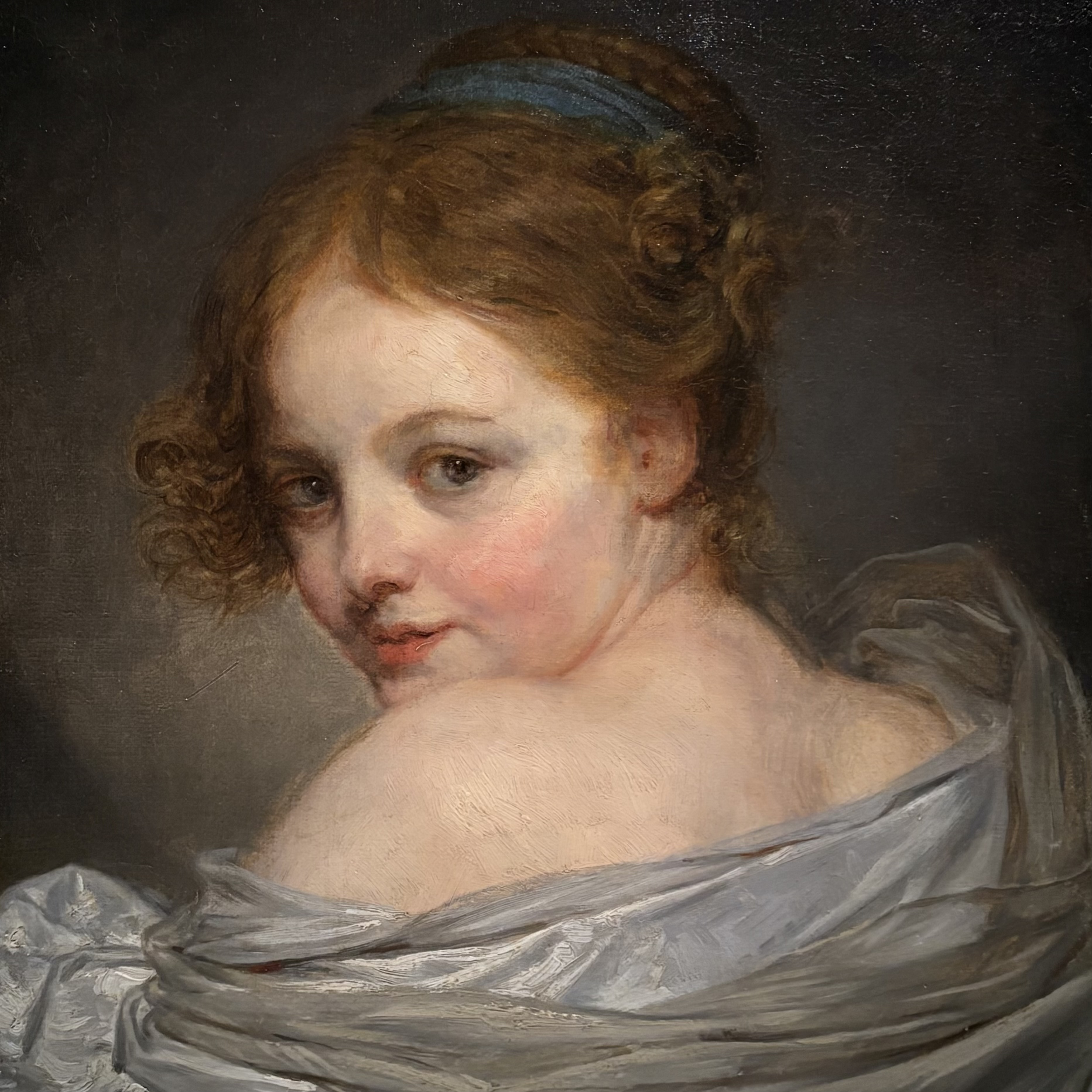
The exhibition dedicated to Jean-Baptiste Greuze at the Parisian Petit Palais, running until January 25, 2026, restores to the spotlight a painter once celebrated in his time, later consigned to oblivion. Modern critics long dismissed his work as sentimental or insipid, but such an opinion overlooks the fact that Greuze, born in 1725 and deceased in 1805, was deeply shaped by the Enlightenment, its ideals, and its concern for the individual. He quickly became the intimate interpreter of the social debates of his age.
Indeed, the exhibition “Childhood in the Light” brings together his works devoted to childhood and adolescence – those fragile yet decisive stages in which the personality of the future adult is formed.
A true man of his time, Greuze was fascinated by the individual and by emotion, in a society undergoing transformation and engaged in vigorous debates about the child’s place in society – whether on questions of education, the question of breastfeeding, or the rejection of nursing.
Like the philosophers of the Enlightenment, Greuze saw in a childhood nurtured by love the source of a social renewal – just as Élisabeth Vigée Le Brun who, in a similar naturalistic and humanist vein, repeatedly painted tenderly affectionate portraits of mothers and children.
In the same spirit, Greuze also saw in education the foundation of this renewal, and his many depictions of young students reveal how deeply he cared about this emerging societal concern.

The Young Student – 1755-1757

Portrait of Charles-Étienne de Bourgevin de Vialart – 1782-1784

The Little Mathematician – Circa 1790

The Little Lazy Boy – 1755
Yet Greuze did more than illustrate the debates of his day: he captured innocence – and also its loss. His portraits – sometimes of his own daughters, though many of his models remain anonymous – express the full range of emotion: from love to sadness, from boredom to mischief.
Boredom overwhelms young students at their desks; protective love radiates from a child cradling her pet in her small arms; pride shines in the gaze of a very young woman; while the innocence of tender age lights up the faces of little children.

Portrait of Anne-Geneviève Greuze – 1766

Portrait of Louise Gabrielle Greuze – 1766

Young Blond Boy in an Open Shirt – Circa 1760

Young Boy in a Red Waistcoat – 1775

Bust of a Young Girl – Circa 1780

Little Nanette – Circa 1770-1780


Young Girl with a Dove – Circa 1780 – Radiant and serene, the young girl dressed in white seems destined for a bright and secure future, as symbolized by the dove she holds in her arms, which also represents purity and innocence. Like 17th-century Dutch painters, Greuze often created close visual associations between femininity and birds – or between a state of mind and birds. A dead bird can suggest the loss of virginity, or the end of innocence

A Child playing with a Dog (Portrait of Louise Gabrielle Greuze) – Circa 1767

A Nymph’s Head – 1760

Back View of a Young Girl – Circa 1770–1780
But the emotions he painted were not always joyful, and innocence often slips away – because of life, because of death. Sadness engulfs young girls mourning their dead bird; anxiety burdens a young man uncertain whether his sweet feelings are shared.

The Dead Bird – 1800

Young Girl Weeping over Her Dead Bird – 1765

Young Girl Weeping over Her Dead Bird – 1757

Young Shepherd Holding a Dandelion – circa 1760–1761 – This painting is a companion piece to the young shepherdess plucking a daisy (below) and depicts the torments of love. In one, the young boy blows on a dandelion to see if his feelings are reciprocated; in the other, the young lady plucks a daisy for the same reasons. In both works, Greuze captures romantic sentiment using the language of pastoral imagery. Both paintings once belonged to Madame de Pompadour, mistress of King Louis XV

Young Shepherdess Plucking a Daisy – 1759
Sometimes, innocence vanishes because of men, and despair consumes a very young girl. “The Broken Vessel” is probably Greuze’s most famous work and has provoked much debate.
Some saw in it a depiction of lost virginity; others, a representation of rape. Virginity, in the 18th century, was a crucial issue, being the indispensable condition of a woman’s marital future. But virginity lost through rape meant a complete and irreparable social downfall.
So, does “The Broken Vessel” depict a loss of virginity or rape?
Rape, obviously. How daring not only to address such a subject, since most contemporary paintings depicted amorous preliminaries, whether consensual or not, in playful, gallant tones – but above all, to do so with such explicitness.
The series of drawings and preparatory sketches reveals the depth of Greuze’s reflection on this profoundly uncomfortable subject. As his studies progressed, the girl’s distress became more enigmatic, less overtly violent, but much more moving.

Preparatory Study – 1771

Preparatory Study – 1771
The broken pitcher symbolizes lost virginity – the shattered vessel that should have remained intact. But Greuze shows more: the disordered clothing exposes a breast that should have remained covered; hands clutch at the pubis beneath a dress lifted too high; a sphinx statue with male features spurts a stream of water and its expression is far from reassuring.

The Broken Vessel – Circa 1771-1772
Most striking of all is the girl’s gaze: empty, lost – what we might now describe as a dissociation state. In her eyes lies both questioning – she seems unsure of what has just happened – and an unspoken accusation: it happened because society allowed it.

Detail of The Broken Vessel
In “The Broken Vessel”, Greuze condemns the permissiveness society grants itself over the bodies of young girls of modest condition, who have no recourse. The young girl already knows that what has just happened is shameful – for her – and irrevocable. With this canvas, Greuze achieves the extraordinary feat of stirring in us overwhelming empathy, for he depicts the very instant when innocence flees forever.
Greuze was fully aware of the dangers threatening childhood and adolescence – dangers of physical and psychological violence. His work is far removed from the mawkishness with which he has so easily been branded.
October 3, 2025
