
Social media – Instagram and TikTok in particular – are quietly reshaping female beauty standards, creating a uniform ideal that now spans the globe.
In 2025, the so-called perfect body supposedly requires large breasts, wide hips, and a razor-thin waist (nothing new there), long hair – either deep brown or bright blonde – but always perfectly tamed, never gray, white, or even dull brown. Tiny nose, big eyes, high cheekbones, full lips, and, above all, flawless, poreless skin.
Some people are shocked.
I’m not.
Every era has its own beauty standards, dating back to Ancient Greece (and even earlier). Greece and Rome prized harmonious proportions, the Renaissance and the Enlightenment celebrated curves, the 19th century idolized the hourglass figure, flappers went for an androgynous silhouette, and the post-war era, understandably, brought curves back in style – because after years of deprivation, people craved abundance.
What’s different today is the almost instantaneous global spread of these standards, thanks to social media. Kim Kardashian, clever as she is, masterfully imposed her improbable body measurements on the entire world – and the world complied.
Another shift today is the performative nature of beauty, crafted and calibrated for social networks, not real life.
If you’ve ever done your makeup for a camera – even just your iPhone – you know that what works on camera rarely works in reality. Everything is exaggerated, heightened, because you have to play with light. No one looks dumber in real life than with contouring that fakes cheekbones or makes a nose unnaturally tiny. It’s almost like Japanese kabuki theater makeup – you get what I mean. And indeed, few women are fooled, you rarely see kabuki-contoured faces on the subway or at work.
Today, artificiality is key: beyond the extreme makeup, cheekbones are enhanced through wisdom tooth or molar removal (an old practice) and bichectomies, a surgery to remove fat pads in the cheeks. Lips are plumped with overlining, silicone, collagen, or now hyaluronic acid. Hips and buttocks are unnaturally rounded with implants or fat transfers. Waists are slimmed through rib removal (once common, thankfully now rare), liposuction, or corsets. Hair, long and unnatural, is tamed by endless identical blowouts.
Many brutal procedures existed before, let’s not kid ourselves.
The difference today is that the beauty market – yes, it’s a market, make no mistake – is democratized. Many of us can access these tools if we want. Even without surgery, the global success of chains like Sephora or Dyson’s revolutionary hairdryers shows that standardized beauty is more attainable than ever.
Another change is the duality of beauty today. There’s the digital version – enhanced by heavy makeup, photo editing, and filters that make us younger, prettier and more polished – and real life, where no one walks around with full-on contouring or overlining (though plenty sport duck lips enhanced with hyaluronic acid).
For some, the gap between digital and real life is unbearable, triggering severe body dysmorphia and outrageous cosmetic requests based on Instagram images.
It’s heartbreaking, it’s outrageous. We live in a post-capitalist world where we turn ourselves into supposedly beautiful products, fueled by overconsumption of beauty products that will do nothing at all.
It’s heartbreaking, it’s outrageous, it’s absurd. Everyone looks the same – it’s depressing.
It’s heartbreaking, it’s outrageous, it’s tragic because these utterly false standards place unbearable pressure on women when all they need to do is be themselves.
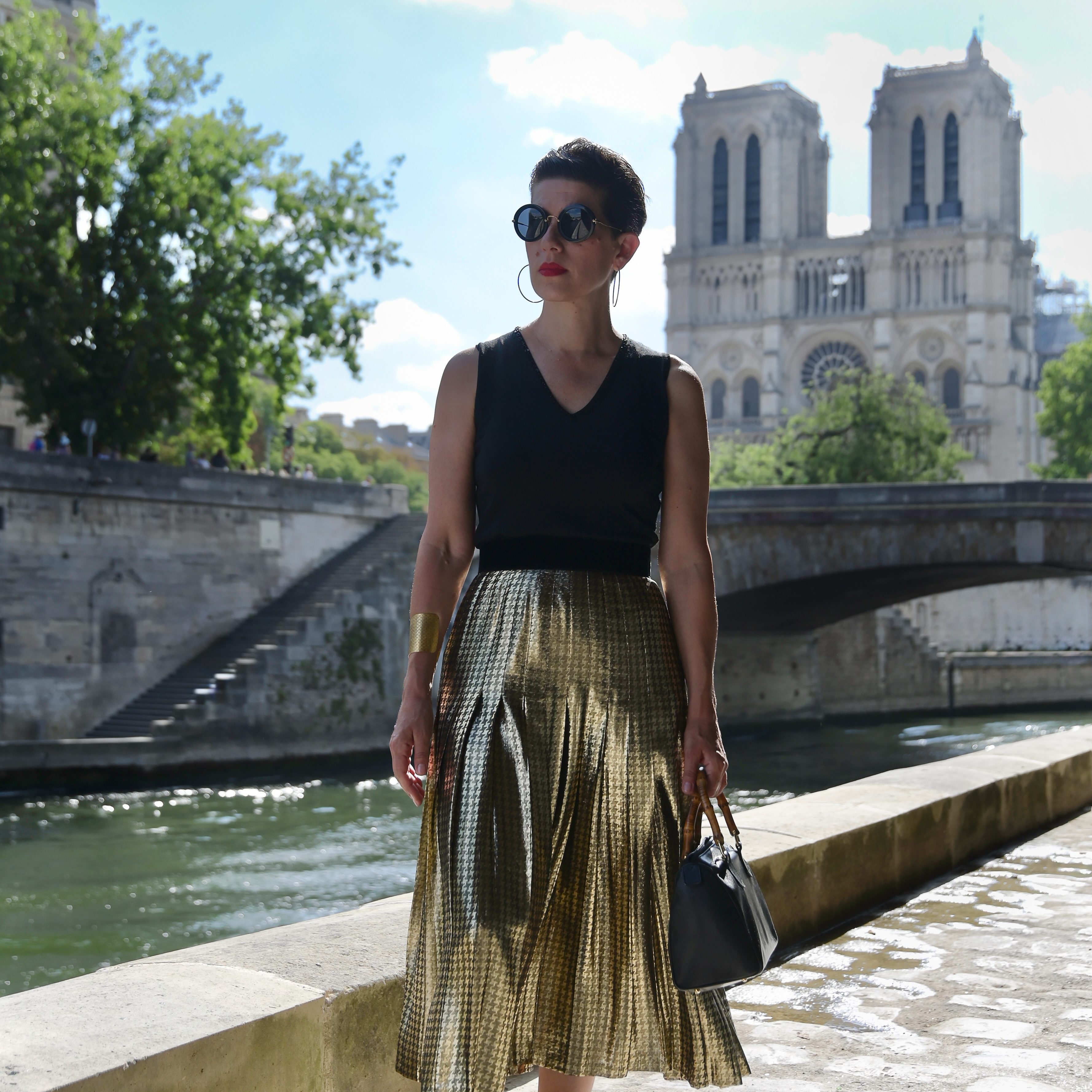
Editor’s note: Here I am, fifty, wearing a 90’s skirt, a thirty-year-old top, flats, short hair, and no makeup except this lipstick I love, because doing makeup bores me. Am I angry writing this? Absolutely.


Gérard Darel top – Dior skirt – Miu Miu sunglasses – Gucci handbag – Repetto flat shoes
September 19, 2025
