
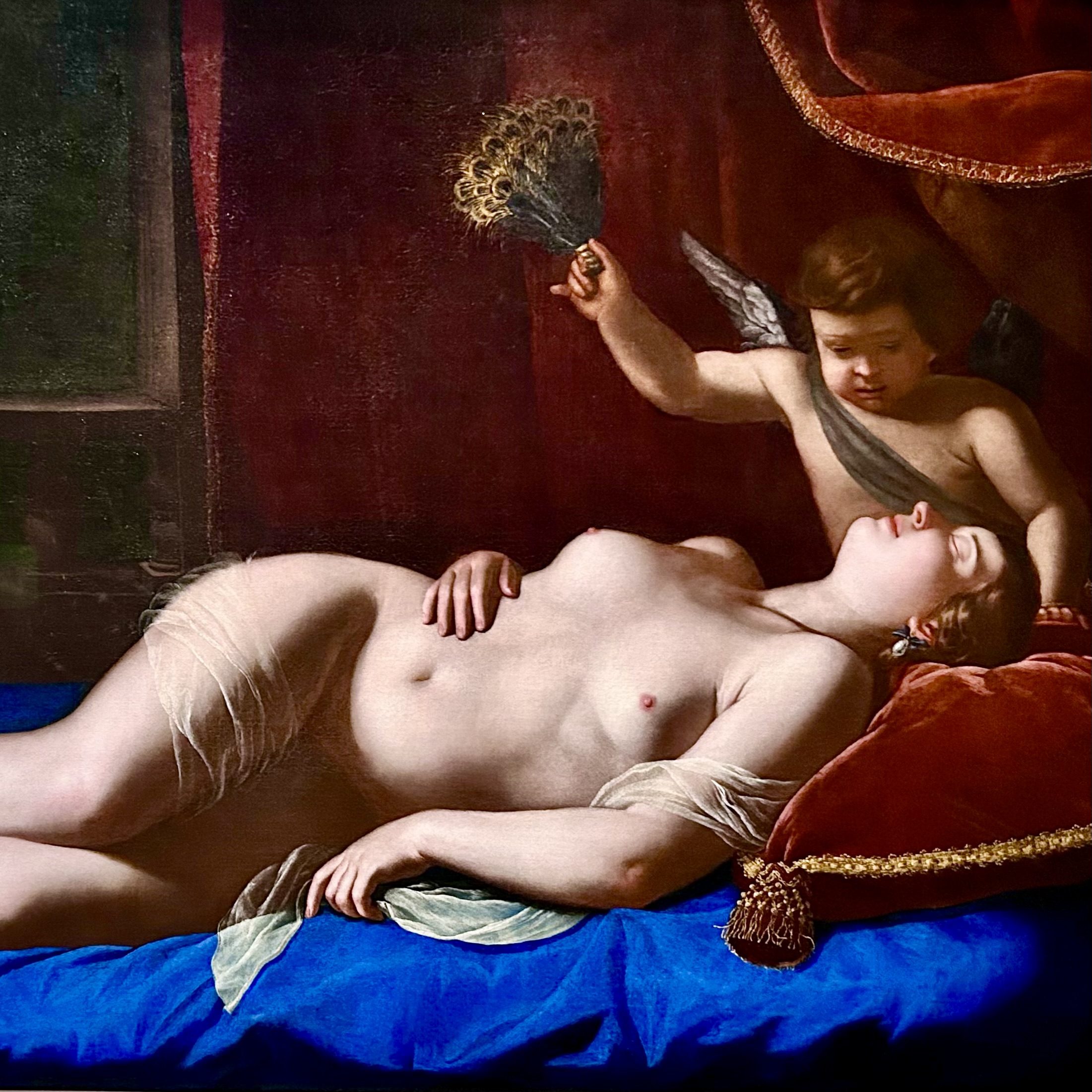
The exhibition proposed by the Jacquemart-André museum until August 3, 2025, “Artemisia, Heroine of Art” sheds light on the life and talent of the woman considered the first female painter recognized during her lifetime, Artemisia Gentileschi.
Artemisia, more than anyone else, managed to turn lead into gold. She is born in Rome in 1593 to a highly reputed painter father – Orazio Gentileschi – and a mother who passed away when her daughter was only twelve, leaving Artemisia to take on a maternal role toward her three younger brothers.
Living in a man’s world and a Roman society steeped in rigid conventions, Artemisia, however, learns to paint in her father’s workshop. Orazio quickly realizes that his daughter, unlike his sons, possesses an extraordinary talent.
As Orazio’s style explicitly refers to the art of Caravaggio, Artemisia’s artistic beginnings are very much in the wake of the famous Lombard painter.
The first work attributed to Artemisia, signed at the age of seventeen, is Susanna and the Elders, which she completes in 1610. The painting recounts a biblical episode about a young woman, Susanna, who, while taking a bath, refuses the indecent propositions of two old men. To take revenge, they accuse her of adultery and have her sentenced to death, but the prophet Daniel intervenes, proves the young woman’s innocence, and has the old men condemned.

While this theme has always inspired artists, its selection by a very young woman may seem surprising, and it appears, in hindsight, to be a grim foreshadowing of the trauma Artemisia would soon experience.
The First Trauma: The Rape
It is Orazio, unwittingly, who let the wolf enter into the fold in 1611. He asks a painter friend specializing in architectural decoration to give Artemisia lessons in perspective. The wolf’s name is Agostino Tassi. Taking advantage of the father’s trust and the girl’s isolation, Tassi rapes Artemisia, promising marriage – a lie that leads the young girl to consent to his desires multiple times. When Orazio is made aware of the rape, he files a complaint, and the subsequent nine-month trial will be another ordeal for Artemisia.
The Second Trauma: The Court Case
She undergoes humiliating medical examinations to prove her past virginity and the torture of the sibyl, which involves crushing her fingers with cords to confirm the veracity of the witness’s testimony.
“È vero, è vero, è vero.”
It’s true, it’s true, it’s true.
Artemisia under the sibyl’s torture.
Beyond everything, the public humiliation is immense.
Although Tassi is found guilty and sentenced to five years of exile, he will never serve his sentence and is even pardoned thanks to his connections in Rome. To put an end to the dishonor of the trial scandal, Artemisia, two days after her rapist’s conviction, consents to an arranged marriage with the brother of her father’s notary.
The humiliation is immense, but Artemisia will take her revenge.
Revenge
Judith Beheading Holofernes is undoubtedly her most famous and striking work. She paints two versions of it, one in Florence just after the trial (1612–1613), and the other in Naples (1620).


The scene is drawn from the Book of Judith, a deuterocanonical biblical text. Judith, a Jewish widow, saves her people by seducing and then beheading the Assyrian general Holofernes, who is threatening her city. Artemisia paints the very moment of the beheading, in a confined, intimate scene with no landscape or narrative background. The chiaroscuro that she masters perfectly plunges the faces into shadow or light, making the action even more theatrical. Judith is not, unlike her representation in works painted by men (Caravaggio, Orazio Gentileschi, Allori), a fragile and hesitant young beauty: she is determined, powerful, sovereign, and unrepentant. How could one not see this painting as a pictorial revenge for the rape suffered by Artemisia? Holofernes bears the features of Tassi, and Judith, the executioner, bears those of Artemisia. At the time, the painting shocks: the violence is too explicit and incomprehensible coming from a woman.
Renaissance
Artemisia leaves Rome shortly after the trial to settle in Florence. This new start allows her to close a painful and humiliating chapter of her life and experience a personal renaissance. Florence, then the intellectual and artistic capital of… the Renaissance, has no difficulty appreciating the extraordinary talent of this painter who is even more Caravaggesque than Caravaggio himself.
She is welcomed into the Academy of the Arts of Drawing – becoming the first woman to join. She paints without the shadow of her father, even signing her works as Artemisia Lomi to distinguish herself from him. She frequents Galileo and exchanges with poet Michelangelo Buonarroti the Younger.
Commissions flow in. She becomes a court painter under the patronage of the Medici and King Charles I of England. She travels – to Naples, Venice, London. Everywhere, she is sought after. Everywhere, she is celebrated. Her name is respected, even among those who are not fond of female presence in artistic circles.
Eros and Thanatos
In the same vein as Judith Beheading Holofernes, Artemisia paints Judith and Her Maidservant with the Head of Holofernes (1640–1642), Jael and Sisera (1620), Tarquin and Lucretia (1626–1630), and Cleopatra (1620–1625, then 1630–1635, then again 1639–1640), all depicting powerful but broken women, tragic yet active, who prefer death (their own or that of their adversary) to dishonor.


Tarquin and Lucretia echoes Susanna and the Elders, the artist’s youthful work from 1610, with both paintings illustrating two women resisting male sexual violence.
The women Artemisia paints are women who fight, who act, who exist. The bodies are real, the gazes hard, the gestures assertive. Their violence is the perfect reflection of cold, determined, and deliberate anger.
She transforms her immense trauma into creative power : she often lends her own face to these violent women who take justice into their own hands – and sometimes Agostino Tassi lends without knowing, his face to the decapitated or murdered figures.
When the women painted by Artemisia turn away – for a moment – from violence – it is their subtle eroticism that strikes. Danaë (1612–1613) is represented naked and sensual as Zeus takes her body in the form of a rain of gold.

Venus and Love (1626) presents an intimate and erotic vision of the mythological goddess – a perspective rarely addressed at Artemisia’s time – that emphasizes the eroticism radiating from Venus’s skin and position.

Mary Magdalene Penitent, painted twice in 1625, may be touched by divine grace, but Artemisia’s brush creates a troubling link between mystical ecstasy and erotic ecstasy.


Artemisia, unlike the male painters of her time who struggle to find female models willing to pose naked, has easy access to female nudity: she models herself before her mirror.
Oblivion and Renaissance – Again
Artemisia is recognized during her lifetime, but the following centuries bury her in oblivion.
It is the feminist movements of the 1960s-1970s, questioning the marginalization of women in art history, that rediscover Artemisia. Linda Nochlin and Mary Garrard, art historians, play a key role in reassessing Artemisia as a great Baroque artist who was not simply a female exception but also a fully integrated artist of her time. The major turning point comes in 1976, with an international exhibition in Milan, which allows the public to rediscover her work – and her life.
Artemisia, heroine of art? Undoubtedly.
Artemisia, heroine of her own life? Even more so.
“Arte mi sia” – Let art be mine.

Self-portrait as the allegory of Painting – 1638-1639

Self-portrait as a lute player – 1614-1615
May 23, 2025
