
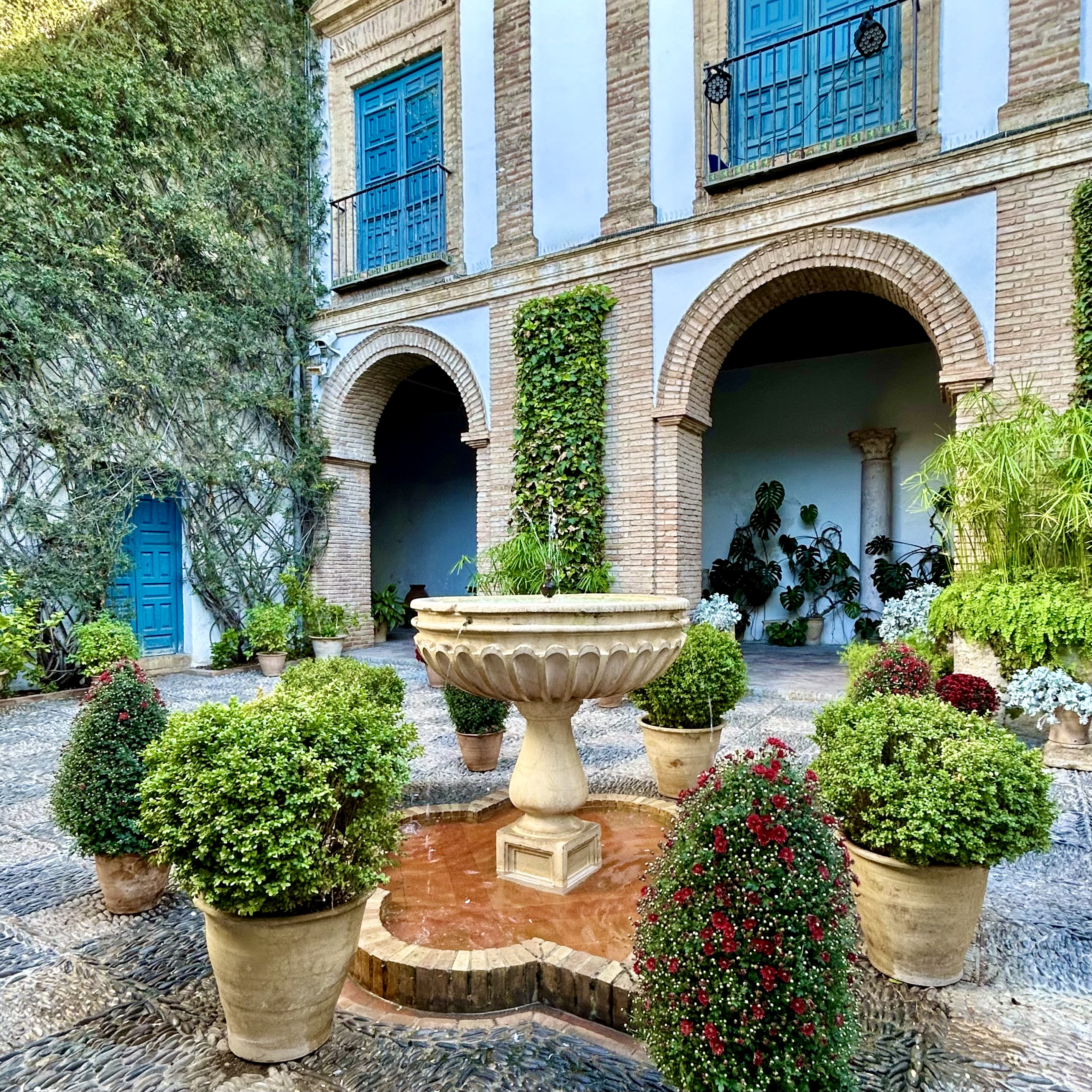
The Andalusian patio, a legacy of the Roman culture of the atrium and the Arab culture always in search of freshness, is – as we have understood here and there – the architectural epicenter around which the social and intimate life of the family unfold.
In Córdoba, the exercise has been multiplied within the Palace of Viana, which has twelve patios, each as wonderful as the next, in addition to a garden of approximately 1,200 square meters.
From the 15th century to the 21st century, the Palace of Viana has had eighteen owners. The first dynasty to acquire, transform and expand the property was, from 1492 to 1704, the Figueroa y Córdoba, lords of Villaseca. In 1704, the last descendant of the Figueroa y Córdoba dynasty dies without descendants, and the residence returns to the Fernández de Mesa, marquis of Villaseca. Among them, a woman will leave her mark. Ana Rafaela Fernández de Mesa y Argote (1737-1788) extensively renovates the palace, creates a historical archive fund and unites, by marriage, her marquisate with the county of her husband, the Count of Villanueva de Cárdenas.
The palace’s size is almost doubled by the acquisitions made in 1814 by one of their descendants but, due to the lack of descendants, the property passes into the hands of the Marquises of Viana.
The Palace of Viana today houses priceless collections of Renaissance art and the various rooms of the residence display a decoration that dates mostly from the 17th and 18th centuries, but let’s be honest, its patios capture all the visitor’s attention. Here are a few of them.

The reception patio is the main entrance to the palace, visible from the square it opens onto and has the function of representing the prestige of the noble family that inhabits the place


The patio of the orange trees is reminiscent of Hispano-Muslim gardens due to its closed structure on the outside and its intimate atmosphere, its central fountain and its fruit trees


The patio of the gates opens to the outside to be seen by the public and to externalize the social position of the palace owners. As it must be seen throughout the year, its trees and plants are evergreen


The patio of the Madame is designed to be seen from the inside. It is neoclassical in style and the Madame is the naiad of the fountain who, in Greek mythology, was a freshwater nymph

The patio of the columns is the most recent of the Palace of Viana because it was built in the 1980s and is intended to host cultural events

The patio of the basin is typically a service patio. The pool plays a role inherited from the Arabs, namely to aerate and oxygenate the water from the well before watering the plants

The garden is home to some of the oldest botanical species in the Palace of Viana. With the acquisition of its land in 1814, the palace almost doubled its surface area


The patio of the gardeners is, like the garden and the patio of the well, a service patio. Its late decoration from the beginning of the 20th century aims to give it a more noble tone


The patio of the well takes its name from the old well that occupies it, which draws its water from the nearby underground stream from which it obtains a sufficient flow to supply water to all the patios and fountains of the Palace of Viana

The patio of the chapel takes its name from the adjacent chapel. It is a patio of half-light, cool, characterized by sobriety


The patio of the gate is decorated on the ground with the small pebbles characteristic of Córdoba
April 26, 2025
