
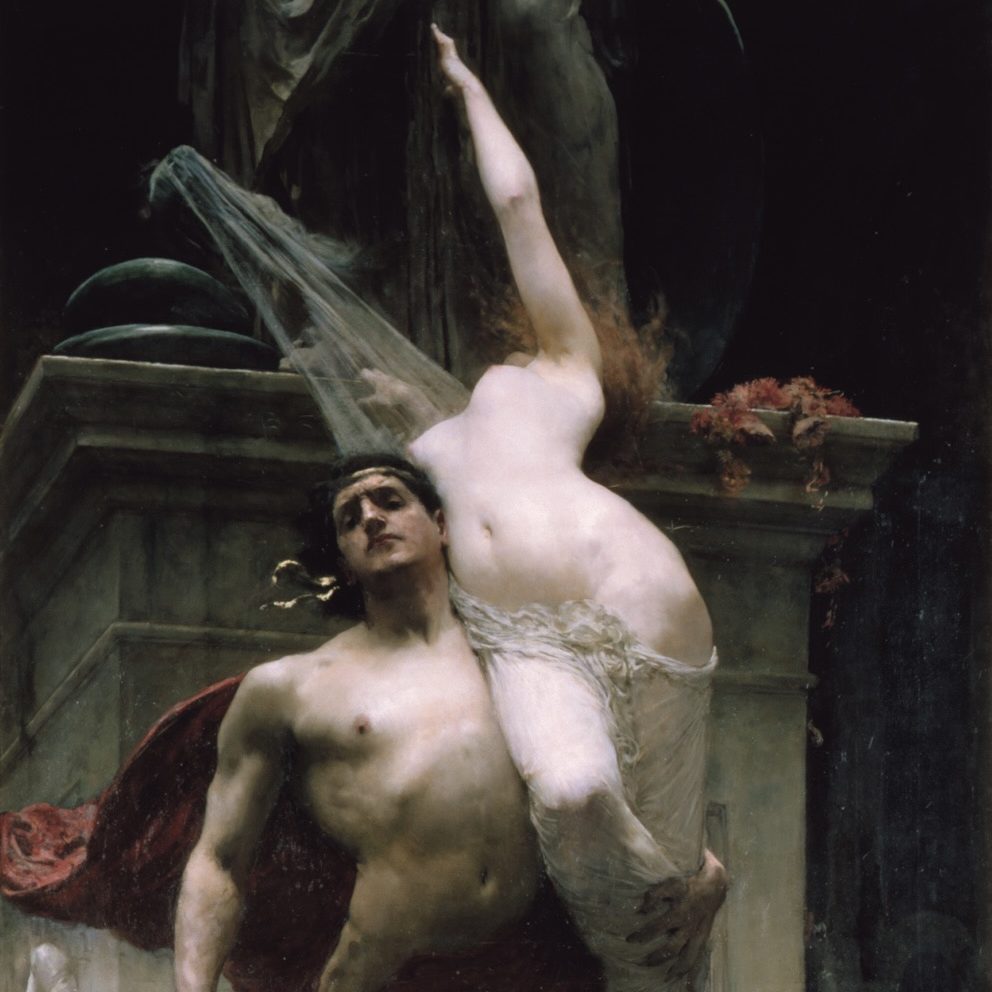
I have already expressed here my astonishment at seeing so many naked women populating museums. They are almost always painted or sculpted by men. The few female artists are ultimately rare, and when they take on the feminine subject, the point is more to depict love, motherhood, the feminine condition or pain than the body as such.
The feminine seen by male artists is just another story of male domination over the female body. This is the theme of Ludivine Gaillard’s very good book, “Imparfaites” (“Unperfect”), which traces the artistic vision of the female body through the centuries. Fear and desire are inextricably linked when it comes to the carnal representation of women in the arts.
I. Power and fear
The power of the feminine is sometimes revered, giving rise to the greatest fantasies. The ultimate archetype of this strong femininity is obviously Venus (or Aphrodite for the Greeks), who expresses the deified power of the female body – and who has been painted a thousand times.

The birth of Venus – Botticelli, vers 1485

The birth of Venus – Cabanel, 1863

Aphrodite – Hirschl, vers 1893
Sometimes, this feminine power is far from being deified, it is objectified.
Beautiful horizontal women are painted like statues, and it is the desirability of their naked bodies that is the main subject of the artwork.

Urbino’s Venus – Titien, 1538

Olympia – Manet, 1865
Objectification is also the main subject in all the works that depict Pygmalion and Galatea. In Ovid’s “Metamorphoses”, Pygmalion falls in love with his creation, the statue of Galatea, to which Aphrodite gives life.

Pygmalion in love – Girodet, 1819

Pygmalion and Galatea – Gérôme, 1890

Pygmalion and Galatea – Falconnet, 1761
The feminine world, poorly transcribed through the body which is idealized, is certainly desired but it is also feared or ridiculed.
Harmful female figures populate the world of the arts, the first obviously being Eve, to whom we owe all the ills of humanity.

God admonishing Adam and Eve – Zampieri, 1625

Pandora – Rossetti, 1871
Where Eve ultimately appears a little foolish – just like Pandora – the first human woman according to Greek mythology who opens the box which contains all the evils of the world – Lilith is presented depending on the sources as Adam’s first wife or as a female demon. The arts transform her into a demonic feminine entity, with unbridled sexuality close to morbidity (without procreation) and arrogant enough to want to be the equal of man. No need to say that the figure of Lilith has often been invoked by feminist movements.

Lilith – Collier, 1887

Lady Lilith, Rossetti, 1866
Judith and Salome are two other harmful figures – because they are murderous. Worse, they execute or have their adversaries executed thanks to their seduction and their bodies coveted by men.
Judith is depicted in the Old Testament Book of Judith. After seducing the Assyrian general Holofernes, she assassinates him in his sleep by cutting off his head, in order to save her people from the siege of Bethulia. Judith is painted many times and it is often her determination and her calm despite the bloody crime that are depicted by the artists – which makes her even more deadly and dangerous in the eyes of men.

Judith and Holopherne – Le Caravage, 1598

Judith and Holopherne – Artemisia Gentileschi (a woman!!), 1650
Salome is a character from the New Testament. She dances in front of Herod of Antipas who, charmed, grants her what she wishes. Manipulated by her mother, she demands the head of Jean-Baptiste which is brought to her on a platter. Over the centuries, she becomes under the brushes of painters the sensual temptress with no will of her own.

Salome dancing, 1876

Salomé with Saint Jean-Baptiste’s head – Luini, 1527

Salome – Bonnaud, 1900
In the same vein, witches and old women, who have often lost all sexual attraction, are portrayed as dangerous and harmful women. In the same way, supernatural feminine beings close to animality, such as the mermaids who pretend to die to drown sailors or the Sphinx, are other sources of concern for a masculinity that wants to be triumphant.

The three ages and Death, Hans Baldung, 1510

The three ages of a woman, Klimt, 1905

The mermaid – Sartorio, 1893

Her – Mossa, 1905

Vice – Von Stuck, 1893
II. Domination of the body
This masculinity which wants to be triumphant – but which nevertheless perceives the risks induced by a full feminine power – will not cease over the centuries to assert its domination over the female body.
The female body must be available in two ways: it is either nurturing or sexualized.
The nurturing archetype is obviously embodied by the Virgin Mary – the sacrificial mother without any sexual dimension.

Boticelli, 1470-1475
Sexual domination is exercised in several ways.
It is exercised through the gaze – as in the scene from “Susan and the Elders”, taken from Chapter 13 of the Book of Daniel. Suzanne is a young woman who refuses the advances of two old men while she is bathing. To take revenge, the two men accuse her of adultery and have her sentenced to death. The prophet Daniel intervenes, saves her and condemns the old men.


Sexual domination is also exercised through actions. Sexual aggression, which does not always say its name, invades the canvases, be it the numerous rapes perpetrated by Zeus (he transforms into a snake to rape his mother Rhea, into rain to rape Danae, into a swan to rape Leda, as a bull to rape Europa), the rape of Cassandra by Ajax, the rape of Lucretia by Tarquin, the kidnapping of the Sabines or even the kidnapping of Persephone by Hades.

Danaé – Klimt, 1907

Léda – Moreau, 1865

Ajax and Cassandra – Salomon, 1886
Far from mythology, sexual domination is coupled with class domination.
Greuze’s painting “The Broken Pitcher” depicts the sadness of a poor and raped youth.

The broken pitcher – Greuze, 1771
Common women and dancers have no choice but to endure male assaults.

An interesting proposition – Prudent, date unknown

Les coulisses de l’Opéra – Béraud, 1889

Les coulisses de l’opéra pendant la représentation d’Aïda – Forain, 1898

The Opera foyer Le Peletier street – Degas, 1872
Class domination sometimes manifests itself as colonialist domination, with the Orientalists. Their women are offered, submissive and conquered (since they come from… conquered peoples). The Orient, which is a European invention, carries a thousand fantasies and the supposed exoticism of its women further exacerbates male gaze and desire.

Odalisque – Ingres, 1814

Odalisque with slave – Ingres, 1839

Almée dancing – Gérôme, 1863
The oriental woman condenses all the clichés and everything is permitted with her, even child crime – as proof let me take the paintings (and the life) of Paul Gauguin.

Finally, sleeping women or dead women are very accessible, because they are sexually available and induce no danger.

Sleeping Venus – Giorgione, 1508

Ophelia – Millais, 1851

The anatomist – Von max, 1869
I have only spoken here about ancient masters, and one might hope that the artistic vision of the female body has changed in modern times. Nothing is less sure. I always think back with horror to the artistic experiment “Rythm 0” that Marina Abramović organized in Naples in 1974, during which the artist stood motionless for six hours, inviting the audience to do whatever they wished, using the 72 objects she had placed on a table in front of her. Among these objects were neutral objects (a rose, a feather, perfume, honey, bread, grapes, wine) but also dangerous objects (scissors, a scalpel, nails, a metal bar, a pistol loaded with a bullet).

Art critic Thomas McEvilley, in attendance, described the experience:
It began tamely. Someone turned her around. Someone thrusted her arms into the air. Someone touched her somewhat intimately. The Neapolitan night began to heat up. In the third hour all her clothes were cut from her with razor sharp blades. In the fourth hour the same blades began to explore her skin. Her throat was slashed so someone could suck her blood. Various minor sexual assaults were carried out on her body. She was so committed to the piece that she would not have resisted rape or murder. Faced with her abdication of will, with its implied collapse of human psychology, a protective group began to define itself in the audience. When a loaded gun was thrust to Marina’s head and her own finger was being worked around the trigger, a fight broke out between the audience factions”.
Marina Abramović later said: “What I learned is that if you let the public decide, they can kill you. I felt really raped: they cut my clothes, planted rose thorns in my stomach, one person pointed the gun at my head and another took it away”.

It’s not 1974 anymore, thank God. Huge progress has been made and my faith in the generations to come is immense. However, art only follows society and tells a lot about the state of such society.
September 27, 2024
