
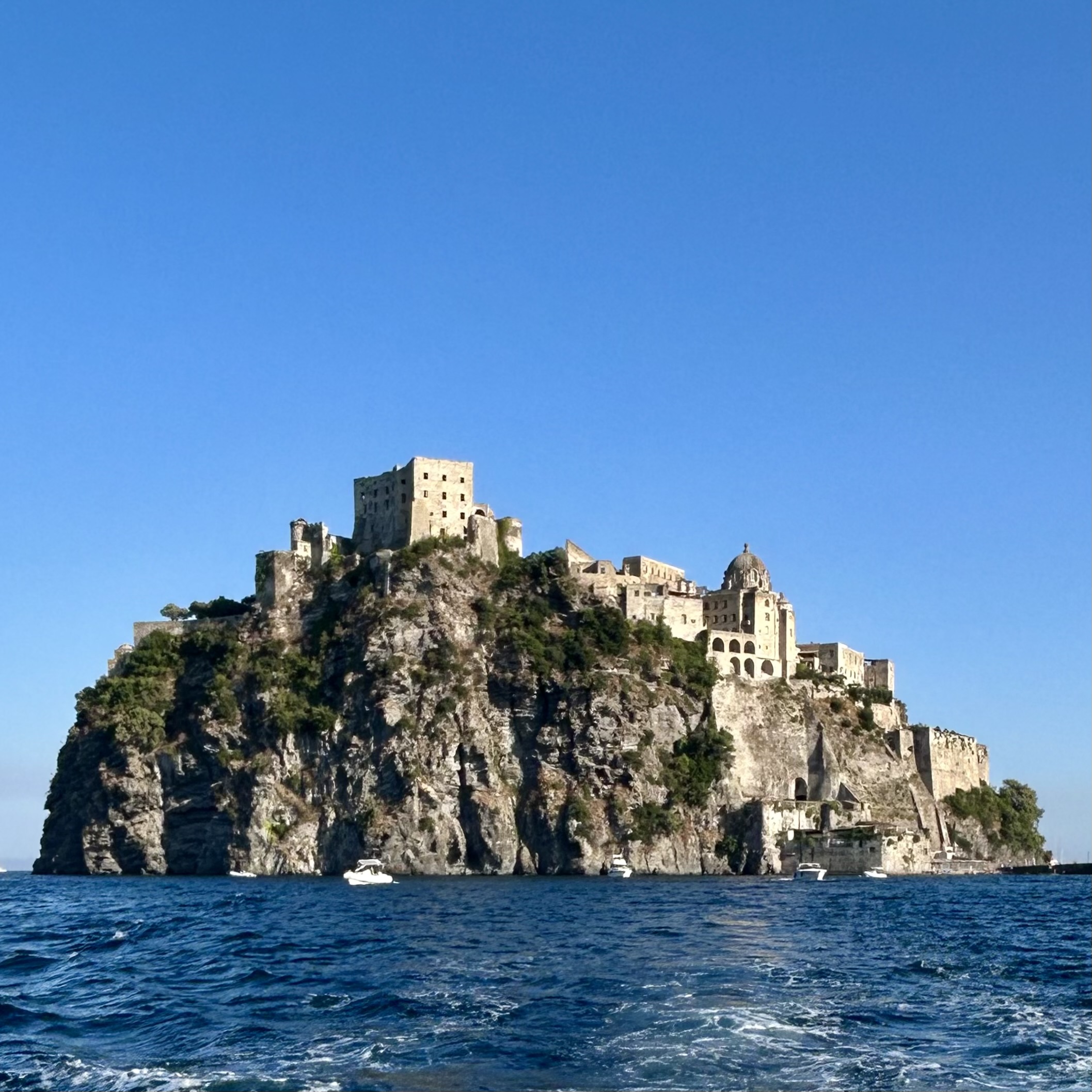
The islet of the Aragonese castle, a small volcanic island which dominates the town of Ischia Ponte from its height of 115 meters, is a marvelous example of a fortress city. The name – Castello Aragonese in Italian – designates both the islet and the castle itself, which bears the name of its most illustrious and active owner.
The first fortress dates from 474 BC and is built by the Greek Hiero the First who receives the city of Ischia and its islet as a reward for his military aid to the inhabitants of Cumae. It is called castrum gironis because of the roundness of its walls.
In the centuries that follow, the pillaging and successive dominations of the Visigoths, Vandals, Ostrogoths, Arabs, Normans, Swabians and Angevins significantly modify Hiero’s fortress, now called insula minor to distinguish it from the island of Ischia, insula major.
In 1301, the eruption of Mount Epomeo on the island of Ischia pushes the inhabitants to take refuge on the islet on which they create a real city.
In 1441, Alfonso V of Aragon, who conquered the islet when he took possession of Naples, has fortifications and a keep built there, and connects it to the island of Ischia by a 220-meter bridge. Almost the entire population of Ischia finds refuge and protection there during pirate incursions. The influence of the Aragon family will be such that the islet will only be referred to under the name of Castello Aragonese.
The Aragonese castle experiences its golden age in the 16th century, when the citadel houses 1892 families, thirteen churches, a convent, an abbey as well as the prince and his garrison.
Around 1750, the risks of piracy being less frequent, the inhabitants migrate to the various municipalities of Ischia, thus developing fishing and agriculture on the island.
In 1809, the English besiege the islet occupied by the French and their cannons almost completely destroy the Castello Aragonese. The last thirty inhabitants are expelled in 1823 by King Ferdinand the First who transforms the place into a prison. A place of detention for prisoners, particularly political ones, the islet loses its prison vocation in 1860 and joins – with the island of Ischia – the Kingdom of Italy.
In 1911, a lawyer, Nicola Ernesto Mattera acquires the castle, which is in ruins, for 25,000 lire. He completes his purchase in 1913 with the acquisition, for 18,000 lire, of the land surrounding the castle. He remains on the islet, which he restores little by little. Becoming a historic monument in 1967, the Castello Aragonese is still the property of the descendants of Nicola Ernesto Mattera. They are working to restore and bring to life the islet, which today hosts numerous cultural events.
The Castello Aragonese may be first discovered by the sea.


Before the construction of the bridge, access to Castello Aragonese was by boat. We can see, on the seaside, the remains of a staircase dug into the rock.

By land, once crossing the bridge which leads to the Castello Aragonese, the climb begins with the gallery that Alfonso V of Aragon had chiseled into the rock in 1441. The enemies who attempted to go up were doused with boiling pitch or knocked down by stones.

The views overlooking Ischia Ponte are obviously superb.


Our Lady of the Assumption (Cattedrale dell’Assunta) experiences its golden age during the Renaissance. Originally in Romanesque style, it is redecorated in the 18th century with very beautiful baroque stuccoes. It collapses in 1809 under English cannon fire.


The convent of Saint Mary of Consolation (Convento Santa Maria della Consolazione) is founded in 1575 and welcomes nearly forty nuns from the order of the Poor Clares. The nuns, most of them eldest daughters of noble families, are destined for monastery life from their childhood to leave the inheritance to the first son of the family.

When the Poor Clares die, their bodies are placed in masonry seats. Their flesh decomposes and the skeletons are piled up in the ossuary. This macabre tradition highlights the uselessness of the body and the refusal of individual burial. The nuns come to pray there every day and, spending many hours in an unhealthy atmosphere, contract illnesses that are often serious, even fatal.

Several absolutely charming cafés provide a welcome break from a two-kilometer climb under a scorching sun.


The church of San Pietro a Pantaniello, hexagonal in shape, is commissioned by Dionisio Basso for his son Pompeo who is a priest. It is opened to worship in 1564.


The terrace of olive trees was formerly the castle garden. Today it offers a spectacular view of the Gulf of Naples and the imposing towers of the keep rebuilt by Alfonso V of Aragon who gave it as a gift to Lucretia d’Alagno, a beautiful commoner with whom he fell in love.


Capri can be seen in the distance.

The church of the Madonna della Libera is built in the 12th century. In 1301, during the last eruption of Epomeo, the population of Ischia builds a church dedicated to the Virgin because she saved it from the catastrophe.


The Virgin is represented inside the church with her hands extended forward to stop the flow of volcanic lava.


The island of Vivara is a natural and protected reserve. We can see the island of Procida just behind.


The islet is absolutely beautiful. Mediterranean vegetation abounds there and the views of the sea and neighboring islands are incomparable.
August 30, 2024
